I started the research unit very enthusiastic about this digital/social approach to writing. I had heard reports from some students from last semester's class of their topics and research and was really excited to try my own. I already knew I wanted to do something with Shakespeare and games because I had been digging into the idea of games scholarship of any and all kinds the semester before. Games have always been a huge part of my life, even if I haven't always acknowledged it (no one you know owned a wider array of trading card games as I did--I promise), and I wanted all that time I spent playing games to amount to something interesting and intellectual. Ironically, however, I've played many, many more board and card games in my life than video games--my parents never allowed any video game console into my house until the winter I left for college, so the move to video games was a strange one for me. I figured, though, that in a way gave me an advantage because I could look at games more objectively and intellectually. I could more legitimately answer the question "Can video games be art?" because I hadn't already answered it for myself. I started looking around and found some interesting resources on Shakespeare possibly being a game designer were he alive today, and that helped narrow things down to just four possible paper topics.
The paper I ended up writing was, of course, really a mash-up of all four ideas. (Good thing I had ten pages.) I was pleasantly surprised to find out that other people were actually interested in this topic, and that there was plenty of material from Shakespeare's text itself to support such claims. As I kept looking, I found discussions actually happening about a topic I thought was extremely specific, which was very encouraging. The class really got involved in my paper, too, as I kept getting a lot of good responses on my posts, even when I was just musing. All of this really got me going, so by the time we had to do annotated bibliographies and find possible audiences, I already had tons of info--enough that I could easily pass some of it over to Britton in hopes that he could treat some stuff I didn't have time for but really interested me. By the time I did my first rough draft, my mind was racing all over the place because I had found so much information and so much interest.
That's when my paper took a difficult turn. I realized I was getting too much to say and too many angles on the topic that my paper just wouldn't be cohesive unless I cut. I went back to the primary text because I knew if I stuck close to The Tempest I could keep it tight. When I went back to do research again, I focused a lot more on specific arguments I had rather than general information on video games, art, and Shakespeare like I was doing before. The stuff I found in that round of research actually made up the bulk of my final paper because, thanks to the suggestions of others and some great feedback from author and game philosopher Chris Bateman (twice), I tightened up my paper significantly to be a discussion of the legitimacy of video games in our culture compared to the fight for legitimacy for English drama in Shakespeare's own day, which made for a good first full draft.
In discussions with Dr. Burton late in the game, I found out about the RMMLA conference and, luckily, they had a panel planned for this year's conference about games and new media that instantly became my number one choice for publishing. I got into contact with the panel chair and got enthusiastic responses from her because she was having a hard time getting the panel off the ground, so I was quickly accepted, though with the chance that I might not get to present because the panel might get canceled.
After getting accepted, though, I had to really make sure the paper turned out well, so after a final interview with Professor Burton I made some pretty big organizational changes and brought back a couple elements from my first draft and kicked out some from the full draft and finally submitted my finished paper. I'm still not sure what's going to happen, but I've been so inspired that I'm seriously considering starting a blog about the intersection of the humanities and video games, which I very well might do after this semester ends and I have some free time this summer. It's been a great ride--and it's not over yet.
Showing posts with label The Tempest. Show all posts
Showing posts with label The Tempest. Show all posts
Saturday, April 20, 2013

Monday, April 15, 2013
Submitted and Accepted!...Sort of
I submitted my paper to the ScholarsArchive without problems.
I also submitted to the Rocky Mountain MLA, as I've reported earlier. I paid my membership fee (it was only $25) so that the panel chair could submit my name as a presenter. I'm in this weird limbo state, though, because I'm still not sure if it's actually happening because the panel might get cancelled due to lack of submissions. And there's the issue of funding, but I can't really work on that until it's confirmed that I'm actually going. Here's to hoping it all works out.
I submitted to the panel "Games, New Media and Virtual Spaces: At play in new media," found under "Special Topics" here.
Just to save the jump, here's my abstract I submitted:
"Such Stuff as Dreams are Made On": Shakespeare and the Cultural Legitimacy of Video Games
For years now, the debate has raged over "video games as art." While the medium has taken several steps forward and we now have many strong examples of artistic games, they still have not achieved the sense of legitimacy our culture gives to anything considered "art." In many ways, video games are fighting the same battle that English drama fought in Renaissance England, a battle chiefly won by William Shakespeare. The video game industry is currently in much the same state that English drama was in when Shakespeare entered the scene, and game designers could learn much from his example, as he arguably innovated a new medium as much as he achieved anything else.
Part of Shakespeare’s success depended on looking backward to bring already culturally important stories to the stage in order to prove that this new medium could be a vehicle for powerful art. I will argue that in order for video games to win cultural legitimacy they must prove they can do the same, and this paper specifically includes ways in which a video game adaptation of The Tempest could help expand scholarship of Shakespeare's text and exploit some of the unique mechanics of the video game medium to create a new and excellent artistic experience. This is experience would be beneficial to both Shakespeare and video game scholars, but also to students, inviting naturally the kind of engagement that teachers so often struggle to produce. While video games may not yet have their “Shakespeare,” such a legitimizing influence can and will come soon to the video game medium, and, someday, sitting and playing through a video game can and will be seen as a cultural experience and not just a waste of time.
Here's hopin'!
I also submitted to the Rocky Mountain MLA, as I've reported earlier. I paid my membership fee (it was only $25) so that the panel chair could submit my name as a presenter. I'm in this weird limbo state, though, because I'm still not sure if it's actually happening because the panel might get cancelled due to lack of submissions. And there's the issue of funding, but I can't really work on that until it's confirmed that I'm actually going. Here's to hoping it all works out.
I submitted to the panel "Games, New Media and Virtual Spaces: At play in new media," found under "Special Topics" here.
Just to save the jump, here's my abstract I submitted:
"Such Stuff as Dreams are Made On": Shakespeare and the Cultural Legitimacy of Video Games
For years now, the debate has raged over "video games as art." While the medium has taken several steps forward and we now have many strong examples of artistic games, they still have not achieved the sense of legitimacy our culture gives to anything considered "art." In many ways, video games are fighting the same battle that English drama fought in Renaissance England, a battle chiefly won by William Shakespeare. The video game industry is currently in much the same state that English drama was in when Shakespeare entered the scene, and game designers could learn much from his example, as he arguably innovated a new medium as much as he achieved anything else.
Part of Shakespeare’s success depended on looking backward to bring already culturally important stories to the stage in order to prove that this new medium could be a vehicle for powerful art. I will argue that in order for video games to win cultural legitimacy they must prove they can do the same, and this paper specifically includes ways in which a video game adaptation of The Tempest could help expand scholarship of Shakespeare's text and exploit some of the unique mechanics of the video game medium to create a new and excellent artistic experience. This is experience would be beneficial to both Shakespeare and video game scholars, but also to students, inviting naturally the kind of engagement that teachers so often struggle to produce. While video games may not yet have their “Shakespeare,” such a legitimizing influence can and will come soon to the video game medium, and, someday, sitting and playing through a video game can and will be seen as a cultural experience and not just a waste of time.
Here's hopin'!
Saturday, April 13, 2013
Paul Bills: "'Such Stuff as Dreams Are Made On': Shakespeare and the Cultural Legitimacy of Video Games"
Paul Bills: "'Such Stuff As Dreams Are Made On': Shakespeare and the Cultural Legitimacy of Video Games"
In many ways, video games are fighting the same battle for cultural legitimacy that English drama fought in Renaissance England, a battle chiefly won by William Shakespeare. The video game industry is currently in much the same state that English drama was in when Shakespeare entered the scene, and game designers could learn much from his example, as he arguably innovated a new medium as much as he achieved anything else. Part of Shakespeare’s success depended on looking backward to bring already culturally important stories to the stage in order to prove that this new medium could be a vehicle for powerful art. I will argue that in order for video games to win cultural legitimacy they must prove they can do the same, and this paper specifically includes ways in which a video game adaptation of The Tempest could help expand scholarship of Shakespeare's text and exploit some of the unique mechanics of the video game medium to create a new and excellent artistic experience.
In many ways, video games are fighting the same battle for cultural legitimacy that English drama fought in Renaissance England, a battle chiefly won by William Shakespeare. The video game industry is currently in much the same state that English drama was in when Shakespeare entered the scene, and game designers could learn much from his example, as he arguably innovated a new medium as much as he achieved anything else. Part of Shakespeare’s success depended on looking backward to bring already culturally important stories to the stage in order to prove that this new medium could be a vehicle for powerful art. I will argue that in order for video games to win cultural legitimacy they must prove they can do the same, and this paper specifically includes ways in which a video game adaptation of The Tempest could help expand scholarship of Shakespeare's text and exploit some of the unique mechanics of the video game medium to create a new and excellent artistic experience.
Friday, April 5, 2013
for Paul and for the Gamers
Paul, I thought your conclusion was especially convincing, and the idea of that moment when the gamer has to turn off the video game to win the game seems like this legitimately lovely and moving moment. You do a great job of basing your argument in a debate that is totally relevant to us today and using historical background to support that, especially with the idea that Shakespeare's plays are today's video games in terms of people's views on their cultural value.
Wednesday, April 3, 2013
Full Draft: "Such Stuff as Dreams are Made On": Shakespeare and the Cultural Legitimacy of Video Games
I don't know why it chose to do some double-spacing and some single, but in any case, here it is!
Paul Bills
Dr. Gideon Burton
English 382
22 March 2013
“Such Stuff as
Dreams are Made On”: Shakespeare and the Cultural Legitimacy of Video Games
For
several years, the debate has raged over “video games as art.” Roger Ebert, the
acclaimed film critic, famously declared on his blog for the Chicago Sun-Times that “in principle video games cannot be art” (“Video games” 2010,
emphasis in original). Ebert ranked up 4,936 comments from readers responding
to this post, the overwhelming majority “united in opposition” against him (“Play”
2010). For many, video games won the battle in 2011 when the US Supreme Court
overturned a California law banning violent video games, with Justice Scalia
writing for the majority that “like the protected books, plays, and movies that
preceded them, video games communicate ideas—and even social messages—through
many familiar literary devices (such as characters, dialogue, plot, and music)
and through features distinctive to the medium (such as the player's interaction
with the virtual world)” (Sutter 2011). Despite the Supreme Court ruling,
however the debate rages on.
In addition to expressing
“social messages” and expressing ideas, video games have already shown that
they can certainly move people as much as any art—again, like Justice Scalia
said, “through features distinctive to the medium.” Some of the most
talked-about games in this debate recently include Fumito Ueda’s Ico
and Shadow of the Colossus,
Thatgamecompany’s Journey, Irrational
Games’s Bioshock and Bioshock Infinite, and Valve’s Portal and Portal 2. All of these games do new and powerful things with the
interactivity of their medium to enhance the emotional effects of the story. In
Ico, the player controls a boy who
tries to get himself and a girl out of a castle safely. The main action of the
game is to reach out and grab the girl’s hand to take her along. The act of
deciding when and why to do this each time is an emotional experience within
the game that could not be experienced in the same way in another medium. Chris
Suellentrop writes “My first time
doing it gave me goosebumps: I am with her. I am not alone” (2011). Journey’s artwork is highly stylized and the musical score was the first ever
from a video game to be nominated for a Grammy. Matt Miller writes “Each time
[I played Journey], without fail,
individual moments (particularly the final level) managed to give me
goosebumps, and those moments have remained on my mind for weeks afterward”
(2012). Adam Sessler said of Bioshock Infinite’s story and world,
“It only can work as a game. The unique agency and complicity of the player in
the game's narrative is part of its commentary. This isn't a game filled with
player choice. But it is the best game about the choices we make as a person
and a people, their consequences, and their uncertainty of absolution..."
(2013). Even the much-debated “Citizen Kane moment” question, the assertion
that video games do not yet have a work that defines the medium like Orson
Welles’s 1941 masterpiece did for film, may now be closed. As one reviewer put
it: “So, when will gaming have its Citizen Kane moment? Forget
that. When will anything else have its BioShock Infinite moment?” (GamesTM
2013).
Most
surprisingly, one game even saved a boy’s life. Draven Miltenberger played the
old versions of the popular game Tomb Raider growing
up, before abuse, abandonment, and other family problems sent him on a
depressive downward spiral. He considered thoughts of suicide after dropping
out of high school—until he heard about the new Tomb Raider game released this year. He waited anxiously and got the game as soon
as it came out. In the game, when the protagonist Lara Croft performs her first
kill, she breaks down crying at the shock of it before shaking it off and
getting up to carry on. As Draven watched this, he realized something about his
own life. “Just because life had started off with a wreck doesn't mean I
wouldn't survive it,” he said (Hernandez). All of these powerful emotional
reactions came from the way the player interacted with the story, and would not
have been as powerful had that interaction been cut off by presenting the story
through some other medium.
In a
follow-up reconciliation post, Ebert conceded he was wrong to judge video games
without ever playing them himself, but maintained that he believed in principle
and theory it just didn’t work for video games. Interestingly, he cited a
conversation with filmmaker and game auteur Clive Barker where they ran into
discussing Romeo and Juliet. “Sooner
[or] later,” he writes on his blog, “these arguments all get around to
Shakespeare, and have a way of running aground on him” (“Play” 2010). While
Shakespeare has gained status as a sort of patron saint of “art” in our
culture, he didn’t always enjoy that privilege. In his own time, the Bard wrote
in a medium dismissed as mere spectacle and show much like video games now.
Shakespeare himself, I will argue, would go beyond the “art” argument and
instead just show how video games can explore themes, emotions, and topics at
least as well as any other medium, and for that reason they should be as
culturally legitimate as any other form of expression. I will then show how The Tempest—Shakespeare’s final,
fantastic work about a self-made sorcerer living in exile and seeking
revenge—could better be explored and studied if it were developed as a video
game.
Video
games are fighting much the same battle today that theater itself was fighting
in Shakespeare’s day. Shakespeare’s theater in his own time was literally not
much removed from such cheap entertainments as bear baiting, thus Shakespeare’s
famous stage direction from The Winter’s
Tale: “Exit, pursued by a bear” (3.3). Just like those concerned California
parents who wanted to ban video games, in Shakespeare’s time civic officials
often petitioned the royal council to abolish drama altogether, causing
Shakespeare and other dramatists to build their theaters outside the
jurisdiction of London itself (“Theater” xxxv). Similar to video games’ enemies
today, drama’s opponents in Shakespeare’s day objected to plays on both moral
and academic levels. Stephen Gosson wrote in 1579 a lament on the destruction
of England’s dignity by way of plays. He argued that Ovid’s theater “chargeth
his pilgrims to creep close to the Saints whom they serve” but in the theaters
of his London he saw only “such heaving and showing, such itching and
shouldering to sit by women …[and about a half page more of other examples]
that it is a right comedy to mark their behaviour” (Harrison 133). In Sir
Philip Sidney’s “Apology for Poetry” he claimed that “our tragedies and
comedies (not without cause cried out against), observ[e]…rules neither of honest
civility nor of skillful poetry” (Harrison 134). In Sidney’s view in 1580, only
one English play could claim status as true tragedy—Gorboduc, the earliest known tragedy in the English language
written by Thomas Sackville and Thomas Norton around 1560. While we revere
Shakespeare in our time perhaps more than any other playwright in history,
Shakespeare wrote those same plays we now know and love in an intellectual
warzone.
Shakespeare
himself complicates the debate about “art” in The Tempest. Look how Shakespeare plays with several definitions of
art in the following lines from Act
1, Scene 2:
my daughter, who
Art ignorant of what thou art,...
Lie there, my art. Wipe thou thine eyes; have comfort.
The direful spectacle of the wreck, which touch'd
The very virtue of compassion in thee,
I have with such provision in mine art
So safely ordered that there is no soul—
No, not so much perdition as an hair
Betid to any creature in the vessel
Which thou heard'st cry, which thou saw'st sink.
(20-21, 31-39)
The word art is used ten times in
this single scene, and never with the typical definition of creative
expression. Indeed, “art” as we think of it today wasn’t totally solidified as
a concept until Immanuel Kant and other thinkers defined it in the 18th
century, and Shakespeare obviously played with the many meanings it carried in
his time here. From my reading, in the lines above, Shakespeare uses three
different definitions for art: (1)
art as in "are" ("thou art"), (2) art as in witchcraft or
power ("in mine art"), and an interestingly metaphorical use
referring, perhaps, to our standard expression "art," but meaning
more literally, "creation" or "product" ("lie there,
my art"). Later in the same scene, we even have Prospero say he was well
versed in the "liberal arts" (1.2.91), yet another definition of art
not quite the traditional definition.
In the rest of The
Tempest, the word art keeps
popping up, with at least two more additional definitions. In Act 4, we get
perhaps the closest to today’s typical definition of art: “for I must / Bestow upon the eyes of this young couple / Some
vanity of mine art: it is my promise, / And they expect it from me” (4.1.42-44).
Shakespeare uses art here in the same
way as definition (2) above, but adding to it the idea of “vanity” gives the
sense of aesthetics that we know attach to the term. Finally, the word art is used in a totally new way in the
play’s epilogue: “Now I want / Spirits to enforce, art to enchant, / And my
ending is despair, / Unless I be relieved by prayer,” (5.1.13-16). Here again, the definition of art is related to definition (2) above,
but now means more directly "ability" or "capability."
Shakespeare knew well the debate surrounding his own works and his medium, and
while he may not have been directly commenting on this debate by blurring the
definition of art so purposely in The
Tempest, it is interesting that the very word we’ve attached such value to
and labeled his works with so often is a word he purposely exploited for its
varied and inconsistent definitions. If Shakespeare could add his voice to the
current debate surrounding video games as art, he just might ignore the word art completely because he knew well the
risks of the word.
The debate, then, is not really
about art, but perhaps more about a sense of cultural legitimacy. Roger Ebert
doesn’t think video games can be art because he doesn’t believe an author can
connect with an audience on the same emotional and intellectual level as that
same author could by means of novels, theater, or film (“Video games” 2010). No
matter people’s personal opinions, our culture agrees with Ebert. We see this
based on simple reactions to video games today. Parents the world over lament
the amount of time their kids spend playing video games, yet those same parents
would praise a child for reading books for the same amount of time, in neither
case paying much attention to the quality of the pieces their children engage
with, only the medium. Additionally, if those same children read Shakespeare
for the same hours they played video games, their parents would tout it to the
whole world, lauding their children’s intelligence and maturity. What many
don’t know and others too easily forget, though, is that young people attending
English plays in Shakespeare’s own day were considered worse off than our gamers
of today. Gosson wrote that “the common people which resorte to Theatres [were]
but an assemblie of Tailors, Tinkers, Cordwayners, Saylers, olde Men, yong Men,
Women, Boyes, Girles, and such like” and felt that, in Andrew Gurr’s words,
people “needed protection from corrupting experiences like playgoing” (Gurr
145). What everyone regards now as beautiful and cultural was then ugly trash.
The people that made up Shakespeare’s earliest audiences were, effectively, the
35-year-old parental basement gamers of their day.
Shakespeare fought for his medium’s legitimacy and
won, but not on his own nor even in his own lifetime. Going to a Shakespeare
play now lends to the audience a sense of culture, intellect, and worth—but it
once meant all the opposite. Thanks not just to the extreme popularity of
Shakespeare’s play (though that certainly helped), but also to the
proliferation of printed versions of the plays and other written works, a culture
of criticism and intellectual review rose around English drama that ultimately legitimized
the medium. As the culture rose up around Shakespeare, his plays rose up as
“art” as well, even though the texts themselves remained essentially the same.
Shakespeare’s works were always “art,” but they weren’t always viewed that way,
and the sense of cultural legitimacy that they won is what we really refer to
when we say now that Shakespeare is great art. The fight for video games as art,
then, isn’t really about whether or not the medium fits the definition of art, but whether or not sitting and
playing a video game is viewed as a dangerous waste of time or a legitimate
cultural experience.
Shakespeare found a powerful
weapon to legitimize his theater in looking backward—in harkening back to
classical tragedy, medieval history, and other stories already deemed
culturally important. When Shakespeare proved that theatre could tackle
politics, religion, revenge, love, and all the themes so important to the stories
and mediums of the past, the argument for English drama was all but won. Video
games could take a page from Shakespeare’s book here, as it were, and in some
ways already have. In 2010, EA Games released a video game adaptation of The Divine Comedy entitled Dante’s Inferno. This marked the first
major attempt to adapt great literature to video games—others had been done,
but none funded as well or marketed as widely as this. The game’s reception was
lukewarm, however, from both the literary and the gamer ends, due largely to
the conflict between making a game that would sell to the current market and
making a game that could do justice to Dante’s masterpiece. Games have taken
several strides to release themselves from the need for non-stop slashing and
bashing that doomed Dante’s Inferno,
however, and the next attempt to adapt great literature to a game will benefit
from the strides the game did make—if nothing else, the precedent of game
adaptations.
Jonathan Knight, the executive
producer of Dante’s Inferno, said in
an interview when asked about how Shakespeare would react to the gaming
industry, “Shakespeare would have been on the forefront. He was an innovator
and not just a great story-teller. Arguably, he’s more of a medium innovator”
(Brophy-Warren 2010). Knight makes a valid point here. All scholars (and most
students) realize that Shakespeare wrote very few original plots (The Tempest excepted, perhaps) and
mostly just converted stories from other mediums to the stage, or even from
other stage productions to his own. Knight specifically sites Hamlet, but King Lear, Romeo and Juliet,
Othello, and several others also have
very clear source material—not to mention all of the history plays.
Shakespeare’s genius was not in plot, but style and innovation. Shakespeare’s plays, if we
care to saw it this way, were the Citizen
Kane of English drama, proving what could be done with the medium and
cementing their place in cultural history as great art. Therefore, if we
take his track record as any pattern, it is not difficult to believe that
Shakespeare would indeed be innovating with the newest medium of our own day
that is commonly seen as base and crass—specifically, video games.
Apart
from his pattern of innovation, the very themes he dealt with lend themselves
to video games better than other mediums. Most of Shakespeare’s plots—and
certainly his most famous plots—center around a single, strong character’s
crucial decisions in crucial moments. King Lear’s reaction to his daughters,
Hamlet’s reaction to his father’s ghost, Othello’s reaction to Iago’s words,
Romeo’s reaction to Juliet’s beauty—the plots of every play hinge on these important
choices, and all their choices lead to the ultimate tragedy of each. The Tempest’s Propsero takes this
principle even further as he has more power than perhaps any other Shakespeare
character thanks to his magical powers and his control of the spirit Ariel.
Prospero essentially crafts his own entire plot through his magic, leading his
family and friends through the island in a veritable maze, guiding them step by
step to their final decisions and his own eventual relinquishment of power. The
art and emotion of Shakespeare’s stories comes from the audience identifying
with these central characters and wrestling in their own heart with the choices
these characters face—then, ultimately, coming to understand and sympathize
with the character’s decision despite the tragedy it caused. Video games are
better equipped than any other medium to take on this theme of choice and
consequence because they can literally put that choice in the hands of the audience
like no other medium can.
Consider,
for instance, the ways the following aspects of The
Tempest could be powerfully recast in a video game version of the play:
First, Caliban and Prospero’s
relationship. "All the charms / Of Sycorax, toads, beetles, bats, light on
you!” Caliban curses on Prospero, “For I am all the subjects that you have, /
Which first was mine own king: and here you sty me / In this hard rock, whiles
you do keep from me / The rest o' the island” (1.2.406-411). Prospero gained his
power after reaching the island—we're not sure how long it took him. However,
at some point he had to decide to enslave Caliban and the spirits of the
island. Many have connected Caliban with natives that Europeans enslaved upon
reaching the New World, bringing up themes of power, abuse, and slavery. An
RPG/Adventure game of The Tempest
could extend this theme interestingly with game mechanics. The game could be
designed as such that the player knows he/she can enslave Caliban, but may not
want to morally and so consider that maybe they could get by without him.
However, inevitably, the player could be forced to realize that he/she has to
enslave Caliban to carry on. This in turn brings a new interpretation to the
play itself and the character of Prospero. Prospero has often been interpreted
as angry and domineering, but as players play the game version set up like
this, it could open a new interpretation of a Prospero turning to his powers to
survive as he tries to rebuild his life after exile. Alternatively, players
could decide that Prospero is angry
and domineering, and enslave Caliban as soon as they learn how to from Prospero’s
books. Thus, interpretations of the play itself could become part of the game,
and players would naturally reflect on the implications of these decisions
without having to be prompted to by a teacher.
Second, the Trinculo and
Stephano subplot. Following in the tradition of interactive productions of
Shakespeare such as Punchdrunk’s Sleep No
More, and even first-person video games like Bioshock, this subplot could be hidden within the game world, never
forced upon the player, but rather something to be sought out and discovered. As
Ken Levine, creative director for the Bioshock
series said, “When people find stuff, they feel like it’s theirs” (NPR). Letting
the player find this subplot while navigating through the island in pursuit of
the main movement of the narrative would naturally open up more interest in
these characters, and could realize the same power this subplot was meant to
have on the stage—comedic relief and absurdity, but also plot depth and range
of perspective. These subplot moments could even introduce absurd mini-games (“Untangle
Trinculo and Caliban!” for example) to draw out the comedic elements in a way
that might be missed by an inexperienced reader trudging through the text of
the play.
Third, Prospero’s final speech
and the theme of vision v. reality. Some moments of The Tempest seem more relevant to a gamer community than any other
group of people in human history. Prospero’s speech in act 4, for instance,
seems almost directed at gamers: “And, like the baseless fabric of this vision,
/ The cloud-capp'd towers, the gorgeous palaces, / The solemn temples, the
great globe itself, / Ye all which it inherit, shall dissolve / And, like this
insubstantial pageant faded, / Leave not a rack behind. We are such stuff / As
dreams are made on, and our little life / Is rounded with a sleep” (4.1.168-175).
This comes in direct response to Ferdinand’s wish: “Let me live here ever. / So
rare a wondered father and a wise / Makes this place paradise,” a wish surely
shared by many a gamer toward their own game worlds (4.1.137-139). A player
controlling Prospero and choosing to
stop the visions before hearing Prospero give those words would naturally
ponder deeper on their meaning, especially if the “visions” were done with the
powerful and beautiful aesthetics modern games are capable of.
This theme could reach a level
deeper than even any stage production ever has at the end of the game, after
Prospero’s final speech. “Now my charms are all o'erthrown,” Prospero tells the
audience, “And what strength I have's mine own, / Which is most faint: now,
'tis true, / I must be here confined by you, / Or sent to Naples. Let me not, /
Since I have my dukedom got / And pardon'd the deceiver, dwell / In this bare
island by your spell; / But release me from my bands / With the help of your
good hands.” (Epilogue.1-10). Having played the game as Prospero in first
person, the end of the game could suddenly shift to third-person for the player,
and Prospero could speak directly at the player. The game could be programmed
as such that the only way to progress to the game’s close and “win” is to
answer Prospero’s request and “release” him by turning off the game controller.
After some time of great confusion and even frustration before discovering this,
the moment would surely stick in the player’s mind long after turning of the TV
and leaving the game. The same point Shakespeare made with these lines about
the difference between fantasy and reality and the need for both, and especially
the need to understand the limits of both would be made in a powerful,
emotionally charged way that requires the player to physically and literally
fulfill Prospero’s request. Such an ending would have players otherwise
unfamiliar with Shakespeare understanding and talking about The Tempest like no other medium of
production could ever achieve.
Video games may not have their “Shakespeare”
yet, but with how the industry has grown and the strides it has taken—with the
possibilities that are now open to the medium and the innovations that have already
been made to achieve those possibilities—such a powerful, legitimizing influence
cannot be far off. Video games can and will win their cultural legitimacy, and
in the not-too-distant future, children and adults alike will sit down to play
a video game not just for entertainment, but for some of the most powerful and
emotional cultural experiences of their lives—experiences that will uplift,
enlighten, and provoke thought along with the very best art humanity has ever
produced.
Works Cited:
G.B. Harrison, England in Shakespeare's Day. The Folcroft Press, Inc. Folcroft, PA. 1969.
Brown, Ivor. Shakespeare in His Time. Thomas Nelson and Sons Ltd. Edinburgh. 1960.
Gurr, Andrew. Playgoing in Shakespeare's London. 3rd ed. Cambridge University Press. 2004.
"Shakespeare's Theater." The Tempest. Folger Shakespeare Library. 2009.
NPR Interview with Ken Levine, April 2, 2013
Ebert, Roger. "Okay, kids, play on my lawn." 1 July 2010. Web.
__________. "Video Games can never be art." 16 April 2010. Web.
Kotaku.com, "The New Tomb Rader Saved This Teenager's Life"
John D. Sutter, "Supreme Court Sees Video Games as Art"
Jamin Brophy-Warren "Dante’s Inferno: Do Classic Poems Make Great Videogames?"
Games TM Review of Bioshock Inifinite
Matt Miller, review of Journey
Adam Sessler, Bioshock Infinite Review,
Sullentrop, Chris, "Video Game Art of Fumito Ueda"
Thursday, March 28, 2013
So Happy Together: Social Scholarship
 |
| Chris Bateman's Beyond Game Design |
So I have more to report about effort on this subject this week than results, but I still think what I did was important. I emailed three people directly who I think would have great insights on my project: Jane McGonigal, Clint Hocking, and Chris Bateman. McGonigal is a very famous game designer and game activist (she kind of made that a thing all by herself) who believes games can change the world. Hocking is an influential game designer and thinker. Bateman is a philosopher, game designer, and author of Beyond Game Design: Nine Steps Toward Creating Better Video Games. I emailed all three of them slight variations on the following:
My name is Paul Bills and I'm an undergrad English Major at Brigham Young University. I'm currently doing a research project on Shakespeare and video games and I've found your book Beyond Game Design helpful and very insightful.
My basic point is that we need a "Shakespeare of Games." Shakespeare was himself as much an innovator as a storyteller, mostly taking old stories and adapting them to the new medium of English theater. He took this medium from simple popular entertainment to a true art form. Sometime, I argue, someone could/will do the same for video games and change the world of art and expression all over again.
My question for you, then, is simple: What do you think it would take to create such a "Shakespeare of Games"? Is it possible for just one person, or will it have to be a whole team? Or has it already happened, in your opinion? If so, who?
Also--do you see games ever being studied as part of the "liberal arts" with a "canon" and "conventional interpretations" and other such academic dressings, or will games remain part of "cultural studies" more for sociologists/psychologists? Or are they something entirely new?
Any insight you have would be great.
Thanks,
Paul Bills
I chose this messaging because I'm hoping to add any comments I get back from them to the conclusion of my paper--my "so what?" point about calling people to action to take game design to the next level and strive to seek/become the "Shakespeare of games." I haven't received any response yet, but the other reason I chose these three is because they all were very open to being contacted on their websites and all encouraged opening conversations with them. I also was sure to specifically reference the work of theirs that I had read and appreciated to show that I knew what I was talking about (you can see I mentioned Bateman's book in the example above).
Also, Mikaela's post about possible publishing venues got me really excited because the Shakespeare festival is specifically looking for papers on The Tempest this year (already bought my tickets to go see it August 15th!). David has also been a huge help. Dr. Burton, he, and I just sat and talked about my paper for a straight hour on Wednesday. David also offered to have me come over and play some of his favorite games to help me out, an offer I'm pretty sure I'm going to take him up on sometime soon.
As far as helping other people, I think it was last Friday that I talked with Kaylee about her thesis in class and brought up a panel I had attended during the English Symposium that talked about heroes and villains and we talked a lot about the lack of strict heroes or villains in Shakespeare, and whether or not Henry V was an exception. It was a great discussion and Kaylee's since integrated it into her work.
Also, since Britton's topic is so close to mine, talks with him have been very helpful and I feel like I've helped him in return. I brought up the theme of free will v. fate in Julius Caesar and how that would be low-hanging fruit for a game theme because games give players the illusion of free will when really the player is fated to one destiny no matter what they do because the designers (or narrative games, anyway) have to bring the story to a conclusion.
Monday, March 25, 2013
Sunbeams from the Primary Text
Though I've blogged about my primary text before, The Tempest, it can't hurt to dig in again and find something else, so here goes:
On the theme of vision vs. reality (which I argue would be well-adaptable to a video game):
Now my charms are all o'erthrown,
And what strength I have's mine own,
Which is most faint: now, 'tis true,
I must be here confined by you,
Or sent to Naples. Let me not,
Since I have my dukedom got
And pardon'd the deceiver, dwell
In this bare island by your spell;
But release me from my bands
With the help of your good hands:
O, wonder!
How many goodly creatures are there here!
How beauteous mankind is! O brave new world,
That has such people in't!
Good boatswain, have care. Where's the master?
Play the men.
my daughter, who
Art ignorant of what thou art,...
Lie there, my art. Wipe thou thine eyes; have comfort.
The direful spectacle of the wreck, which touch'd
The very virtue of compassion in thee,
I have with such provision in mine art
So safely ordered that there is no soul—
No, not so much perdition as an hair
Betid to any creature in the vessel
Which thou heard'st cry, which thou saw'st sink.
for I must
Bestow upon the eyes of this young couple
Some vanity of mine art: it is my promise,
And they expect it from me.
Now I want
Spirits to enforce, art to enchant,
And my ending is despair,
Unless I be relieved by prayer,
On the theme of vision vs. reality (which I argue would be well-adaptable to a video game):
You do look, my son, in a moved sort,
As if you were dismay'd: be cheerful, sir.
Our revels now are ended. These our actors,
As I foretold you, were all spirits and
Are melted into air, into thin air:
And, like the baseless fabric of this vision,
The cloud-capp'd towers, the gorgeous palaces,
The solemn temples, the great globe itself,
Ye all which it inherit, shall dissolve
And, like this insubstantial pageant faded,
Leave not a rack behind. We are such stuff
As dreams are made on, and our little life
Is rounded with a sleep.
(Prospero, 4.1.1877-1889)
I've referred to this quote several times, but never in it's full context like this. I think the effect of Prospero telling this to Ferdinand (and, in turn, the player) of a video game would be especially powerful, because it's reminding the player that this is all just a game, just "baseless fabric," "such stuff as dreams are made on."
And what strength I have's mine own,
Which is most faint: now, 'tis true,
I must be here confined by you,
Or sent to Naples. Let me not,
Since I have my dukedom got
And pardon'd the deceiver, dwell
In this bare island by your spell;
But release me from my bands
With the help of your good hands:
(Prospero, 5.1.2404-2423)
This is from Prospero's final speech in the epilogue of the play, which reminds the audience that this has all been a play ultimately fleshed out by their own imaginations--so in their imaginations they must return Prospero to Naples or he's stuck on the island forever (because in their imagination is the only place he really exists). I have this vision of Prospero saying these final lines in the game version of The Tempest and it being programmed so that the only way to really end the game and "win" is to turn off the controller (or unplug the keyboard or mouse, or something), proving that you won't play anymore and you'll let Prospero go. This would be a powerful, inclusive, interactive way to present this theme of the play in general and the point of this final speech to the player. There would likely be a sense of frustration as the player can't figure out for awhile how to finish the final step and win, but then when they realize (or, let's be honest, look it up on the internet), hopefully they would reflect on what that means, and go away a little better as a person and think a little more about their real life, as well as the video game/play/story. Just like Shakespeare tried to do with the play in the first place.
How many goodly creatures are there here!
How beauteous mankind is! O brave new world,
That has such people in't!
(Miranda, 5.1.2233-2236)
Here, the vision v. reality theme is reversed, as Miranda has only ever seen visions (she's lived on the island with Prospero practically her whole life), and now she sees real human beings for the first time. She's taken aback by how wonderful real people are, how "goodly" and "beauteous." Video games, like all art, allow us to paint pictures of human beings that can seem startlingly or disturbingly realistic, or obviously and grotesquely false. Either way, watching false humans (whether they be actors or computer-generated images) can lead to real and powerful insights into real humans--just like Miranda appreciated real humanity after experiencing visions for all her life.
Good boatswain, have care. Where's the master?
Play the men.
(Alonso, 1.1.15-16)
"Act like men" or "make the men work" (according to Folger edition note). Even from the very beginning of the play, we see this theme come out--either of vision vs. reality (playing something even if you aren't actually that thing) or power and submission (also a big part of the play).
The Definition of Art
A big part of my argument revolves around the concept of "art," which gets more fluid and indefinite the more I study it. Shakespeare seemed to be aware of this too (another part of my argument is how Shakespeare had to legitimize his own medium in his own time as an art form, so I wonder while reading this if he was struggling with the very same question when he wrote it):
Art ignorant of what thou art,...
Lie there, my art. Wipe thou thine eyes; have comfort.
The direful spectacle of the wreck, which touch'd
The very virtue of compassion in thee,
I have with such provision in mine art
So safely ordered that there is no soul—
No, not so much perdition as an hair
Betid to any creature in the vessel
Which thou heard'st cry, which thou saw'st sink.
(Prospero, 1.2.104-105,115-122)
The word "art" is repeated over and over again in this scene, with Miranda saying it before Prospero does. We see three definitions of "art" just in these lines, none of which are even cleanly our definition of "art" as creative expression--(1) art as in "are" ("thou art"), (2) art as in witchcraft or power ("in mine art"), and an interestingly metaphorical use referring, perhaps, to our standard expression "art," but meaning more literally, "creation" or "product" ("lie there, my art"). Later in the same scene, we even have Prospero say he was well versed in the "liberal arts" (1.2.172), yet another definition of art not quite the traditional definition.
Bestow upon the eyes of this young couple
Some vanity of mine art: it is my promise,
And they expect it from me.
(Prospero, 4.1.41-43)
This is perhaps the closest we get to the typical definition of "art" in The Tempest, despite how often the word is used--Prospero will use his "art," or power, to bring up wondrous visions, beautiful things for them to look at--"art," in the traditional sense through non-traditional methods (hey--that's like video games!)
Finally, the word "art" is used in a totally new way in the same epilogue quoted above:
Spirits to enforce, art to enchant,
And my ending is despair,
Unless I be relieved by prayer,
(Prospero, 5.1.2416-2419)
Here, the definition of "art" is related to definition (2) above, witchcraft or power, but now means more directly "ability" or "capability." While Shakespeare's work is so universally received in our day as "art"--even the highest level of "art"--it seems he himself took a very liberal view of the word, while making that same great art out of a medium that few even imagined could be.
I could go on (I didn't touch on the theme of power and submission--I do a little bit in my previous primary text post when I talk about Caliban and Prospero's relationship near the end), but this is super huge already and I'll stop here.
Thursday, March 21, 2013
Scruffy Draft
I hit a huge rough patch this week on my topic, kind of getting tired of my own enthusiasm, if that makes sense. I almost had done too much research and thought about too many different angles to be able to get back to my initial point and brings things to cohesion. Doing this mini-paper really helped me find one way to bring it all together. I hope it works.
Brave New Worlds:
Shakespeare’s Perspective on Video Games
READ ME! I'LL HELP!
After doing some research on publication venues here's what I found:
The European Shakespeare Research Association is holding a conference this upcoming June on Shakespeare and myth. It costs money to go to it, though it's free to become a member of the Association and I think you only need to be a member to submit something (though I'll have to look a little closer into that).
University of Akron is having a conference in October that's basically for anything Shakespeare related and the submissions are due by the end of August.
The Shakespeare festival here in Cedar City is looking for paper submissions - the conference is at the end of August and the submission is due by May 1, and it's anything Shakespeare related though they're particularly interested in papers relating to Love's Labour's Lost, King John, and The Tempest.
This is a conference I found taking place in early May about music within Shakespeare work, which is perfect because that's a huge staple to my paper. I don't think it's still accepting submissions, but I just thought it was cool that there are other people out there interested in what I am and I'll be following this conference to see if anything gets posted online in May.
Anyways, I hope this is helpful for some of you - especially since I know there's a couple people looking at Love's Labour's Lost and The Tempest right now.
The European Shakespeare Research Association is holding a conference this upcoming June on Shakespeare and myth. It costs money to go to it, though it's free to become a member of the Association and I think you only need to be a member to submit something (though I'll have to look a little closer into that).
University of Akron is having a conference in October that's basically for anything Shakespeare related and the submissions are due by the end of August.
The Shakespeare festival here in Cedar City is looking for paper submissions - the conference is at the end of August and the submission is due by May 1, and it's anything Shakespeare related though they're particularly interested in papers relating to Love's Labour's Lost, King John, and The Tempest.
This is a conference I found taking place in early May about music within Shakespeare work, which is perfect because that's a huge staple to my paper. I don't think it's still accepting submissions, but I just thought it was cool that there are other people out there interested in what I am and I'll be following this conference to see if anything gets posted online in May.
Anyways, I hope this is helpful for some of you - especially since I know there's a couple people looking at Love's Labour's Lost and The Tempest right now.
Friday, March 15, 2013
This is a post including my annotated bibliography called this is a post including my annotated bibliography
Working thesis statement: Though many debate the potential for video games as art, theater provides a working model for how video games could become great art. Shakespeare's The Tempest provides the perfect framework for this claim.
Thursday, March 14, 2013
"Playing" Prospero
I've been thinking about my post of "The Tempest: The Video Game" and my point at the end about how the player could play Prospero and be forced to enslave Caliban as a new way to interpret the themes of the play. There's something much bigger in that idea than I thought at first.
Clint Hocking, an influential game designer, was quoted in the New Yorker in 2011 as saying,
"Finding a way to make the mechanics of play our expression as creators and as artists—to me that’s the only question that matters."
Like my suggestion in my post, he was talking about how the mechanics of the game could enhance the art of the author and designer. However, in a post on his blog he altered this quote ever-so-slightly but importantly to say,
"Finding a way to make the dynamics of play support the creative expression of players—to me that’s the only question that matters."
A lot of the art of theatre comes from actors coming up with new interpretations for characters, or in the subtle differences a certain actor gives to a script by the way they he or she plays it. Why can't it be the same with video games? Taking that same scenario from above, a player could choose to try and avoid enslaving Caliban, or that same player could enslave Caliban the second he/she meets him, before the reasons to enslave him are even clear. Just like an actor or actress, the gamer could "play" Prospero however he/she chooses.
That's good art.
Clint Hocking, an influential game designer, was quoted in the New Yorker in 2011 as saying,
| Clink Hocking's online avatar |
Like my suggestion in my post, he was talking about how the mechanics of the game could enhance the art of the author and designer. However, in a post on his blog he altered this quote ever-so-slightly but importantly to say,
"Finding a way to make the dynamics of play support the creative expression of players—to me that’s the only question that matters."
A lot of the art of theatre comes from actors coming up with new interpretations for characters, or in the subtle differences a certain actor gives to a script by the way they he or she plays it. Why can't it be the same with video games? Taking that same scenario from above, a player could choose to try and avoid enslaving Caliban, or that same player could enslave Caliban the second he/she meets him, before the reasons to enslave him are even clear. Just like an actor or actress, the gamer could "play" Prospero however he/she chooses.
That's good art.
Monday, March 11, 2013
Brave New Worlds: Finding Forums for My Topic
After extensive search on the subject, I found two forums discussing specifically Shakespeare as a video game designer, one on Kotaku, and one on The Escapist.
The funny thing was how opposite the opinions were. Kotaku had some naysayers, but it seemed that several of them thought Shakespeare would actually work out as a game designer. On The Escapist, however, it was almost a unanimous "NO."
The Kotaku forum is now closed, but I linked to my "The Tempest: The Video Game" post on The Escapist and told them a little of what I thought. Hopefully I'll persuade somebody.
Looking forward, I want to find more forums about video games as art, and possibly even the connection of art and theatre, as that seems to be where the most people think the real meat of my topic is.
The funny thing was how opposite the opinions were. Kotaku had some naysayers, but it seemed that several of them thought Shakespeare would actually work out as a game designer. On The Escapist, however, it was almost a unanimous "NO."
The Kotaku forum is now closed, but I linked to my "The Tempest: The Video Game" post on The Escapist and told them a little of what I thought. Hopefully I'll persuade somebody.
Looking forward, I want to find more forums about video games as art, and possibly even the connection of art and theatre, as that seems to be where the most people think the real meat of my topic is.
The Tempest: The Video Game
The following is a brief list of quotes from The Tempest that take on a whole new meaning when you think of the play in the context of video games:
"She / Is daughter to this famous Duke of Milan, / Of whom so often I have heard renown, / But never saw before; of whom I have / Received a second life..."
"Go make thyself like a nymph o' the sea: be subject / To no sight but thine and mine, invisible / To every eyeball else."
"She / Is daughter to this famous Duke of Milan, / Of whom so often I have heard renown, / But never saw before; of whom I have / Received a second life..."
(Ferdinand, 5.1.212-216)
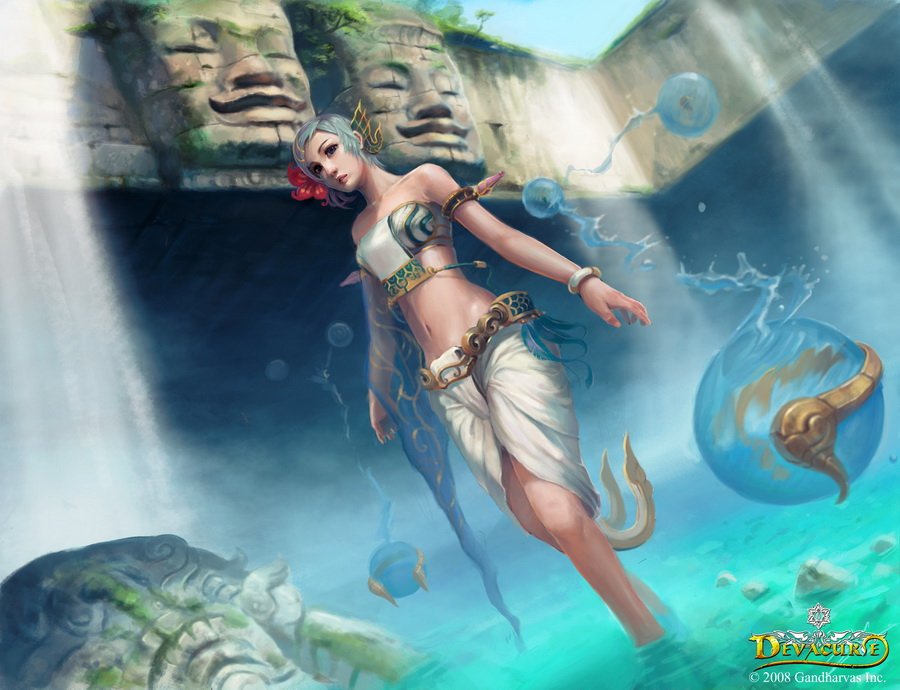 |
| Water Nymph CC by zionenciel |
(Prospero, 1.2.354-356)
"O, wonder! / How many goodly creatures are there here! / How beauteous mankind is! O brave new world, / That has such people in't!"
(Miranda, 5.1.203-206)
These are a few tongue-in-cheek examples, obviously, but I think they help establish a connection quickly, even if it is a shallow connection.
What really intrigues me, though, are the more profound, relevant connections that come up from certain themes. The first and perhaps most obvious is vision vs. reality, captured most poignantly in the following lines (As some may have already heard me explain, this quote comes at an important part of the play where Prospero, the exiled duke of Milan and self-made sorcerer by reading books, shows his daughter Miranda and her love Ferdinand a great vision, and Ferdinand says he wants to stay on the magic island forever):
"These our actors, / As I foretold you, were all spirits and / Are melted into air, into thin air: / And, like the baseless fabric of this vision, / The cloud-capp'd towers, the gorgeous palaces, / The solemn temples, the great globe itself, / Ye all which it inherit, shall dissolve / And, like this insubstantial pageant faded, / Leave not a rack behind. We are such stuff / As dreams are made on, and our little life / Is rounded with a sleep."
(Prospero 4.1.161-171)
The point made in these lines has perhaps never been more relevant, especially for gamers. All they "have" or "achieve" in a game is really just "baseless fabric...such stuff as dreams are made on" that they can't take into real life. Prospero doesn't have his powers before he lives on the island, and as he leaves the island he forsakes his powers, making the island somewhat like Prospero's "game."
Additionally, I think a video game could help pull out other themes of the play that are on more of a subtextual level. One example is with the character of Caliban:
"All the charms / Of Sycorax, toads, beetles, bats, light on you! / For I am all the subjects that you have, / Which first was mine own king: and here you sty me / In this hard rock, whiles you do keep from me / The rest o' the island."
(Caliban 1.2.389-394)
 |
| Screenshot of Bioshock CC BY Chadrew |
Prospero gained his power after reaching the island--we're not sure how long it took him. However, at some point he had to decide to enslave Caliban and the spirits of the island. Many have connected Caliban with natives that Europeans enslaved upon reaching the new world, bringing up themes of power, abuse, and slavery. An RPG/Adventure game of The Tempest could extend this theme interestingly with game mechanics. The game could be designed as such that the player knows he/she can enslave Caliban, but may not want to morally and so consider that maybe they could get by without him. However, inevitably, the player could be forced to realize that he/she has to enslave Caliban to carry on. (A similar situation to this happens in Bioshock with the Little Sisters.)
This in turn brings a new interpretation to the play itself and the character of Prospero. Prospero has often been interpreted as angry and domineering, but as players play the game version set up like this, it could open a new interpretation of a Prospero turning to his powers to survive as he tries to rebuild his life after exile.
In any case, I hope this post shows that there are at least several possibilities for intersections between video games and The Tempest that not only take advantage of the supernatural elements in the play, but also explore and enhance its themes, ultimately enriching both the play and the video game medium.
(Lines and line numbers taken from Shakespeare Searched.)
After the Final Rose (My happily ever after?)
I did it. I found my connection, my Shakespeare research paper soul mate, and we're in love. Hopefully this love lasts longer than any Bachelor contestant's love, because I'm not here to play games. I'm here to find my thesis.
Ok, enough with the lame Bachelor jokes (they relate, I promise). This past week or so I've been struggling to find a topic for my paper that really resonated within me. My play I chose to read was Twelfth Night, and while I absolutely loved the play, I felt as though it didn't give me something to latch on to. It did, however, give me a dive board from which I feel into the genre of researching love and romance. I took to Facebook immediately, figuring the masses would definitely have something to say on the subject. That was my first mistake. I received no response. I figured it was because I either
Ok, enough with the lame Bachelor jokes (they relate, I promise). This past week or so I've been struggling to find a topic for my paper that really resonated within me. My play I chose to read was Twelfth Night, and while I absolutely loved the play, I felt as though it didn't give me something to latch on to. It did, however, give me a dive board from which I feel into the genre of researching love and romance. I took to Facebook immediately, figuring the masses would definitely have something to say on the subject. That was my first mistake. I received no response. I figured it was because I either
a. was too general in my questions, or
b. asked way too many in one status update
(probably both)
So I switched tactics. After reading Amelia's comment here, I had an idea:
I can't believe I'm admitting this, but I love the Bachelor/ette reality TV show. I'm addicted to it, like millions of other men and women (8.6 million, to be exact), so why not explore it's connection to Shakespeare? I thought I'd see what Facebook had to say about this.
 |
| Somebody actually posted this in response to my questions. |
The initial response wasn't great. I got a pretty strong negative reaction at first, but it's always darkest before the dawn. I finally got a positive response from (gasp) another English major! We began discussing the similarities between reality TV today and Shakespeare in the past. We came down to this basic idea:
People throughout the ages seem to have this obsession with unrequited love, finding love, crazy passionate love, puppy love, mismatched love... the list really goes on. From the mismatched love of Midsummer Night's Dream, to the gender confused triangle in Twelfth Night, people love love, and that love has carried over into the modern world (Don't believe me, check it out here. People have DEFINITELY taken from Shakespeare's love plots to create the reality TV we watch today). But, it's not just love that we love, it's love that's seemingly out of our control, love manipulated by someone with greater power than those experiencing the infatuation. And we don't just like it when love is manipulated be someone, but when everything is out of the hands of the hero/ine. Take The Tempest, where really everything lies in the hands of Prospero, or The Bachelor/ette, where everything lies in the hands of the producers (let's be real here, people. we all know this is true).
So this is where I'm a little stuck. Maybe this whole connection to Shakespeare seems contrived to you, but I really do think there's something there. I mean I just see a lot of connections between reality TV today and the way Shakespeare's characters manipulate and handle love in the plays. What do you think? Hopefully you're in agreement, because I really really don't want to find another topic.
So this is where I'm a little stuck. Maybe this whole connection to Shakespeare seems contrived to you, but I really do think there's something there. I mean I just see a lot of connections between reality TV today and the way Shakespeare's characters manipulate and handle love in the plays. What do you think? Hopefully you're in agreement, because I really really don't want to find another topic.
Thursday, March 7, 2013
Pick Your Poison: Potential Topics
So this Shakespeare and video games idea has blown up way bigger than my original musings. I know it can be awesome and I want it to be awesome, but I know for that to happen I need to pick a focused topic within all the huge ideas that have been floating around. So, in a nutshell, here are my possible approaches:

1. If Shakespeare were alive today, he would be a video game designer
2. Video Games can be art, and Shakespeare is the key to opening this new medium
3. The Tempest is a video game, and either should be produced in the style of video games or made into a video game
4. Video games probably share more in common with theatre than any other art form, and Shakespeare is the key to bridging this gap and improving both mediums
Of the four (and there's more, possibly), the first catches attention the fastest and I probably have the most evidence for it/would do the best job arguing it. I care a lot about the other topics, though, and could potentially put them into the work, but probably couldn't give them the attention I wanted.
And there's another problem when I find stuff like this:
embedded from http://media.salon.com/2011/08/ive_gotten_to_the_secret_level_in_macbeth-460x307.jpg
What you see here is a performance of Macbeth called Sleep No More that's been running in NYC since 2011. No one speaks. The guys in masks are the audience, not the actors. Old warehouses have been turned into a fake five-story hotel and audience members are let loose to explore while the story of Macbeth plays out throughout the hotel as the night goes on--all stylized in the tradition of film noir and the early 20th century. If you want it to make sense, you have to follow a single character around the hotel all night--unless, of course, they run so fast you can't find them, or they just lock a door behind them, as they just might do.
To find the whole story, though, you have to play the game. Meaning, you have to find clues, collaborate on the internet, decode a website, and even find clues hidden in real-world NYC locations, which can lead to real-world encounters with actors outside of the hotel, but still in their roles. It's a performance. It's a game. It's mind-blowing.
You see what I mean?
Sunday, March 3, 2013
HECK YES
That's my answer to the question we were supposed to respond to ("Have I reviewed my own recent writing and thinking and identified texts and topics of real interest to me?"), But also my general response to this whole experience that Dr. Burton is setting up for us. I just feel like this is why we live in the age we live in--to talk like we've never talked before and think like we've never thought before and create like we've never created before. I want to do something new because I want to live in the world I live in now, simply because no one else before us got to and I feel like we should take full advantage of it because they're probably jealous.
So I want to write about Shakespeare and video games. I feel like The Tempest is a great springboard, but I hope to touch on many other plays as well. I want to prove we've learned from the past, but I want the past to learn from us as well. I want to create dialogue that's never happened before--both between people and between texts (media? I don't even know how to jointly label Shakespeare with video games).
I wasn't only just excited by my own ideas, however (that would be kind of hypocritical to what I'm saying here). I also was really excited by Nyssa's idea about Kate not being tamed, but just putting on the final disguise of the play, as well as David's idea of the symbolic nature of the names in A Winter's Tale, and Mikaela's ideas of how Shakespeare presents Time almost has a dominant force over men. Lots of great stuff.
So I want to write about Shakespeare and video games. I feel like The Tempest is a great springboard, but I hope to touch on many other plays as well. I want to prove we've learned from the past, but I want the past to learn from us as well. I want to create dialogue that's never happened before--both between people and between texts (media? I don't even know how to jointly label Shakespeare with video games).
I wasn't only just excited by my own ideas, however (that would be kind of hypocritical to what I'm saying here). I also was really excited by Nyssa's idea about Kate not being tamed, but just putting on the final disguise of the play, as well as David's idea of the symbolic nature of the names in A Winter's Tale, and Mikaela's ideas of how Shakespeare presents Time almost has a dominant force over men. Lots of great stuff.
Subscribe to:
Posts (Atom)