Showing posts with label primary texts. Show all posts
Showing posts with label primary texts. Show all posts
Tuesday, March 26, 2013

"Now We're Back to the Beginning"
Here are a few quotes I am considering for my paper. I have posted my very brief and inadequate rough draft and so I am hoping these quotes will give me better insight into Iago's character, better tie ins to Jung, and more direction for my research paper. Once I have a better foundation and grasp of Iago, I will have a direction to head.
Were
I the Moor I would not be Iago.
In following him I follow but myself;
Heaven is my judge, not I for love and duty,
But seeming so for my peculiar end.
For when my outward action doth demonstrate
The native act and figure of my heart
In compliment extern, ’tis not long after
But I will wear my heart upon my sleeve
For daws to peck at. I am not what I am. (I.i.57–65)
Iago offers this dialogue in speaking to Roderigo and it exemplifies the twisted nature of his character reflected in the cunning twists of his language. He openly seems to admit to his duplicity "I am not what I am" and by being open about this, is purposefully more cryptic in the way he communicates it. The first line in particular "Were I the Moor I would not be Iago," says very little about him in all actuality while appearing to be communicating much.
How poor are they that have not patience!
What wound did ever heal but by degrees?
Thou know'st we work by wit, and not by witchcraft;
And wit depends on dilatory time. (II.iii.376-379)
Iago is attempting to convince a lovesick Roderigo to stay so as to win Desdemona's heart, when, in reality, Iago needs him to bring about the ultimate ends of his revenge on Othello. While he is trying to convince Roderigo to stay, he reveals a bit about himself, the patience he has seems to be his only true and consistent personal characteristic besides an overabundance of energy dedicated to vengeance.
Similar to those above, continued are other quotes by Iago that deal principally with proving his duplicitous character not only in his interactions with others, but in his overall lack of a conclusive stream of a concrete personality or self. The thing that grounds him as a character is his villainy, often he behaves graciously, other times outright meanly in his attempts to reach his aims. He seeks vengeance on Othello either over suspicion of his having slept with Iago's wife or for giving Cassio a promotion he felt he deserved. Or even both? Either way, his motivations do not seem to drive him. It is the ends that drive him. It doesn't seem to matter what drives him. He seems to be finding motivations to fit his behavior rather than fitting his behavior to his motivations.
I follow him to serve my turn upon him. (I.i.42)
I have profess'd me thy friend, and I confess me knit to thy
deserving with cables of perdurable toughness. I could never better
stead thee than now. Put money in thy purse; follow thou the
wars; defeat thy favor with an usurp'd beard. I say put money in
thy purse. It cannot be long that Desdemona should continue her
love to the Moor—put money in thy purse—nor he his to her. (I.iii.336-344)
O, beware, my lord, of jealousy;
It is the green-ey'd monster, which doth mock
The meat it feeds on. That cuckold lives in bliss,
Who, certain of his fate, loves not his wronger:
But O, what damnèd minutes tells he o'er
Who dotes, yet doubts, suspects, yet strongly loves! (III.iii.165-171)
Good name in man and woman, dear my lord,
Is the immediate jewel of their souls.
Who steals my purse steals trash; 'tis something, nothing;
'Twas mine, 'tis his, and has been slave to thousands;
But he that filches from me my good name
Robs me of that which not enriches him,
And makes me poor indeed. (III.iii.155-161)
But for my sport and profit. I hate the Moor:
And it is thought abroad, that 'twixt my sheets
He has done my office: I know not if't be true;
But I, for mere suspicion in that kind,
Will do as if for surety. (I.iii.12)
The Moor is of a free and open nature,
That thinks men honest that but seem to be so,
And will tenderly by led by th'nose... (I.iii)
Monday, March 25, 2013
A Whole New Light
 |
| At last I see the light! CC Lichtmagnet |
Previously, I just wanted to show that Henry was a good guy,
but I think there is value in understanding that he does have his faults, and
looking back at the text helped me see everything again in a whole new light.
Henry V Quotes
Act I
Chorus – “Then should the warlike Harry, like himself, / Assume
the port of Mars” (I.chorus.5- 6)
Scene 1 – Allusion to Biblical “drink the bitter cup”
20.1-20.2
-
Canterbury’s description of Henry’s character
(38-59)
-
Ely’s Response
Scene 2 – Henry’s caution to Canterbury (line 21ish)
-
“May I with right and conscience make this
claim?” (ln 96)
-
Many fault Henry for going into France with
barely a claim to the throne, but in this scene EVERYONE is telling him to
fight and claim it.
-
Henry’s worried about leaving his country defenseless
against the Scots. He’s the only one that cares about this. (ln 136-139)
Back to the Source--King Lear
So here is an excerpt from the second part of my paper. In paragraph 1 I am evaluating the primary text from Act I Scene i in King Lear. In Paragraph 2 I am looking at Scene ii. Please note that I have yet to go back and add citations.
In King Lear, legitimacy is not merely a matter of political opinion and legal
proceedure but of defining individual worth and character. The play
opens with a dialogue between the Earls of Gloucester and Kent as
Gloucester introduces his illegitimate son Edmund to Kent. Of Edmund,
Gloucester says, “I have so often blushed to acknowledge him, that
now I am brazed to it.” Kent replies, “I cannot conceive you,”
and .Gloucester jests, “Sir, this young fellow's mother could.”
Gloucester turns Kent's use of the term “conceive” into wordplay.
While Kent means to say he cannot conceive or understand how
Gloucester has grown bold about an illegitimate son he used to be
ashamed of, Gloucester says that Edmund's mother, with whom he had
illicit intercourse, was bold enough to conceive a child from their
union. Gloucester adds, “this knave
came something saucily into the world before he was sent for, yet was
his mother fair; there was good sport at his making,”. The term “saucily” means
“impudent or flippant” or sexually suggestive. Gloucester says he
enjoyed his brief affair with Edmund's mother, but it was her fault
for getting pregnant and that Edmund was an unwelcome surprise. Kent
remarks, “I cannot wish the fault undone, the issue of it being so
proper.” As Edmund hovers politely in the background, Kent thinks
it is a pity that Edmund is illegitimate, as though if Edmund were
legitimate he would be entitled to Kent's complete rather than
partial regard. To Kent and Gloucester, Edmund's illegitimacy
devalues his worth as a person.
Although he does not say much
in the first scene, it becomes clear in scene ii of King Lear
that Edmund knows exactly what his father and Kent think of him. He
questions why society should devalue him. He says of himself, “my
dimensions are as well compact,/ My mind as generous, and my shape as
true,/ As honest madam's issue.” However, other people refuse to
acknowledge that because of his birth. “Why brand they us /With
base? with baseness? bastardy? base, base?” In these last two lines
quoted here, Edmund repeats the words “base” over and over, the
context being that because he was produced from the “base” or
improper union of his father with a woman he was not married to,
Edmund himself is “base” or immoral. Edmund's repetition of the
word “base” shows how much he is concerned about his self-worth,
because other people do not agree that he is as good “As honest
madam's issue.” His motive for his behavior towards his father and
legitimate half-brother, then, is to make them and the other
characters see that he is just as good and reaffirm how he defines
himself. To Edgar, legitimacy is only a label.
Sunbeams from the Primary Text
Though I've blogged about my primary text before, The Tempest, it can't hurt to dig in again and find something else, so here goes:
On the theme of vision vs. reality (which I argue would be well-adaptable to a video game):
Now my charms are all o'erthrown,
And what strength I have's mine own,
Which is most faint: now, 'tis true,
I must be here confined by you,
Or sent to Naples. Let me not,
Since I have my dukedom got
And pardon'd the deceiver, dwell
In this bare island by your spell;
But release me from my bands
With the help of your good hands:
O, wonder!
How many goodly creatures are there here!
How beauteous mankind is! O brave new world,
That has such people in't!
Good boatswain, have care. Where's the master?
Play the men.
my daughter, who
Art ignorant of what thou art,...
Lie there, my art. Wipe thou thine eyes; have comfort.
The direful spectacle of the wreck, which touch'd
The very virtue of compassion in thee,
I have with such provision in mine art
So safely ordered that there is no soul—
No, not so much perdition as an hair
Betid to any creature in the vessel
Which thou heard'st cry, which thou saw'st sink.
for I must
Bestow upon the eyes of this young couple
Some vanity of mine art: it is my promise,
And they expect it from me.
Now I want
Spirits to enforce, art to enchant,
And my ending is despair,
Unless I be relieved by prayer,
On the theme of vision vs. reality (which I argue would be well-adaptable to a video game):
You do look, my son, in a moved sort,
As if you were dismay'd: be cheerful, sir.
Our revels now are ended. These our actors,
As I foretold you, were all spirits and
Are melted into air, into thin air:
And, like the baseless fabric of this vision,
The cloud-capp'd towers, the gorgeous palaces,
The solemn temples, the great globe itself,
Ye all which it inherit, shall dissolve
And, like this insubstantial pageant faded,
Leave not a rack behind. We are such stuff
As dreams are made on, and our little life
Is rounded with a sleep.
(Prospero, 4.1.1877-1889)
I've referred to this quote several times, but never in it's full context like this. I think the effect of Prospero telling this to Ferdinand (and, in turn, the player) of a video game would be especially powerful, because it's reminding the player that this is all just a game, just "baseless fabric," "such stuff as dreams are made on."
And what strength I have's mine own,
Which is most faint: now, 'tis true,
I must be here confined by you,
Or sent to Naples. Let me not,
Since I have my dukedom got
And pardon'd the deceiver, dwell
In this bare island by your spell;
But release me from my bands
With the help of your good hands:
(Prospero, 5.1.2404-2423)
This is from Prospero's final speech in the epilogue of the play, which reminds the audience that this has all been a play ultimately fleshed out by their own imaginations--so in their imaginations they must return Prospero to Naples or he's stuck on the island forever (because in their imagination is the only place he really exists). I have this vision of Prospero saying these final lines in the game version of The Tempest and it being programmed so that the only way to really end the game and "win" is to turn off the controller (or unplug the keyboard or mouse, or something), proving that you won't play anymore and you'll let Prospero go. This would be a powerful, inclusive, interactive way to present this theme of the play in general and the point of this final speech to the player. There would likely be a sense of frustration as the player can't figure out for awhile how to finish the final step and win, but then when they realize (or, let's be honest, look it up on the internet), hopefully they would reflect on what that means, and go away a little better as a person and think a little more about their real life, as well as the video game/play/story. Just like Shakespeare tried to do with the play in the first place.
How many goodly creatures are there here!
How beauteous mankind is! O brave new world,
That has such people in't!
(Miranda, 5.1.2233-2236)
Here, the vision v. reality theme is reversed, as Miranda has only ever seen visions (she's lived on the island with Prospero practically her whole life), and now she sees real human beings for the first time. She's taken aback by how wonderful real people are, how "goodly" and "beauteous." Video games, like all art, allow us to paint pictures of human beings that can seem startlingly or disturbingly realistic, or obviously and grotesquely false. Either way, watching false humans (whether they be actors or computer-generated images) can lead to real and powerful insights into real humans--just like Miranda appreciated real humanity after experiencing visions for all her life.
Good boatswain, have care. Where's the master?
Play the men.
(Alonso, 1.1.15-16)
"Act like men" or "make the men work" (according to Folger edition note). Even from the very beginning of the play, we see this theme come out--either of vision vs. reality (playing something even if you aren't actually that thing) or power and submission (also a big part of the play).
The Definition of Art
A big part of my argument revolves around the concept of "art," which gets more fluid and indefinite the more I study it. Shakespeare seemed to be aware of this too (another part of my argument is how Shakespeare had to legitimize his own medium in his own time as an art form, so I wonder while reading this if he was struggling with the very same question when he wrote it):
Art ignorant of what thou art,...
Lie there, my art. Wipe thou thine eyes; have comfort.
The direful spectacle of the wreck, which touch'd
The very virtue of compassion in thee,
I have with such provision in mine art
So safely ordered that there is no soul—
No, not so much perdition as an hair
Betid to any creature in the vessel
Which thou heard'st cry, which thou saw'st sink.
(Prospero, 1.2.104-105,115-122)
The word "art" is repeated over and over again in this scene, with Miranda saying it before Prospero does. We see three definitions of "art" just in these lines, none of which are even cleanly our definition of "art" as creative expression--(1) art as in "are" ("thou art"), (2) art as in witchcraft or power ("in mine art"), and an interestingly metaphorical use referring, perhaps, to our standard expression "art," but meaning more literally, "creation" or "product" ("lie there, my art"). Later in the same scene, we even have Prospero say he was well versed in the "liberal arts" (1.2.172), yet another definition of art not quite the traditional definition.
Bestow upon the eyes of this young couple
Some vanity of mine art: it is my promise,
And they expect it from me.
(Prospero, 4.1.41-43)
This is perhaps the closest we get to the typical definition of "art" in The Tempest, despite how often the word is used--Prospero will use his "art," or power, to bring up wondrous visions, beautiful things for them to look at--"art," in the traditional sense through non-traditional methods (hey--that's like video games!)
Finally, the word "art" is used in a totally new way in the same epilogue quoted above:
Spirits to enforce, art to enchant,
And my ending is despair,
Unless I be relieved by prayer,
(Prospero, 5.1.2416-2419)
Here, the definition of "art" is related to definition (2) above, witchcraft or power, but now means more directly "ability" or "capability." While Shakespeare's work is so universally received in our day as "art"--even the highest level of "art"--it seems he himself took a very liberal view of the word, while making that same great art out of a medium that few even imagined could be.
I could go on (I didn't touch on the theme of power and submission--I do a little bit in my previous primary text post when I talk about Caliban and Prospero's relationship near the end), but this is super huge already and I'll stop here.
Hello, my name is the Oracle
I figured as I was going back to look at the primary text that it would be important to find out more about the oracle in The Winter's Tale, as the oracle is a pretty obvious part of the supernaturalness of the play.
A servant comes in during Act II, scene 3, to tell Leontes that his friends had come back with news from the oracle he'd asked about his wife's, Hermione's, fidelity. Leontes says:
'Twenty-three days / They have been absent, 'tis good speed; foretells / The great Apollo suddenly will have / The truth of this appear. Prepare you, lords, / Summon a session, that we may arraign / Our most disloyal lady; for as she hath / Been publicly accused, so shall she have / A just and open trial. / While she lives, / My heart will be a burden to me. Leave me, / And think upon my bidding."
Thursday, March 14, 2013
Blerg (might be TMI for some of you)
It's been a crummy week. I loved David's post on his failure to manage time well. Feeling that lately. More so that my bf broke up with me and life seems very intent on being mean lately.
This is about how I have felt the last few days...

(courtesy of tumblr.com)
Not a lot of productivity going on.
I did start to go back to my primary text and really try to find something specific to grasp on to. I got some great feedback on my last post so I've been trying to stick to listening to others, rather than running off with my own ideas (that obviously doesn't work in writing a paper or life either). Pardon the pessimism. But yeah, I get that idea that we need others, and I need to be less prideful about that. So here's to getting through the next hour without crying and to losing myself in schoolwork and being ok with that!
Monday, March 11, 2013
The Tempest: The Video Game
The following is a brief list of quotes from The Tempest that take on a whole new meaning when you think of the play in the context of video games:
"She / Is daughter to this famous Duke of Milan, / Of whom so often I have heard renown, / But never saw before; of whom I have / Received a second life..."
"Go make thyself like a nymph o' the sea: be subject / To no sight but thine and mine, invisible / To every eyeball else."
"She / Is daughter to this famous Duke of Milan, / Of whom so often I have heard renown, / But never saw before; of whom I have / Received a second life..."
(Ferdinand, 5.1.212-216)
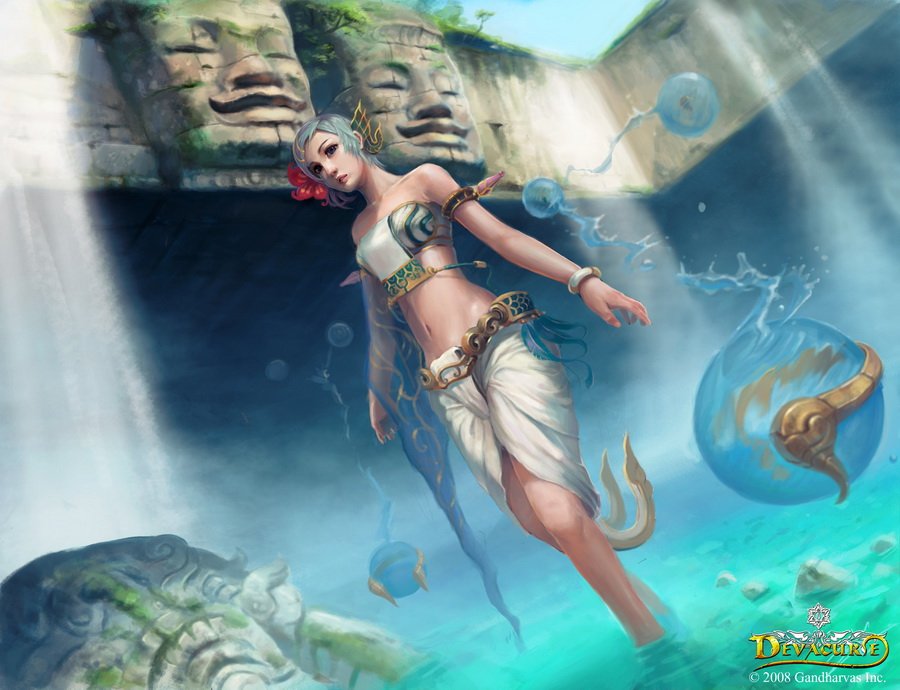 |
| Water Nymph CC by zionenciel |
(Prospero, 1.2.354-356)
"O, wonder! / How many goodly creatures are there here! / How beauteous mankind is! O brave new world, / That has such people in't!"
(Miranda, 5.1.203-206)
These are a few tongue-in-cheek examples, obviously, but I think they help establish a connection quickly, even if it is a shallow connection.
What really intrigues me, though, are the more profound, relevant connections that come up from certain themes. The first and perhaps most obvious is vision vs. reality, captured most poignantly in the following lines (As some may have already heard me explain, this quote comes at an important part of the play where Prospero, the exiled duke of Milan and self-made sorcerer by reading books, shows his daughter Miranda and her love Ferdinand a great vision, and Ferdinand says he wants to stay on the magic island forever):
"These our actors, / As I foretold you, were all spirits and / Are melted into air, into thin air: / And, like the baseless fabric of this vision, / The cloud-capp'd towers, the gorgeous palaces, / The solemn temples, the great globe itself, / Ye all which it inherit, shall dissolve / And, like this insubstantial pageant faded, / Leave not a rack behind. We are such stuff / As dreams are made on, and our little life / Is rounded with a sleep."
(Prospero 4.1.161-171)
The point made in these lines has perhaps never been more relevant, especially for gamers. All they "have" or "achieve" in a game is really just "baseless fabric...such stuff as dreams are made on" that they can't take into real life. Prospero doesn't have his powers before he lives on the island, and as he leaves the island he forsakes his powers, making the island somewhat like Prospero's "game."
Additionally, I think a video game could help pull out other themes of the play that are on more of a subtextual level. One example is with the character of Caliban:
"All the charms / Of Sycorax, toads, beetles, bats, light on you! / For I am all the subjects that you have, / Which first was mine own king: and here you sty me / In this hard rock, whiles you do keep from me / The rest o' the island."
(Caliban 1.2.389-394)
 |
| Screenshot of Bioshock CC BY Chadrew |
Prospero gained his power after reaching the island--we're not sure how long it took him. However, at some point he had to decide to enslave Caliban and the spirits of the island. Many have connected Caliban with natives that Europeans enslaved upon reaching the new world, bringing up themes of power, abuse, and slavery. An RPG/Adventure game of The Tempest could extend this theme interestingly with game mechanics. The game could be designed as such that the player knows he/she can enslave Caliban, but may not want to morally and so consider that maybe they could get by without him. However, inevitably, the player could be forced to realize that he/she has to enslave Caliban to carry on. (A similar situation to this happens in Bioshock with the Little Sisters.)
This in turn brings a new interpretation to the play itself and the character of Prospero. Prospero has often been interpreted as angry and domineering, but as players play the game version set up like this, it could open a new interpretation of a Prospero turning to his powers to survive as he tries to rebuild his life after exile.
In any case, I hope this post shows that there are at least several possibilities for intersections between video games and The Tempest that not only take advantage of the supernatural elements in the play, but also explore and enhance its themes, ultimately enriching both the play and the video game medium.
(Lines and line numbers taken from Shakespeare Searched.)
Friday, March 8, 2013
Returning to Primary Texts
In developing a research paper idea about a literary, it's important to circle back to that literature in light of one's developing thinking. Here's a suggested procedure:

- Summarize your current thinking, identifying one or two main directions, perhaps in terms of a question or two. With those in mind...
- Review key passages (noted by yourself or others)
- Analyze (a passage, a word, a pattern), often by using critical aids (like footnotes) or other tools (like concordances), looking for patterns (thematically, or in terms of language, form, etc.).
- Synthesize your current thinking in a brief post (which can narrate your process, not just articulate your claim or analysis)
Example from Twelfth Night
- Current thinking: What is the connection between the themes of madness and love in Twelfth Night? Is this kind of madness related to non-love types of madness?
- Key Passages
- "I am as mad as he, / If sad and merry madness equal be" (3.4.15-16)
- "But tell me true, are you / not mad indeed? or do you but counterfeit?" (4.2.107-08)
- Analyze
- I used Shakespeare Searched to look for mentions of madness in Twelfth Night. From this, it appears that madness is linked both to merriness and to sadness, and has both positive and negative connotations. Characters of all rank demonstrate various types of madness. It is associated with music, with mourning, with being lovesick, deluded, and with being either overly religious or with being overly loose in one's morals.

- Synthesize
- A repeated saying in Twelfth Night is "some are born great, some achieve greatness, and some have greatness thrown upon them."I am starting to see that one could say the same thing about madness. Some seem to be by nature foolish or crazy, some have events happen in their lives that bring about some kind of irrational behavior, and some become crazy because others drive them to it.
Subscribe to:
Posts (Atom)