I've been doing some reading up on King Lear and its critical interpretations about family and monarchy. The ONE good article I have so far is a transcript of a panel discussion between several fathers who have just watched a stage production of King Lear and are discussing its implications about fatherhood from their own personal experience. They commented a lot about what kind of relationship Lear had with his daughters and what he expected from them, and they noted the absence of the princesses' mother.
This made me think about my idea about the Tudors. What kind of a father was Henry VIII to his children? From the numerous books I have read about the Tudors I have come to several conclusions. The facts are that they were raised away from him for the most part, and the mothers of both of his daughters were estranged from Henry before their untimely deaths, so they probably were not very close. Edward is usually depicted as a somewhat spoiled favorite, partly because he was the male heir Henry had always wanted, and I can imagine that Jane Seymour's good sense to die before Henry could find anything wrong with her helped a lot. I can see Henry being the same kind of father-figure that the men in the panel discussion saw King Lear was to his daughters: imperious and demanding respect. And for much of their lives they lacked the presence of a mother figure.
It is not hard to imagine how this kind of childhood would have affected the rest of their lives. Elizabeth, of course, never married. Mary was married to Phillip II of Spain and was determined to produce an heir, but she was years older than him and he was never very close to her and cheated on her. Mary also hated Elizabeth because their father had dumped her mother Katherine of Aragon for Elizabeth's mother Anne Boylen. Mary exiled Elizabeth to run-down estates in distant parts of England, perhaps as revenge because Henry had done the same thing to Mary's mother and this ill-treatment resulted in her death.
It kind of makes you think about how difficult it is to be a monarch or a member of a monarch's family. Natural family ties are corrupted as parents and children are divided into different court factions competing for power, and siblings and parents end up hurting and betraying each other, sometimes killing one another. Although Elizabeth and Philip II were rivals and Phillip wanted to invade England, the mind-blowing fact that he was technically her brother-in-law makes you wonder what would drive him to do it. Is there more to family than blood or marriage ties?
Showing posts with label Marriage. Show all posts
Showing posts with label Marriage. Show all posts
Wednesday, March 6, 2013

Thursday, November 29, 2012
Revised Annotated Bibliography
Social Graph
I was able to bounce some ideas off my "homies" and also a hometeacher but I think the most important social graph here were my parents who are helping me to hone my ideas and clarify points.
I was able to bounce some ideas off my "homies" and also a hometeacher but I think the most important social graph here were my parents who are helping me to hone my ideas and clarify points.
New MediaI was excited to find Bruce Young's book online in a digital format. It made reading certain chapters really easy because I could just upload the chapters to my laptop and read them whenever I had a few minutes in between classes. Rather than carry a book around I was carrying my laptop. Although in this case I think my laptop was heavier than the book itself. . .
Social
Networks
- Goodreads Shakespeare Group
- Maybe Google + I'm not really established on here but I might try it.
Traditional Scholarly Sources-
- Smith, Amy L. “Performing Marriage with a Difference: Wooing, Wedding, and Bedding in The Taming of the Shrew.” Comparative Drama 36, nos. 3-4 (fall-winter 2002-2003): 289-320.
- Martins, Maria Lúcia Milléo. “The Taming of the Shrew:
Shakespeare’s Theater of Repetition.” In Foreign Accents: Brazilian Readings of Shakespeare, edited by
Aimara da Cunha Resends, pp. 126-37. Newark: University of Delaware Press,
2002.
This has the changing ideas of marriage and how women are supposed to behave and act even though they are the vehicles through which men receive property and money. - Crocker, Holly A. “Affective Resistance: Performing passivity and Playing A-Part in The Taming of the Shrew.” Shakespeare Quarterly 54, no.2 (summer 2003): 142-59.Argues that feminine virtue is a performance that allows women to obtain their desires of free agency within the play.
- Young, Bruce Wilson. Family Life in the Age of Shakespeare. Westport, CT: Greenwood, 2009. www.npu.edu.ua. Web. 12 Nov. 2012.This is the electronic copy of the book that Professor Burton mentioned in class. (The BYU Library didn't have a copy of it so I luckily was able to find it online.)
Wednesday, November 21, 2012
Marriage Politics in Measure for Measure--Final Paper
I think my top publication option would be through BYU's Criterion, but another viable option would be the University of Washington's undergraduate journal Intersections.
Tuesday, November 20, 2012
Equality Within Elizabethan Marriage
So I was super stoked because this paper was coming along so nicely. I sent it to a few friends to have them edit it and they gave me great feedback. However I came to realize that perhaps this paper wasn't as polished as I originally thought. . . but here is the final draft and I am happy with how it turned out. Equality Within Elizabethan Marriage
As for venues to publish this paper I tried a few conferences but all came back with negative responses so I am working on submitting this to Criterion. I liked this over all process and hope that you all enjoyed it as well or at least found that it improved some aspect of your writing as it did mine!
As for venues to publish this paper I tried a few conferences but all came back with negative responses so I am working on submitting this to Criterion. I liked this over all process and hope that you all enjoyed it as well or at least found that it improved some aspect of your writing as it did mine!
Tuesday, November 13, 2012
Elizabethan Marriage Politics
Well, my renewed efforts to get some feedback from the Shakespeare forum on Goodreads were successful! I re-phrased my question to get more general help on the topic of marriage during the Renaissance, particularly in reference to Measure for Measure, and a wonderful gentleman in the UK recommended a chapter of a book on British history that I was able to find in the BYU library. Pretty cool.
My Grandfather's online feedback on what kinds of things to look for when exploring/developing my topic helped direct my general search for specific contextual information regarding marriage customs/conflicts during Shakespeare's time.
I've also been talking with roommates about the topic, and trying to explain my paper, just like with the video exercise, has helped me clarify my argument and my understanding of how I want to develop it.
I found the majority of my most helpful sources on JSTOR and in the Shakespeare reference section of the HBLL (5th floor), as well as Tudor history books in the reference section on the 1st floor.
Monday, November 12, 2012
Mawridge, Mawridge is what brings us togewther tewday!
Initially I was stupefied at the daunting task of where to begin. Then I went to the my common search engine, Google and found much more than I originally anticipated. There are symposiums EVERYWHERE and even if you can't find a recent one you can look at the page of symposium that occurred in the past and (ideally) find a link to the more current page. I found the 18th Annual CSU Shakespeare Symposium at CSU (California State University) Fullerton back in 2010. Its a joint effort put on by The Acacia Group and As You Like Shakespeare Society. I found that the quest speaker was a Louise Sorel who actually played Katherine in Taming of the Shrew on stage. She would be a great example of someone who I found because of content, however, I decided to go through another individual and ask her a few questions because of her career as a professional actress. (She is also easier to contact because I don't have an Imdb or LinkedIn account.)
In order to strengthen my mini paper I decided that I needed more historical context so I obtained the book recommended by Professor Burton, and read the chapters that I thought pertained to marriage. I also e-mailed the author who happens to be a professor at BYU and am waiting to hear back. Meanwhile I will probably go back to the library for more biographical/historical information as I have already proven that to be a valuable resource in the past.
If anyone sees anything regarding family life in Elizabethan times I'd love to have you link it to this page or let me know where I can find it!
Thursday, November 8, 2012
Video Preview of Marriage in The Taming of the Shrew
The individuals who I asked for a response liked the paper and found it interesting to read however they wanted more historical context and more discussion between points. This was insightful to me because I usually struggle with the actual points themselves but now I know where to add depth and length to my paper for Tuesday. One pointed out that although the points I argued were strong, she didn't have enough time in between each point for her to think about and fully understand each individual concept. (She was also confused by me quoting a facebook post from my roommate as the rest of my paper was academic. So as discussed in class, I will need to find a way to somehow maintain a good tone throughout while still including the social aspects.)
Video, Process, and Bibliography
Here's my video preview:
(I spent over two frustrating hours trying to get this to work, so I hope it came through okay this time... if not, I'm sorry.)
Social Networks/New Media:
(I spent over two frustrating hours trying to get this to work, so I hope it came through okay this time... if not, I'm sorry.)
Social Networks/New Media:
Thanks to the comments on my 1st draft, I was tipped off to find a link to some scholarly essays about "Measure for Measure," which is great, since I've struggled to find sites related to this specific play. This site has other plays as well, and gives access to digital versions of first folios, prompt books, illustrations, etc., so it could be useful for others, too: http://college.holycross.edu/projects/isp/measure/mainmenu.html
Tuesday, November 6, 2012
Shakespearian Marriage Politics
Well, I didn't get as many responses to my Facebook or blog/forum posts as I had hoped, but I did get some helpful ideas from my former-English-professor grandfather in response to my Facebook message that helped me better hone my search. Imagine that! I didn't expect him to be one who communicates through Facebook, so that was fun.
In the course of my research, I found an article which references a painting by Jon van Eyck which reflects the tradition of "common consent" marriage practices I'm discussing in my analysis. Although I'm not currently planning on using the picture in my paper, I thought it would be interesting to include it here for reference. And maybe it will even be useful for one of you...?
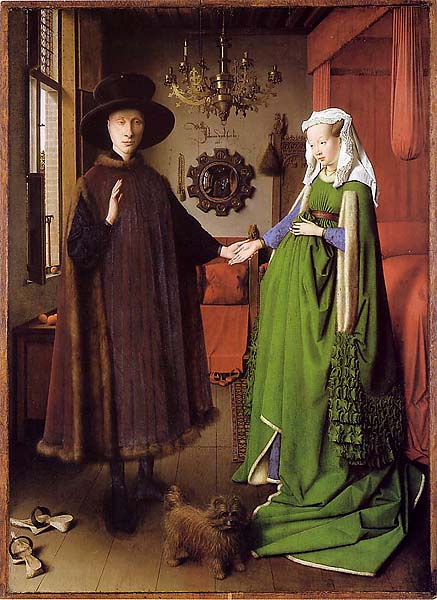
(Interesting note: although only the couple is present, the mirror reflects four people, perhaps representing God and the painter--or observer of the painting--as witnesses of their marital vows.)
Now, normally I wouldn't be any more willing to let people read my draft at this point than I would be to let them rifle through my sock-and-underwear drawer, but... here are the first few pages of my draft in all its odious roughness:
In the course of my research, I found an article which references a painting by Jon van Eyck which reflects the tradition of "common consent" marriage practices I'm discussing in my analysis. Although I'm not currently planning on using the picture in my paper, I thought it would be interesting to include it here for reference. And maybe it will even be useful for one of you...?
(Interesting note: although only the couple is present, the mirror reflects four people, perhaps representing God and the painter--or observer of the painting--as witnesses of their marital vows.)
Now, normally I wouldn't be any more willing to let people read my draft at this point than I would be to let them rifle through my sock-and-underwear drawer, but... here are the first few pages of my draft in all its odious roughness:
Monday, November 5, 2012
Equalized Power in Elizabethan Marriage
So I think that my Tweethis was too specific which scared away potential commentators. Or perhaps I just haven't found the right group through my social searching. I'm finding discussion groups but they are more focused on films and more recent developments rather than on discussing a play with no recent film adaptations. Another problem I faced is that I view Facebook as a more private than public circle. For example I only chose to friend individuals who I see on a daily basis (or did at one point like high school). Thus my "friends" list is rather small only 100-200 people. I certainly don't friend teachers or neighbors and that would limit the social circles that I could reach through Facebook. However my former roommate did comment on my status (She graduated in Classics but knew tons about Shakespeare as her mother is an actress who still performs on stage.) and gave me an insight that I never would have considered otherwise.
Mini-Paper
Thursday, November 1, 2012
Marriage Politics in Measure for Measure
Updated
thesis:
In
his play, Measure for Measure,
Shakespeare draws on teachings from the King James Bible to challenge the moral
superiority of the Puritan Manifesto and new Puritan leadership, especially in
regards to conflicts between traditionally accepted marriage practices and the
stricter Puritan marriage regulations.
Although this is much more condensed than the thesis presented in my last post, I'm still working on researching and refining it, so any feedback would be appreciated.
Wednesday, October 31, 2012
Jessica's Taming of the Shrew Annotated Bibliography
Social Graphmy
friends, dinner group, work associates, goodreads, parents, teachers
New Media
- I found this Blog entitled Wordy Wednesday http://shealwayslovedlarking.blogspot.com/2012/07/wordy-wednesday-wedding-wisdom-from.html
- The speech she gave at the wedding is something that I’m looking at more in depth since it directly discusses marriage in Shakespeare’s time and I might wish to contact her directly in the future. http://shealwayslovedlarking.blogspot.com/p/shakespeare-wedding-speech.html
- I also found this short blog post about Elizabethan marriage in the play Julius Caesar which I’ll look at for the overarching ideas. http://room211capa.blogspot.com/2012/10/julius-caesar-shakespeares-vision-of.html
- This blog is about Much Ado about nothing but states that Beatrice is a shrew for always speaking her mind. I hadn’t thought of that comparison before and am intrigued to follow that thought process. http://npshakespeare.blogspot.com/2012/09/gender-roles-and-marriage.html
Social
Networks
Goodreads Shakespeare Group I’m posting my “Tweethis” here and seeing what response I get, Facebook ditto!
Goodreads Shakespeare Group I’m posting my “Tweethis” here and seeing what response I get, Facebook ditto!
Traditional Scholarly Sources
- Smith, Amy L. “Performing Marriage with a Difference: Wooing, Wedding, and Bedding in The Taming of the Shrew.” Comparative Drama 36, nos. 3-4 (fall-winter 2002-2003): 289-320.
- Martins, Maria Lúcia Milléo. “The Taming of the Shrew: Shakespeare’s Theater of Repetition.” In Foreign Accents: Brazilian Readings of Shakespeare, edited by Aimara da Cunha Resends, pp. 126-37. Newark: University of Delaware Press, 2002.
- This has the changing ideas of marriage and how women are supposed to behave and act even though they are the vehicles through which men receive property and money.
- Crocker, Holly A. “Affective Resistance: Performing passivity and Playing A-Part in The Taming of the Shrew.” Shakespeare Quarterly 54, no.2 (summer 2003): 142-59.
- Argues that feminine virtue is a performance that allows women to obtain their desires of free agency within the play.
Revised Thesis
Although
Kate’s subservient attitude seems to be simply submission to her
husband’s will, it is actually her shaping and controlling both her
husband and their marriage. This movement of power from the man to the
woman showcases the changing concepts of an Elizabethan marriage.
Most everyone seemed to like the thesis I had so I turned to the information from reading some blogs that I had found. One characterized Beatrice as a Shrew for always speaking her mind and yet she often portrayed as being well liked which is in direct contrast to Kate. I thought of how both Kate and Beatrice seem to receive that which they wish in the end, whether it is going to Bianca's wedding feast or reading the love note/marrying Benedict. Other blogs discussed how power is wielded by the women because they manipulate the men. And so I tried to clarify that point in my thesis above to show what I had learned.
Most everyone seemed to like the thesis I had so I turned to the information from reading some blogs that I had found. One characterized Beatrice as a Shrew for always speaking her mind and yet she often portrayed as being well liked which is in direct contrast to Kate. I thought of how both Kate and Beatrice seem to receive that which they wish in the end, whether it is going to Bianca's wedding feast or reading the love note/marrying Benedict. Other blogs discussed how power is wielded by the women because they manipulate the men. And so I tried to clarify that point in my thesis above to show what I had learned.
Monday, October 29, 2012
Much Ado about Marriage
Okay so my focus isn't on Much Ado about Nothing but it's a rather catchy title and I figured that is a must for a first time blog post. But on to the actual topic that I have been considering for this paper. Marriage was and is such an important part of society that has been included in many of Shakespeare's plays (particularly comedies). Earlier in the semester I looked into the inheritance of coat of arms and property down the royal line and would love to tie that into my topic somehow but am finding that rather difficult to find a strong connection. (Other than the marry my daughter and all her inheritance/my property will be yours.) Perhaps I should just save that for another paper?
My favorite concept is the proto thesis of "Although Kate’s subservient attitude seems to be simply submission to her
husband’s will, it is actually her shaping and controlling both her husband and their
marriage which showcases the fluidity of power between man and woman within
marriage."
Basic points
Courting or wooing period, (2.1.195-201)
o She declares him movable
o Their witty banter back and forth “stichomythia” would stop if one or the other was not at the same level of education or wit
Road traveling back
o Explicitly plays to his masculinity but obeying everything he says whether it be the sun/moon
o Embracing the male/female traveler on the road
(And maybe something about) Bianca’s Marriage feast???
o This is the big point of the play because Kate's speech could be considered her final submission to the men but it could possibly be interpreted as "serve the men and then you really control the power."
My other thesis I don't feel as strongly connected to because I think it's just weak. "The showcase of the changing marriage
contract within the play of Taming of the Shrew was Shakespeare’s social
commentary on the issue which brought popularity to his play because it was a
topic that his audience was forced to wrestle with"
The fake marriage of Sly to “his wife,
the noblewoman” who is not allowed in his bed
The marriage of Kate to Petrucio
(classic marriage) only for economic purposes
o
But it ends up okay because they are
perfect matches in wit, and banter
Bianca to Luetensio (non-traditional
marriage, they run off together)
o
They are in love,
o
Bianca doesn’t obey the summons at the
end of the play
Possible connection to Much Ado about Nothing and the marriage contract as more of an agreement between the two parties rather than the parents of the two individuals???
·
Subscribe to:
Posts (Atom)