Showing posts with label assignments. Show all posts

Wednesday, October 21, 2015

Memorization and Performance Assignment - Shakespeare

Shakespeare can be understood on a level otherwise unknown if students memorize and/or perform his words. As part of the final exam for this course, we'll enjoy one another's memorized words from Shakespeare. However, I will require the selection and memorization of passages earlier than the final so that the final is more polished (see calendar of deadlines below).

Students can choose from among these options:

  1. Memorize 50 lines (give or take a few) of Shakespeare. This can be in the form of
    1. a monologue (Hamlet's "To be or not to be"; Kate's final soliloquy in Taming of the Shrew; Henry V's St. Crispin's Day speech; etc.)
    2. four sonnets (two of which must come from this set: 18, 29, 116, 130)
    3. a set of important quotations of your choice from across Shakespeare's plays (from at least four separate plays or sources)
    4. a scene performed with other students where each student has about 50 lines
  2. Perform the above in one of the following ways
    1. Private recitation to the instructor in his office
    2. Video (posted either privately or publicly on YouTube - Doesn't have to be fancy)
    3. Classroom performance
Deadlines:
  • Nov 2 (Mon) - Create a blog post indicating your selections for memorization. Quote the lines to be memorized in their entirety, preceded by a short explanation of why these were chosen and how they will be performed (from the choices listed above)
  • Nov 11 (Wed) - 25 of 50 lines must be memorized and recited in class this day (emphasis on retention, not performance)
  • Nov 23 (Mon) - last 25 of 50 lines must be memorized and recited in class this day (emphasis on retention, not performance)
  • Dec 9 (Wed) - Dress rehearsal for final exam performance
  • Dec 18 (Fri) 3-6pm (Final Exam performance)

Saturday, March 16, 2013

My list of things I've done

THESIS-IN-PROGRESS: 

The suspension of disbelief in both Shakespeare and Reality TV.  For Shakespeare he tends to break the fourth wall, frame plays in outside stories, etc. to remind the audience that they're watching the play. Reality TV likes to remind its viewers that they're watching "real" events and emotions. Shakespeare's process makes the plays seem more real, while Reality TV saying "this is real" makes it seem fake. How would Reality TV maybe showing sets/camera people/behind the scenes maybe change the way we view it?


SOCIAL GRAPH: 


Natalie McChesney, also known as my roommate, is a fellow English major and great at pillow talk. She's incredibly intelligent and hates the Bachelor, so I think it will be interesting to pit my research topic against her when developing my argument. It will keep me level headed.


Jeremiah Quinn, also known as that-one-guy-I'm-dating, is going on here since everyone seems to have a husband or wife that supports them in their thesis. We spend much of our time together, so we've talked about the paper quite a few times and he's really interested in seeing where it goes.


Corey Wozniak, also known as my intelligent friend, helped encourage me to chase the idea of Shakespeare and Reality TV. Being that he is partly responsible for when I am now, I feel that I will continue to discuss the topic with him and see how it develops. He was really excite about it when we first started talking about it!

Britton Parish, also known as fellow classmate, is also doing something a little pop culture related, and he passed the idea of video games being art by me about two months ago, so I've been following him with his thesis, and in return, he's agreed to help me with mine. It's nice to have someone in the class to discuss this with :)


Claire Shumway, also known as my best homie, graduated in philosophy and is incredibly intelligent. I think that her background will help contribute to maybe the more theological/philosophical aspects of the suspension of disbelief or what reality really "is".


NEW MEDIA:


I haven't had a chance to explore this topic, but I feel like not many people sit around comparing Shakespeare to "trash TV". I don't know if the actual show The Bachelor would count as this, or if it would count as a... primary text?  I DON'T KNOW! Overall, this category makes me feel a little overwhelmed.


SOCIAL NETWORKING:


Twitter: Holy cow did I hit a gold mine here! I figured I could maybe try and contact some past Bachelor/ette contestants to get their take on the "realness" of the show, and I even attempted to chase down Arie from Emily Maynard's season since he was in Provo, but Branbury required that I renew my nonexistent contract with them in order to even be in the same room as him (and while I am so excited about this paper, I don't have that kind of $$$ to drop right now). Thus far no responses from the few contestants I've tried to reach, but I'll keep at it. I also found some Shakespeare related Twitter pages I'll contact as well.


Probably because I'm a whiney nobody brat.

Goodreads: Like Nyssa, I've considered joining that one group everybody's joining, but I figure they'll most likely kick me out for the blasphemy that is my research paper (or I'll just get a lot of mean responses since that's mostly what I get from hoity-toity English lovers ;)

I'm still looking around for places to contribute, but there really isn't a lot of great stuff going on concerning the reality of reality TV. I WON'T GIVE UP THOUGH!!!!!!!!!!!!!!!!!!!!!!!!!!!!!!!!!!!!


SCHOLARLY THINGS:


Bertolt Brecht: He use to write plays where in the middle of them, someone would trapse arose the stage carrying a sign reading "YOU ARE WATCHING A PLAY" (he was the original Captain Obvious). I've found some of his old publications and I'm starting to read through them to maybe get an idea of why he does this during his plays.


Reality TV: remaking television culture: AWESOME book I found in the HBLL. It has a bunch of critical articles regarding reality TV. I'm SO excited about readin through more, as I've already read a few of them. 


I'm going to look for some more articles on the suspension of disbelief in Shakespeare's plays, but I haven't had the chance to yet because I've been trying to actually figure out my thesis. 

Tuesday, March 12, 2013

The eBibliography: Annotated Bibliography in the Age of New and Social Media

Image: creative commons licensed by Moyan Brenn - Flickr
In preparing instructions for my students for completing an annotated bibliography assignment, it's occurred to me that what is evolving here is a different sort of creature than the more traditional bibliographies used in the print-oriented world of academic writing. I might have titled this genre "eBibliography."

How does the "eBibliography" differ from the regular sort?

As those instructions for my students show, this new sort of bibliography does not consist purely of sources from traditional scholarship. It includes a strong social component as well as a focus on new media.

This diversity of sources should help students focus both on developing their ideas, but also sharpening their sense of the relevance and currency of their ideas. By having to list and talk about one's "social graph" and various social networks, this makes students conscious of available avenues for what I call "social proof."

For more on social proof, see "Ignite Your Ideas with Social Proof"
In addition, by looking at and reviewing various new media, students can tap into current discussion and also expert networks.


Overall, this genre of bibliography is also an in-progress genre. It is not a Works Cited page, nor a formally published scholarly bibliography. Far from it. No, this exemplifies the value and importance of publishing process (see "The In-Process Post Genre" and "Burning Redwoods: The Lost Assets of Academia"). The long and short of that is that in the digital age, we are at our best when publicly documenting our processes of discovery and the curation and formation of our ideas. In-process knowledge might even be more important than more formalized varieties of knowledge production.

Wednesday, November 7, 2012

Twelfth Night Video Preview

So, I had some technical difficulties with this movie...and it has a watermark across it. Sorry about that...


Tuesday, November 6, 2012

Shakespearian Marriage Politics

Well, I didn't get as many responses to my Facebook or blog/forum posts as I had hoped, but I did get some helpful ideas from my former-English-professor grandfather in response to my Facebook message that helped me better hone my search. Imagine that! I didn't expect him to be one who communicates through Facebook, so that was fun.

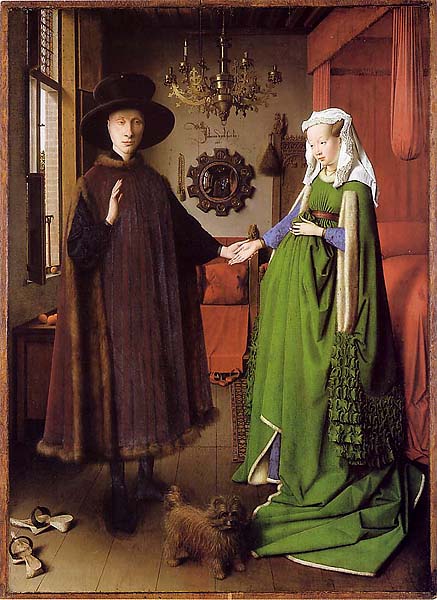
In the course of my research, I found an article which references a painting by Jon van Eyck which reflects the tradition of "common consent" marriage practices I'm discussing in my analysis. Although I'm not currently planning on using the picture in my paper, I thought it would be interesting to include it here for reference. And maybe it will even be useful for one of you...?

(Interesting note: although only the couple is present, the mirror reflects four people, perhaps representing God and the painter--or observer of the painting--as witnesses of their marital vows.)

Now, normally I wouldn't be any more willing to let people read my draft at this point than I would be to let them rifle through my sock-and-underwear drawer, but... here are the first few pages of my draft in all its odious roughness:

Monday, November 5, 2012

Twelfth Night Draft and Tweethis Comments

For my paper I asked people on my Facebook account if they read Twelfth Night in junior high, and if not what plays they read.  I found out that, at least amongst my acquaintances, it is not commonly taught.  I have one acquaintance, though, who knew of a school where the 8th graders are studying it. He directed Twelfth Night last year and he's played Malvolio. I've asked him more about that and I'm awaiting his response.

Here's my 4 page draft!  It's very rough. I have a lot more research to do. Any thoughts would be appreciated, though.

Tuesday, October 30, 2012

Production Schedule for Shakespeare Research Papers

My current Shakespeare students are creating research papers, using this blog to document and develop their research in conversation with others. Here is our updated production schedule.