Showing posts with label The Winter's Tale. Show all posts
Sunday, October 4, 2015
Hermione the Muggle (Or maybe not?)
I've seen The Winter's Tale performed before, so the ending did not shock me the second time around. I was pretty surprised during the production to see that happen, though to be honest once they began speaking of a statue I began to suspect. It just seemed a little too perfect to have an artist suddenly finish this statue of the dead queen right when everything becomes restored and everybody is found, etc. Especially since Paulina begins to go on and on about the king only marrying again once he finds a woman like Hermione. Initially I did believe that Paulina had faked Hermione's death, and her actions seemed consistent with this. John's post, however, mentioned that there is proof that Hermione had to have been dead the entire time, else certain parts of the play didn't pan out. When I did see the play though it seemed obvious and purposeful that Paulina had been the mastermind behind the plot to teach Leontes a lesson. They played it with this intention, leading me to believe that there was no magic whatsoever, but really only a carefully crafted long con. After reading the play and the blog posts, and understanding the romantic genre better, I can see how this magical aspect fits.
It seems that there is a general consensus about Shakespeare's romances, that they are the most mature of all his writing. I may not have understood that before, and in regards to magical aspects I might have some arguments. But in the general sense of character and plot development, I think that I agree. Hermione and Leontes have a deeper, richer, more complicated love story than do many other couples in Shakespeare's works. When we read Midsummer we identified the fact that those characters are more like tropes, or stereotypes, due to the comedic genre. And even in the tragedies, there is only so much character development.
Saturday, October 3, 2015
The Eternal Nature of Art
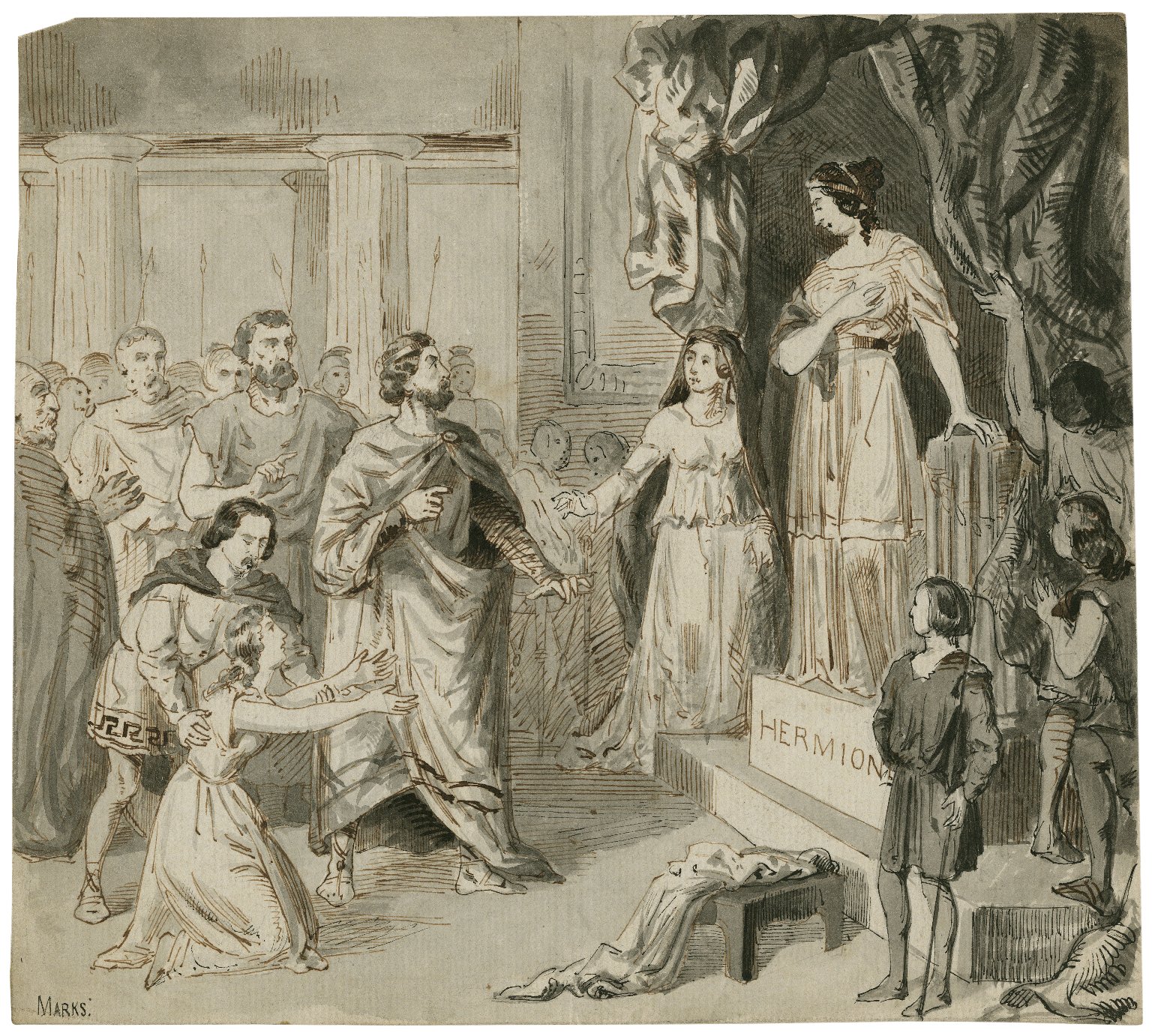
In Act V Scene II, the gentlemen speaking of the sculptor of the statue of Hermione say "had he himself eternity and could put breath into his work, would beguile Nature of her custom, so perfectly he is her ape". This high opinion of an artist, especially in light of Hermione's statue coming alive at the end of the play, reminded me of the ending of Shakespeare's Sonnet 18 when it says: "So long as men can breathe or eyes can see, So long lives this and this gives life to thee." In Hermione's case, this became quite literal since her statue (somehow) allowed her to come back to life. While the quality of the statue was not the only factor in her return to life, the incredible accuracy of the statue appears to allow Leontes to imagine that it really is his wife. This is a very bold statement about the power of art to immortalize its subject.
Tuesday, September 29, 2015
Honor in Royalty
Something that stood out to me in Act IV scene IV was the way everyone is impressed by Perdita's grace and beauty and is surprised that she could be a shepherd's daughter. This seems to suggest that Perdita's royal blood shows in the way she looks and acts, even though she wasn't brought up as a princess. I found an article ("Themes" by Joan Lord Hall) that talks about this idea and how it conflicts with the way Laertes is shown so negatively in the beginning of the play even though he is a king. It went on to talk about how the play shows both sides of the argument as to whether royal blood naturally makes someone more honorable or not. It gave examples of different characters who were honorable despite their low birth, such as Camillo and the Shepherd, and then addresses how Perdita is a "perfect hybrid" of the ideas that honor can come from high birth or "can be achieved through virtuous actions". She is "down-to-earth" due to her upbringing but also "instinctively courteous" because of her royal blood. I agreed with this view that the characters in A Winter's Tale seem to be able to act independently of their social class, while at the same time Perdita has some inherent characteristics that are associated with royalty despite her upbringing.
Time
![]() |
| From BYU's production |
At the beginning of Act IV, our last stretch of reading for tomorrow, we are introduced to "Time". Time is a character, and a thing, and serves as a chorus. When I saw The Winter's Tale at BYU, and again when I read it for this class, I wondered why time was being brought into the play as a character. In the very first scene of the play we see two of the background characters introducing the setting; so why did Shakespeare not do that again? What could be his purpose in using Time in this interlude?
I looked into the character, and surprisingly much of the scholarship I found on the matter stated quite plainly that Time was being used a simple bridge, to mark the passing of years (something frowned upon for plays at that time). One more recent article that I found though gave perhaps a different explanation for Time, focusing not on the character, but on the hourglass.
"More significant to an interpretation of this passage, it should be noted that one representation of the hourglass in Renaissance art, as Guy de Tervarent has shown, was an attribute of Youth or Age, depending on whether the superior part of the glass was empty or full. Thus one can surmise that one reason for Time's turning his hourglass is to show the upper part full and hence a potential for growth-life renewed; but also this action indicates that his concern now will be with Youth (Florizel and Perdita) and spring, while the grief-ravaged and aging Leontes must yet for a time endure the winter of his discontent" Raymond J. Rundus, "Time and His Glass in the Winter's Tale". Article
With this in mind, the setting becomes all the more interesting, as does the extreme shift in the mood of the play. It does feel like two different plays, and through Time flipping his hourglass, Shakespeare symbolically flips the world, time, and the mood.
Wednesday, April 17, 2013
Submitting, A Story
I have successfully submitted my paper to the Scholar's Archive at BYU (after checking over it once again to make sure I haven't accidentally mis-cited things), as instructed!
I have also submitted my paper to BYU's Criterion. While discussing my paper with Dr. Burton, he mentioned that my paper is less of an academic one, so a blogging atmosphere might be more appropriate for it. I did want to try to submit it to a journal, so I felt this would be a more willing one, but if it isn't accepted to the Criterion, I'm going to shorten it, change it into a blog post style, and submit it to the blog No Sweat Shakespeare for publication, as I've already talked to Ed Goldswain about the possibility of publishing on the blog.
Friday, April 12, 2013
Rachel Olson: "Choosing Not to Believe: Realistic Unrealism in The Winter’s Tale"
The romantic elements of mixing genres
and the influence of the supernatural within Shakespeare's The Winter's Tale have
led to the critics' rejection of the play.
Leontes's, the tragic hero's, interaction with the oracle in the play
thus becomes a metaphor for this rejection, as it is a rejection seemingly
based on a desire for realism. In reality, it is a rejection predicated on an
inability to recognize that the romantic elements of the play are in fact what
makes it realistic, a belief that is essential to understanding and
appreciating the message of the play. The mishmash of genres has resulted in critics’
contempt. This contempt is mirrored by Leontes' reaction to the oracle and becomes a metaphor for a rejection of the play. The Winter’s Tale actually faces
unavoidable resistance to being taken seriously because it is easy to dismiss
the happy ending created by romantic elements. Even with this happy ending, most of the losses
in the play reveal that romances mix comedy and
tragedy; this happy ending, while happy, is not an easy-out. What is required to overcome a skepticism of the truth of the play is a willingness to, as Paulina explains, “awake [one’s] faith” (Shakespeare
V.iii.95).
IT LIVEEEESSSS!
Honestly, I wish I could spend a little more time with it, but... There comes a point where you've just got to decide you're done. Enjoy! and sorry the Works Cited is practically a paper within itself...
https://docs.google.com/file/d/0B3BxqhQTu_ynWHZJNWNqLUIwclk/edit?usp=sharing
Tuesday, April 9, 2013
Where I'm At
![]() |
| Life is good! And if only today looked like this. |
- Paul mentioned that I should work on transitioning between ideas better, so I've started to do that with my paper. I realized that even though headings are helpful, with them I have to be especially careful that I don't separate the parts of my paper too much and have them not work together.
Friday, April 5, 2013
Investing Time in Mikaela's Draft
Mikaela, I felt as I was reading your essay that the order of the paragraphs made sense in building up your argument. You have an engaging voice as you write and you definitely used the research you've done to your advantage, not just sticking it in the paragraphs but making it prove your point. You use your knowledge of Shakespeare's time to make a convincing argument and I like how you've connected all these aspects of time into something that doesn't feel sporadic, but orderly.
Thursday, April 4, 2013
Realistic Unrealism in the Winter's Tale and a Rough Draft
Rachel
Olson
English
382
Dr.
Burton
28
March 2013
Choosing Not to Believe: Realistic
Unrealism in The Winter’s Tale
“If you had to choose between romances
and tragedies, which would you say is the genre most true to life?” Well, first we’d have to decide what we mean
by romances. Instead of the kind
involving romantic love, we’d be discussing the genre of William Shakespeare’s The Winter’s Tale. But even after we discuss romance as a mixture
of tragedy and comedy, we still have a tendency as a society to answer firmly,
“Tragedy,” to what is true to life. It
is easier to believe that the worst is going to happen, that positive thinking is
wishful thinking. Romances, however, are a mix of tragedy and comedy. Although Shakespeare's romance The Winter's Tale has been accepted and
enjoyed by the masses, the romantic elements of mixing genres and the influence
of the supernatural within it have led to the critics’ rejection of the play on
an intellectual level. Leontes' interaction
with the oracle in the play thus becomes a metaphor for this rejection of the
romance, as it is a rejection seemingly based on a desire for “realism.” In reality, this rejection of the romance of The Winter’s Tale is predicated on an
inability to recognize that the romantic elements of the play—its mixture of
genres and supernatural elements—are in fact what makes it realistic.
Wednesday, April 3, 2013
rough draft!
Some notes: I don't have an intro or a conclusion yet, so I just included some notes as to what I'm planning on putting in the intro/conclusion. There are still some things I have to work out, the writing isn't polished, and I have to read it through and put in a couple more in-text citations that need to be there. Biggest issue though: Once I finish my intro/conclusion it's going to be about 12 pages. Which is too long. Tell me which argument seems the weakest so I can cut it out!
Mikaela Kemsley
Dr. Gideon Burton
Shakespeare 382
3 April 2013
All in the Timing
Thesis: In his play, The Winter’s Tale, Shakespeare utilizes the duality of time as being simultaneously constraining and liberating, both within the text and within his time.
When Time, the aptly named chorus, begins the fourth act by “sliding o’er” sixteen years of plot, it defines itself through use of binary oppositions, mirroring the similar opposition between the constraint and liberation of time. The chorus identifies itself, “I that please some, try all: both joy and terror/Of good and bad”(4:1:1-2). The pairs of pleasing and trying, joy and terror, and good and bad instantaneously set time apart as being paradoxical and self-contradictory, and they also coincide with the themes of constraint and liberation. Being pleased, good, and joy can readily be considered liberations from feelings of anger, pain, and negativity, while being tried, terror, and bad are constraints in one’s ability to experience positive emotions. In this sense, time literally is introducing itself at the beginning of the fourth act as being somewhat recondite and as being both liberating and constraining.
Time continues his speech at the beginning of the fourth act by skipping over sixteen years in the lives of the characters, bringing the plot to a point where Perdita has reached adulthood and Leontes has been pining over his deceased wife for sixteen years. This use of time is a liberation to the plot of the play, which consequently was a liberation to Shakespeare in producing a play that could be commercially successful in his time. Passing over sixteen years allows the story to depict the most engaging and salient points without the complicating use of flashback or excessive narration. In short, the time gap vastly improved the play’s entertainment value which was amenable to Shakespeare as a producer and a business man. Though this is oftentimes a less studied topic within the confines of an English classroom or within the presentations of a conference, Shakespeare was writing in an attempt not only to create art, but to sell tickets in his contracted theaters. In his book Writing for Performance, John Russell Brown cites this saying, “Whatever the subject of the dialogue, Shakespeare’s mind had access to the business of theater”(3). Russell goes on to point out that many of Shakespeare’s plays, if not all of them, have some reference to theatrical reception or even a direct appeal to the audience for a favorable reception, such as when Time asks for the audience’s indulgence in the fourth act, “Your patience allowing/ I turn my glass and give my scene such growing/ As you had slept between” (4.1.15-7). This effort to “crowd please” is also evidenced in The Winter’s Tale by the bear in act three scene three, which earned the play possibly the most famous stage exit ever written, “Exit, pursued by a bear”(3.3). While the bear isn’t wholly pertinent or necessary for the plot, it does incorporate an ostentatious element of spectacle that would’ve drawn in larger audiences for performances. Even a record of Shakespeare’s economic success with his performances would indicate his fruitful efforts in producing plays that were widely and appreciatively received by the public. Brown describes this, “The remarkable outline of Shakespeare’s career, as deduced from legal papers, account books, and other documentary evidence, argues for some quite exceptional drive behind his work in the theater…he was highly successful for more than twenty very productive years”(6). Clearly, Shakespeare intended his works to bring in an audience, perpetuate his reputation as a popular playwright, and keep the theaters that performed his work in business. Had Shakespeare not chosen to use an unnatural pattern of time, The Winter’s Play would’ve centered heavily on the uninteresting tale of Perdita being raised, or of Leontes lethargically mourning for sixteen years. Shakespeare’s goals of creating a commercially popular and successful work would’ve been, if not utterly insurmountable, at least arduous, and so the irregular use of time was a liberation to both the plot and Shakespeare’s business interests.
This isn’t to suggest, of course, that The Winter’s Tale was embraced by everyone in Shakespeare’s time or afterwards. While the play is able to present the most interesting aspects of the story and spectacle through its manipulation of time, this manipulation also flagrantly disregards Aristotle’s Unities, which constrained the play to the derision of scholars. After studying Ancient Greek and Roman theater, Aristotle established three vital rules that he felt a performance must adhere to in order to be successful: unity of place, unity of action, and unity of time. Specifically, The Winter’s Tale violated Aristotle’s unity of time which stated that the plot of a play must take place in a length of time comparable with the time it took to perform the play. Bruce Young, an English professor at Brigham Young University, explained this violation while speaking about Time's speech at the beginning of the fourth act, "Time also jokes in a sense (at least that's how I take it) about the supposed "unity" of time... Time here says basically that since he is Time, he doesn't have to follow rules (like the unity of time) that were established during the course of time--in other words, that are human creations and haven't been around forever." Shortly after Shakespeare’s time, in the beginning of the 18th Century with the Age of Enlightenment, Neoclassicism emerged (though the school of thought wasn’t actually named that until the mid-19th Century). They adopted Aristotle’s unity of time, and produced scathing reviews of Shakespeare’s The Winter’s Tale.
One such review was in a biography of Shakespeare’s life written by Nicholas Rowe in 1709 titled Some Account of the Life of William Shakespeare where he states, “If one undertook to examine the greatest part of [Shakespeare’s work] by those Rules which are established by Aristotle, and taken from the model of the Grecian stage, it would be no very hard task to find a great many faults.” Rowe was one of the more forgiving Neoclassicists, continuing to say that while he was appalled by Shakespeare’s inattention to the Unities, he still enjoyed the work holistically on the merits of its entertainment value. A more vehement Neoclassicist, Charles Gildon, expressed his frustration at the violation of the Unities within The Winter’s Tale in an essay he published in 1710, “[The Winter’s Tale] needs no critic, its errors are visible enough, Shakespeare himself was sensible of this grossness of making the play above sixteen years, and therefore brings in Time as a chorus to the fourth act, to excuse the absurdity to which I refer you…” Here Gildon not only voices contempt for Shakespeare’s unorthodox use of time, he also proposes that Shakespeare was quite aware of his own unconventionality.
Gildon's thoughts in this regard are supported by the plethora of Greek allusions throughout the play. The characters repeatedly swear by the Roman God Jove (The Greek God Zues) such as Perdita does when speaking with Florizel, "Now Jove afford you a cause!" (4.4.19) and Paulina does when pleading with Leontes to accept Perdita as his child, "Look to your babe dear Lord, 'tis yours:/ Jove send her/a better guiding spirit!"(2.3.157-9). Shakespeare also involves an oracle when Leontes is attempting to discover whether his suspicions about his wife’s unfaithfulness are true and he sends Cleomenes and Dion to Apollo’s temple, “To Sacred Delphos, to Apollo’s temple/ Cleomenes and Dion, whom you know/ Of stuff’d sufficiency: Now from the Oracle/ They will bring all” (2.1. some line number or other). This is also reminiscent of ancient Greek theater where characters often went to oracles for advice or prophecies, such as Oedipus asking for Tiresius’ advice inOedipus Rex and Thetis going to the oracle about her son, Achilles, in The Illiad. In his essay "Look Down and See What Death is Doing: Gods and Greeks in The Winter's Tale," Earl Showerman spoke on the prevalence of Greek and ancient classical themes in The Winter's Tale, "The classical names of the characters, the preeminence of Apollo, the themes of vengeful jealousy with attempted regicide and infanticide, and the mysterious resurrection of Queen Hermione all point to sources from the earlier classical period." Clearly, Shakespeare was familiar with the conventions of Greek theater and with Aristotle's Unities surrounding them.
Time also begins his speech in the fourth act by saying, "I that please some, try all: Both joy and terror/ Of good and bad, that unfolds error"(4.1.1-2), in which he rhymes "terror" and "error," putting a natural emphasis on those words. This emphasis on "terror" and "error" is also indicative of Shakespeare's knowledge of the Unities in that he was aware his use of time would be perceived as an "error" and received by some with "terror." In the next two lines of Time's speech, Time rhymes "Time" with "crime," reiterating that the irregular use of time would be imputed by many as a crime. Shakespeare's choice to pass over sixteen years of plot was his conscious choice to "break the rules" established before him. This can be seen as Shakespeare using the irregular passage of time to liberate himself from the stipulations and guidelines that governed theater in his time. Simultaneously, however, this liberation was accompanied by censure and denouncement from dramatists and literary theorists. This is a constraint in that even though his play was written to be supported by the public, it was rejected by intellectuals and thus in many ways was still deemed a failure. Through his atypical utilization of time Shakespeare was simultaneously liberating himself from the accepted theatrical “rules” of the Unities, and constraining his work to the harsh reproach of scholars.
Breaking the theatrical “rule” of the Unity of time is also a liberation to the performers and technical workers putting on productions of The Winter’s Tale. Plays are split into acts and scenes not only to serve the playwright in organizing his/her thoughts, but also to aide performers, directors, dramaturges, and technicians in producing plays. Normally, before a production team even begins the staging process, they participate in “table work” where the team sits and simply talks about the script, splitting the scenes into even smaller sections called beats. These beats are used as an organizational method to enable different members of the production team to be able to work and communicate effectively with each other through the rehearsal and performance process.
The division in The Winter’s Tale caused by the lapse of sixteen years naturally separates the story into two distinct parts: Before the “time gap,” and after it, which provides logistical liberations to the production staff of a performance. Make-up artists, for example, can divide their work within the performance into “before the time gap” where Leontes, Paulina, and Hermoine are young, and “after the time gap” when they’re responsible for making Leontes, Paulina, and Hermoine look aged or tired. For directors, this gap allows room for creative interpretation. Brigham Young University performed a condensed, fifty minute rendition of The Winter’s Tale this past March that was made possible through utilizing this sixteen year gap. The first three acts were told as a prologue where the actors mimed out the plot with a narrator, and the rest of the play focused on the story of Perdita and Florizel. In speaking with the director, she explained her thoughts on time inThe Winter’s Tale, “The irregular passage of time within The Winter’s Tale was extremely liberating for me… I was able to use the rest of the play to focus on the love story between Perdita and Florizel, and the reunion of Perdita, Leontes, and Hermoine.” So, on a production level skipping sixteen years is a liberation both in providing logistical clarity to the production staff and creative liberties for the director.
The use of time within The Winter’s Tale, however, isn’t merely a liberation for the production staff, it's also a liberation to the audience watching the play because it contributes an element of unreality to the play. The Winter’s Tale is widely considered fantastical, and many consider it “ruled by the supernatural” with a “healthy dose of magic and wonder” (Haagensen), or would say that it has "elements of fantasy and romance" with "features of the play that strike us as unrealistic" (Young). This pervading sense of mysticism within the play is due in large part to the irregularity of time. While speaking with the cast of Brigham Young's performance of The Winter's Tale, the actress playing Paulina, Aubree Lyman, said, "The irregularity of time in The Winter's Tale makes the play feel more magical. It creates disillusionment." Time, in reality, is consistently, constantly moving forwards. It passes in seconds, days, and years with absolutely no deviation or altercation. When the Winter's Tale passes over sixteen years of plot, it shatters any imitation of the world in which time passes linearly and regularly. This lends the play a more dream-like quality, which is expressed when Time says, "I turn my glass, and give my scene such growing/ As you had slept between"(4.1.16-7), where Time literally relates the sixteen years passed to sleeping.
Time also has a supernatural aura at the beginning of the fourth act, enacting a God-like power in skipping sixteen years of plot. This God-like quality is represented with the line, "Now take upon me, in the name of Time" (4.1.3). This polysemy could merely be interpreted as a means for the chorus to identify itself to the audience, however it could also be interpreted in terms of its religious connotations. The phrase to "take upon" is a commonly used Christian phrase such as in Matthew 11:29, "Take my yoke upon you and learn from me..." The phrase "in the name of" is also rife with religious context and is most commonly used within Christianity taking upon the name of Christ. When Time uses these phrases to self-identify to the audience, he is identifying himself as having some relation to religious figures, associating him with the powerful and supernatural. This presence of the supernatural also contributes a "magical" or "unreal" sense to the play in that direct contact and interaction with supernatural beings is uncharacteristic of reality.
How does the fairy-tale-like quality time creates produce a liberation? Fantasy presents an avenue of escapism for audience members. When audience members are engrossed in a world of oracles, the supernatural, and statues that spontaneously come to life, their actual lives feel distant and somewhat less relevant. So, mysticism affords a momentary liberation from the pressures and responsibilities of one's everyday life. What about after the audience members leave the theater, however? Does the liberation dissipate as one returns to the stresses of living? C.S. Lewis argued that it didn't, or at least that this liberation prevailed in a new form after leaving the theater. In his book, On Three Ways of Writing for Children, he argued that experiencing something bizarre and extraordinary pushes individuals to seek for "something beyond" the normal in their own lives. This inevitably contributes an element of the extraordinary to the ordinary, as he explains, "He does not despise real woods because he has read of enchanted woods: the reading makes all real woods a little enchanted.” Contrastingly, Lewis proposes, it's the realistic stories that send audience members or readers back to their individual realities disgruntled and displeased. Here he uses "school story" to refer to the realistic story, "The school story is compensatory and we run to it from the disappointments and humiliations of the real world, only to be sent back to the real world undividedly discontented for it is all flattery to the ego. " (Lewis). In this regard, unreality (in this case caused by the irregularity of time) isn't merely a form of escapism but also a liberation to the way those exposed to it view their own realities. Through it's unusual and exceptional nature the incredible opens avenues of thought unavailable to those who refuse to depart from reality - avenues which can then be applied to the way one thinks on a consistent, daily basis. In short, exposure to the incredible allows one to see the "enchantment" in his/her own forest. Wade Hollinghaus, a theater professor at Brigham Young University, expressed this, "...the fantastical can be...beneficial because it provides us with an opportunity to play with the rules of what we consider to be reality. To do so could potentially allow us to think something other than what realism allows us to think."
While the irregularity of time contributes to audience members finding liberation of thought, however, it actually constricts the thought patterns of characters within the play. Seasons are a vital aspect of The Winter's Tale, unsurprisingly considering the play's title. The play begins in Sicilia in the grasp of winter, as indicated when Leontes' son says, "a sad tale's best for winter" (2.1.25) This is said as a precursor to Leontes accusing his wife on infidelity and the ultimate death of his wife and son. Mamillius is warning the audience with his statement, as if saying, "This play is set in winter. I hope you weren't expecting anything uplifting." It's also significant that Mamillius is merely a child saying this, implying that the negativity associated with winter isn't something learned, but rather something inherently understood, even by a child. A post about seasons within Shakespeare's works on the No Sweat Shakespeare blog supported this point, saying, "Shakespeare is never purely descriptive – his nature imagery is always metaphorical, presenting an emotion, a feeling, an idea or a situation...Winter is associated with something negative, such as discontent."
Specifically within The Winter's Tale, winter is directly correlated with the grief of Leontes. As long as he is caught in winter, he is constrained by negative feelings, initially of rage and jealousy and eventually of loss, pain, and regret. Paulina elucidates this association just before bringing Hermoine back to life, "A thousand knees, ten thousand years together, naked fasting/ upon a barren mountain and still winter in storm perpetual, could not move the gods/ to look that way thou wert"(3.2.230-3). Here, "knees" is used as a synecdoche for prayer, which alters the interpretation to: a thousand prayers and ten thousand years of praying could not wipe away your guilt. Reading this, or listening to it, creates a distinct mental image of a severe winter storm, the wind howling with feet of snow, Leontes standing naked in it, emaciated and haggard from fasting, his skin stretching in a thin, insufficient layer over his ribs, on an utterly desolate mountain side. Shakespeare's use of adjectives such as "naked," "barren," and "perpetual" contribute to this enargia, heightening the poignancy and dramatics of the description. Why create such a vivid chronographia of winter here? There are many explanations, but one is that it draws attention to the correlation between Leontes and winter. Specifically, it accentuates the constraints winter has imposed upon Leontes in trapping him in a state of mourning. This would also explain the use of "ten thousand years" and "storm perpetual" within the description. Both of these phrases are measurements of time, which again highlights the presence and influence of time within Leontes' mourning.
Spring and summer within The Winter's Tale, however, is associated with happiness. The No Sweat Shakespeare blog expressed this, "[Shakespeare's] summers and springs are joyous and life affirming." The fourth act after the time gap begins in summertime, where the audience is transported from bleak Sicilia and Leontes' mourning to joyous Bohemia and the Sheep Shearing Festival. Instantaneously it's clear to the audience that with the ushering in of summer there is a simultaneous ushering in of festivity and joy. Specifically, the summer is correlated with the character of Perdita. Her story within the text (with the exception of when she was a child and didn't yet have a character) takes place exclusively in the summer. When Polixenes first meets Perdita he addresses her, "a fair one are you - well you fit our ages/ with flowers of winter" (4.4.77-8). Later on in the scene Perdita responds to him,
"Sir, the year is growing ancient,
Not yet on summer's death nor on the birth of trembling winter,
the fairest flowers o' th' season
are our carnations and streaked gillyvors,
which some call nature's bastards" (4.4.80-5).
When Leontes describes Perdita as fair and then Perdita descibes the gillyvors as the "fairest flowers" it's indicative of the association between Perdita and the gillyvors, which are specifically July flowers(IN TEXT CITATION OF SOME VARIETY). Despite the fact that the gillyvors are the "fairest flowers o' th' season," however, they are still considered by some as nature's bastards. This is a parallelism to Leontes' incorrect belief that she was herself a bastard, which again reaffirms the interpretation of Perdita being a kind of flower belonging to summertime. Thus, Perdita is associated with summer and spends the play enfatuted with Florizel, while Leontes is associated with Winter time and spends the play experiencing jealousy, rage, and guilt. Each character, respectively, is confined to joy or sorrow dependent upon the season in which they appear on stage and the season they are associated with. Time, in the form of seasons, dictates and constrains the attitudes and thought patterns of the characters within the play.
Also prevalent within the summer portion of the play is the inclusion of music, which is another exemplification of the simultaneously restricting and constraining nature of time. (OK that was just about the worst transition of all time... best I could think of though, unfortunately) Music, by default and definition, relies heavily upon the use of time. Without time there can be no rhythm, there can be no time signature, and there can be no music. In many ways this is a constraint. Lyrics within music must adhere to narrow and specific formats to be able to work within the parameters of the rhythm of a song. Songs are often also split into distinct sections, such as the verse and bridge in modern music, which also constricts the construction of the music and lyrics. Much of Shakespeare's work is already constricted by the use of the highly confining form of iambic pentameter, which makes all of his work inherently song-like. An actress in Brigham Young's production of The Winter's Tale commented on this, "It's like singing a song almost when I'm speaking Shakespeare lines" (Lyman). The actual songs within The Winter's Tale have an even more restrictive form, however, the lyrics using rhyme, repetition and alliteration to be able to better coincide with and establish the rhythm of the music. An example of this can be found in the fourth act when Autolycus sings, "Pins, and poking-sticks of steel/ What maids lack from head to heel/ Come buy of me, come; come buy, come buy"(4.1.SOME LINE OR OTHER). In this, "come buy" is repeated multiple times in the last line, and in the first line the words "pins," "poking," "sticks," and "steel" are each emphasized through alliteration while "steel" receives a special attention because it rhymes with "heel." Here, the constraints accompanying form in the inclusion of songs is evident.
And yet, can this constraint to form simultaneously be liberating? On a performance level, memorizing a script that has a set pattern behind it takes much less effort than attempting to memorize something that doesn't follow a set form. Another actress from Brigham Young's The Winter's Tale explained this while talking about iambic pentameter, "It makes it easier to remember things if there's a beat behind it or a rhythm. With The Winter's Tale that was already built in with the iambic pentameter so it wasn't that hard to memorize the lines." This is why it's easier to listen to a song a few times and have the lyrics memorized than it is to read through The Declaration of Independence a few times and have it memorized. Form constraints can also be liberating from the perspective of the writer. Adam Hansen, author of Shakespeare and Popular Music explained this, "Having spoken to writers and musicians, for the Shakespeare book and since, I think they all see constraints as liberating. Constraints focus the artist’s (and the audience’s) attention...Without constraints, anything is possible, yes, but that sense of possibility can be debilitating rather than enabling. Constraint equals concentration." Poets often express this sentiment when writing sonnets or sestinas, discovering that having a limiting format forces them as writers to choose the most relevant words to include, improving the grounding of their writing. So, while time imposes inevitable restrictions on form within the music of The Winter's Tale, it also provides liberation, both for Shakespeare and his performers.
So what: the duality of time isn’t limited to merely affecting one aspect of the play, it had enormous effects on many aspects of the play, and even on the reception of the play on a performance level. An understanding of the role of time is vital to one’s perception of the text, regardless of what angle they may be approaching it from or what their interpretation may be.
Works Cited:
Brown, John Russell. William Shakespeare: Writing for Performance. Malaysia: St. Martin's Press, Scholarly and reference Division, 1996. Print.
Burton, Gideon. Silva Rhetoricae: The Forest of Rhetoric. Brigham Young University, n.d. Web. 5 March 2013.
Dunlap, Amelia. Personal interview. 11 March 2013.
Gildon, Charles. "Remarks on the Plays of Shakespeare." Shakespearean Criticism. 7th ed. 1988. Print.
Haagensen, Erik. "The Winter's Tale: The Public Theater at the Delecorte Theater." Rev. The Winter's Tale, dir. Michael Grief. Back Stage - National Edition 8 July 2010: 40-1. Print.
Hansen, Adam. "Looking for Some Shakespeare Advice." Message to Mikaela Kemsley. 12 March 2013. E mail.
Hansen, Adam. Shakespeare and Popular Music. New York: Continuum International Publishing Group, 2010. Print.
Hollingshaus, Wade. "The Winter's Tale." Message to Mikaela Kemsley. 2 April 2013. E mail.
King. "Shakespeare and Winter Imagery." No Sweat Shakespeare. No Sweat Shakespeare. Blog post. 22 March 2013.
Lewis, C.S. "A Defence of the Fairy Tale." Inklings Forever, Volume 4. Ed. Constance Rice. Upland: Taylor University, 2004. Web.
Lyman, Aubree. Personal interview. 11 March 2013.
Rigney, Joe. "Three Objections to Fairy Tales and C.S. Lewis's Response." Church Leaders. Churchleaders.com. Blog post. 1 April 2013.
Rowe, Nicholas. "Some Account of the life of Mr. William Shakespeare." Shakespearean Criticism. 7th ed. 1988. Print.
Shakespeare, William. The Winter's Tale. n.d. London: Routledge, 1988. Print.
Sutton, Richelle. Personal interview. 11 March 2013.
Trumbull, Eric W. "The Renaissance / Neoclassicism in Italy." Northern Virginia Community College Introduction to Theater. Northern Virginia Community College, 2007. Web. 7 March 2013.
Ullah, Ata. "Shakespeare's Treatment of Time in his Sonnets." Literary Articles. Blogger. Blog post. 12 March 2013.
Young, Bruce. "Teaching the Unrealistic Realism of The Winter's Tale." Approaches to Teaching Shakespeare's The Tempest and Other Late Romances. Maurice Hunt. Modern Language Association of America, 1992. Web.
Young, Bruce. "The Winter's Tale." Message to Mikaela Kemsley. 2 April 2013. E mail.
Mikaela Kemsley
Dr. Gideon Burton
Shakespeare 382
3 April 2013
All in the Timing
Thesis: In his play, The Winter’s Tale, Shakespeare utilizes the duality of time as being simultaneously constraining and liberating, both within the text and within his time.
When Time, the aptly named chorus, begins the fourth act by “sliding o’er” sixteen years of plot, it defines itself through use of binary oppositions, mirroring the similar opposition between the constraint and liberation of time. The chorus identifies itself, “I that please some, try all: both joy and terror/Of good and bad”(4:1:1-2). The pairs of pleasing and trying, joy and terror, and good and bad instantaneously set time apart as being paradoxical and self-contradictory, and they also coincide with the themes of constraint and liberation. Being pleased, good, and joy can readily be considered liberations from feelings of anger, pain, and negativity, while being tried, terror, and bad are constraints in one’s ability to experience positive emotions. In this sense, time literally is introducing itself at the beginning of the fourth act as being somewhat recondite and as being both liberating and constraining.
Time continues his speech at the beginning of the fourth act by skipping over sixteen years in the lives of the characters, bringing the plot to a point where Perdita has reached adulthood and Leontes has been pining over his deceased wife for sixteen years. This use of time is a liberation to the plot of the play, which consequently was a liberation to Shakespeare in producing a play that could be commercially successful in his time. Passing over sixteen years allows the story to depict the most engaging and salient points without the complicating use of flashback or excessive narration. In short, the time gap vastly improved the play’s entertainment value which was amenable to Shakespeare as a producer and a business man. Though this is oftentimes a less studied topic within the confines of an English classroom or within the presentations of a conference, Shakespeare was writing in an attempt not only to create art, but to sell tickets in his contracted theaters. In his book Writing for Performance, John Russell Brown cites this saying, “Whatever the subject of the dialogue, Shakespeare’s mind had access to the business of theater”(3). Russell goes on to point out that many of Shakespeare’s plays, if not all of them, have some reference to theatrical reception or even a direct appeal to the audience for a favorable reception, such as when Time asks for the audience’s indulgence in the fourth act, “Your patience allowing/ I turn my glass and give my scene such growing/ As you had slept between” (4.1.15-7). This effort to “crowd please” is also evidenced in The Winter’s Tale by the bear in act three scene three, which earned the play possibly the most famous stage exit ever written, “Exit, pursued by a bear”(3.3). While the bear isn’t wholly pertinent or necessary for the plot, it does incorporate an ostentatious element of spectacle that would’ve drawn in larger audiences for performances. Even a record of Shakespeare’s economic success with his performances would indicate his fruitful efforts in producing plays that were widely and appreciatively received by the public. Brown describes this, “The remarkable outline of Shakespeare’s career, as deduced from legal papers, account books, and other documentary evidence, argues for some quite exceptional drive behind his work in the theater…he was highly successful for more than twenty very productive years”(6). Clearly, Shakespeare intended his works to bring in an audience, perpetuate his reputation as a popular playwright, and keep the theaters that performed his work in business. Had Shakespeare not chosen to use an unnatural pattern of time, The Winter’s Play would’ve centered heavily on the uninteresting tale of Perdita being raised, or of Leontes lethargically mourning for sixteen years. Shakespeare’s goals of creating a commercially popular and successful work would’ve been, if not utterly insurmountable, at least arduous, and so the irregular use of time was a liberation to both the plot and Shakespeare’s business interests.
This isn’t to suggest, of course, that The Winter’s Tale was embraced by everyone in Shakespeare’s time or afterwards. While the play is able to present the most interesting aspects of the story and spectacle through its manipulation of time, this manipulation also flagrantly disregards Aristotle’s Unities, which constrained the play to the derision of scholars. After studying Ancient Greek and Roman theater, Aristotle established three vital rules that he felt a performance must adhere to in order to be successful: unity of place, unity of action, and unity of time. Specifically, The Winter’s Tale violated Aristotle’s unity of time which stated that the plot of a play must take place in a length of time comparable with the time it took to perform the play. Bruce Young, an English professor at Brigham Young University, explained this violation while speaking about Time's speech at the beginning of the fourth act, "Time also jokes in a sense (at least that's how I take it) about the supposed "unity" of time... Time here says basically that since he is Time, he doesn't have to follow rules (like the unity of time) that were established during the course of time--in other words, that are human creations and haven't been around forever." Shortly after Shakespeare’s time, in the beginning of the 18th Century with the Age of Enlightenment, Neoclassicism emerged (though the school of thought wasn’t actually named that until the mid-19th Century). They adopted Aristotle’s unity of time, and produced scathing reviews of Shakespeare’s The Winter’s Tale.
One such review was in a biography of Shakespeare’s life written by Nicholas Rowe in 1709 titled Some Account of the Life of William Shakespeare where he states, “If one undertook to examine the greatest part of [Shakespeare’s work] by those Rules which are established by Aristotle, and taken from the model of the Grecian stage, it would be no very hard task to find a great many faults.” Rowe was one of the more forgiving Neoclassicists, continuing to say that while he was appalled by Shakespeare’s inattention to the Unities, he still enjoyed the work holistically on the merits of its entertainment value. A more vehement Neoclassicist, Charles Gildon, expressed his frustration at the violation of the Unities within The Winter’s Tale in an essay he published in 1710, “[The Winter’s Tale] needs no critic, its errors are visible enough, Shakespeare himself was sensible of this grossness of making the play above sixteen years, and therefore brings in Time as a chorus to the fourth act, to excuse the absurdity to which I refer you…” Here Gildon not only voices contempt for Shakespeare’s unorthodox use of time, he also proposes that Shakespeare was quite aware of his own unconventionality.
Gildon's thoughts in this regard are supported by the plethora of Greek allusions throughout the play. The characters repeatedly swear by the Roman God Jove (The Greek God Zues) such as Perdita does when speaking with Florizel, "Now Jove afford you a cause!" (4.4.19) and Paulina does when pleading with Leontes to accept Perdita as his child, "Look to your babe dear Lord, 'tis yours:/ Jove send her/a better guiding spirit!"(2.3.157-9). Shakespeare also involves an oracle when Leontes is attempting to discover whether his suspicions about his wife’s unfaithfulness are true and he sends Cleomenes and Dion to Apollo’s temple, “To Sacred Delphos, to Apollo’s temple/ Cleomenes and Dion, whom you know/ Of stuff’d sufficiency: Now from the Oracle/ They will bring all” (2.1. some line number or other). This is also reminiscent of ancient Greek theater where characters often went to oracles for advice or prophecies, such as Oedipus asking for Tiresius’ advice inOedipus Rex and Thetis going to the oracle about her son, Achilles, in The Illiad. In his essay "Look Down and See What Death is Doing: Gods and Greeks in The Winter's Tale," Earl Showerman spoke on the prevalence of Greek and ancient classical themes in The Winter's Tale, "The classical names of the characters, the preeminence of Apollo, the themes of vengeful jealousy with attempted regicide and infanticide, and the mysterious resurrection of Queen Hermione all point to sources from the earlier classical period." Clearly, Shakespeare was familiar with the conventions of Greek theater and with Aristotle's Unities surrounding them.
Time also begins his speech in the fourth act by saying, "I that please some, try all: Both joy and terror/ Of good and bad, that unfolds error"(4.1.1-2), in which he rhymes "terror" and "error," putting a natural emphasis on those words. This emphasis on "terror" and "error" is also indicative of Shakespeare's knowledge of the Unities in that he was aware his use of time would be perceived as an "error" and received by some with "terror." In the next two lines of Time's speech, Time rhymes "Time" with "crime," reiterating that the irregular use of time would be imputed by many as a crime. Shakespeare's choice to pass over sixteen years of plot was his conscious choice to "break the rules" established before him. This can be seen as Shakespeare using the irregular passage of time to liberate himself from the stipulations and guidelines that governed theater in his time. Simultaneously, however, this liberation was accompanied by censure and denouncement from dramatists and literary theorists. This is a constraint in that even though his play was written to be supported by the public, it was rejected by intellectuals and thus in many ways was still deemed a failure. Through his atypical utilization of time Shakespeare was simultaneously liberating himself from the accepted theatrical “rules” of the Unities, and constraining his work to the harsh reproach of scholars.
Breaking the theatrical “rule” of the Unity of time is also a liberation to the performers and technical workers putting on productions of The Winter’s Tale. Plays are split into acts and scenes not only to serve the playwright in organizing his/her thoughts, but also to aide performers, directors, dramaturges, and technicians in producing plays. Normally, before a production team even begins the staging process, they participate in “table work” where the team sits and simply talks about the script, splitting the scenes into even smaller sections called beats. These beats are used as an organizational method to enable different members of the production team to be able to work and communicate effectively with each other through the rehearsal and performance process.
The division in The Winter’s Tale caused by the lapse of sixteen years naturally separates the story into two distinct parts: Before the “time gap,” and after it, which provides logistical liberations to the production staff of a performance. Make-up artists, for example, can divide their work within the performance into “before the time gap” where Leontes, Paulina, and Hermoine are young, and “after the time gap” when they’re responsible for making Leontes, Paulina, and Hermoine look aged or tired. For directors, this gap allows room for creative interpretation. Brigham Young University performed a condensed, fifty minute rendition of The Winter’s Tale this past March that was made possible through utilizing this sixteen year gap. The first three acts were told as a prologue where the actors mimed out the plot with a narrator, and the rest of the play focused on the story of Perdita and Florizel. In speaking with the director, she explained her thoughts on time inThe Winter’s Tale, “The irregular passage of time within The Winter’s Tale was extremely liberating for me… I was able to use the rest of the play to focus on the love story between Perdita and Florizel, and the reunion of Perdita, Leontes, and Hermoine.” So, on a production level skipping sixteen years is a liberation both in providing logistical clarity to the production staff and creative liberties for the director.
The use of time within The Winter’s Tale, however, isn’t merely a liberation for the production staff, it's also a liberation to the audience watching the play because it contributes an element of unreality to the play. The Winter’s Tale is widely considered fantastical, and many consider it “ruled by the supernatural” with a “healthy dose of magic and wonder” (Haagensen), or would say that it has "elements of fantasy and romance" with "features of the play that strike us as unrealistic" (Young). This pervading sense of mysticism within the play is due in large part to the irregularity of time. While speaking with the cast of Brigham Young's performance of The Winter's Tale, the actress playing Paulina, Aubree Lyman, said, "The irregularity of time in The Winter's Tale makes the play feel more magical. It creates disillusionment." Time, in reality, is consistently, constantly moving forwards. It passes in seconds, days, and years with absolutely no deviation or altercation. When the Winter's Tale passes over sixteen years of plot, it shatters any imitation of the world in which time passes linearly and regularly. This lends the play a more dream-like quality, which is expressed when Time says, "I turn my glass, and give my scene such growing/ As you had slept between"(4.1.16-7), where Time literally relates the sixteen years passed to sleeping.
Time also has a supernatural aura at the beginning of the fourth act, enacting a God-like power in skipping sixteen years of plot. This God-like quality is represented with the line, "Now take upon me, in the name of Time" (4.1.3). This polysemy could merely be interpreted as a means for the chorus to identify itself to the audience, however it could also be interpreted in terms of its religious connotations. The phrase to "take upon" is a commonly used Christian phrase such as in Matthew 11:29, "Take my yoke upon you and learn from me..." The phrase "in the name of" is also rife with religious context and is most commonly used within Christianity taking upon the name of Christ. When Time uses these phrases to self-identify to the audience, he is identifying himself as having some relation to religious figures, associating him with the powerful and supernatural. This presence of the supernatural also contributes a "magical" or "unreal" sense to the play in that direct contact and interaction with supernatural beings is uncharacteristic of reality.
How does the fairy-tale-like quality time creates produce a liberation? Fantasy presents an avenue of escapism for audience members. When audience members are engrossed in a world of oracles, the supernatural, and statues that spontaneously come to life, their actual lives feel distant and somewhat less relevant. So, mysticism affords a momentary liberation from the pressures and responsibilities of one's everyday life. What about after the audience members leave the theater, however? Does the liberation dissipate as one returns to the stresses of living? C.S. Lewis argued that it didn't, or at least that this liberation prevailed in a new form after leaving the theater. In his book, On Three Ways of Writing for Children, he argued that experiencing something bizarre and extraordinary pushes individuals to seek for "something beyond" the normal in their own lives. This inevitably contributes an element of the extraordinary to the ordinary, as he explains, "He does not despise real woods because he has read of enchanted woods: the reading makes all real woods a little enchanted.” Contrastingly, Lewis proposes, it's the realistic stories that send audience members or readers back to their individual realities disgruntled and displeased. Here he uses "school story" to refer to the realistic story, "The school story is compensatory and we run to it from the disappointments and humiliations of the real world, only to be sent back to the real world undividedly discontented for it is all flattery to the ego. " (Lewis). In this regard, unreality (in this case caused by the irregularity of time) isn't merely a form of escapism but also a liberation to the way those exposed to it view their own realities. Through it's unusual and exceptional nature the incredible opens avenues of thought unavailable to those who refuse to depart from reality - avenues which can then be applied to the way one thinks on a consistent, daily basis. In short, exposure to the incredible allows one to see the "enchantment" in his/her own forest. Wade Hollinghaus, a theater professor at Brigham Young University, expressed this, "...the fantastical can be...beneficial because it provides us with an opportunity to play with the rules of what we consider to be reality. To do so could potentially allow us to think something other than what realism allows us to think."
While the irregularity of time contributes to audience members finding liberation of thought, however, it actually constricts the thought patterns of characters within the play. Seasons are a vital aspect of The Winter's Tale, unsurprisingly considering the play's title. The play begins in Sicilia in the grasp of winter, as indicated when Leontes' son says, "a sad tale's best for winter" (2.1.25) This is said as a precursor to Leontes accusing his wife on infidelity and the ultimate death of his wife and son. Mamillius is warning the audience with his statement, as if saying, "This play is set in winter. I hope you weren't expecting anything uplifting." It's also significant that Mamillius is merely a child saying this, implying that the negativity associated with winter isn't something learned, but rather something inherently understood, even by a child. A post about seasons within Shakespeare's works on the No Sweat Shakespeare blog supported this point, saying, "Shakespeare is never purely descriptive – his nature imagery is always metaphorical, presenting an emotion, a feeling, an idea or a situation...Winter is associated with something negative, such as discontent."
Specifically within The Winter's Tale, winter is directly correlated with the grief of Leontes. As long as he is caught in winter, he is constrained by negative feelings, initially of rage and jealousy and eventually of loss, pain, and regret. Paulina elucidates this association just before bringing Hermoine back to life, "A thousand knees, ten thousand years together, naked fasting/ upon a barren mountain and still winter in storm perpetual, could not move the gods/ to look that way thou wert"(3.2.230-3). Here, "knees" is used as a synecdoche for prayer, which alters the interpretation to: a thousand prayers and ten thousand years of praying could not wipe away your guilt. Reading this, or listening to it, creates a distinct mental image of a severe winter storm, the wind howling with feet of snow, Leontes standing naked in it, emaciated and haggard from fasting, his skin stretching in a thin, insufficient layer over his ribs, on an utterly desolate mountain side. Shakespeare's use of adjectives such as "naked," "barren," and "perpetual" contribute to this enargia, heightening the poignancy and dramatics of the description. Why create such a vivid chronographia of winter here? There are many explanations, but one is that it draws attention to the correlation between Leontes and winter. Specifically, it accentuates the constraints winter has imposed upon Leontes in trapping him in a state of mourning. This would also explain the use of "ten thousand years" and "storm perpetual" within the description. Both of these phrases are measurements of time, which again highlights the presence and influence of time within Leontes' mourning.
Spring and summer within The Winter's Tale, however, is associated with happiness. The No Sweat Shakespeare blog expressed this, "[Shakespeare's] summers and springs are joyous and life affirming." The fourth act after the time gap begins in summertime, where the audience is transported from bleak Sicilia and Leontes' mourning to joyous Bohemia and the Sheep Shearing Festival. Instantaneously it's clear to the audience that with the ushering in of summer there is a simultaneous ushering in of festivity and joy. Specifically, the summer is correlated with the character of Perdita. Her story within the text (with the exception of when she was a child and didn't yet have a character) takes place exclusively in the summer. When Polixenes first meets Perdita he addresses her, "a fair one are you - well you fit our ages/ with flowers of winter" (4.4.77-8). Later on in the scene Perdita responds to him,
"Sir, the year is growing ancient,
Not yet on summer's death nor on the birth of trembling winter,
the fairest flowers o' th' season
are our carnations and streaked gillyvors,
which some call nature's bastards" (4.4.80-5).
When Leontes describes Perdita as fair and then Perdita descibes the gillyvors as the "fairest flowers" it's indicative of the association between Perdita and the gillyvors, which are specifically July flowers(IN TEXT CITATION OF SOME VARIETY). Despite the fact that the gillyvors are the "fairest flowers o' th' season," however, they are still considered by some as nature's bastards. This is a parallelism to Leontes' incorrect belief that she was herself a bastard, which again reaffirms the interpretation of Perdita being a kind of flower belonging to summertime. Thus, Perdita is associated with summer and spends the play enfatuted with Florizel, while Leontes is associated with Winter time and spends the play experiencing jealousy, rage, and guilt. Each character, respectively, is confined to joy or sorrow dependent upon the season in which they appear on stage and the season they are associated with. Time, in the form of seasons, dictates and constrains the attitudes and thought patterns of the characters within the play.
Also prevalent within the summer portion of the play is the inclusion of music, which is another exemplification of the simultaneously restricting and constraining nature of time. (OK that was just about the worst transition of all time... best I could think of though, unfortunately) Music, by default and definition, relies heavily upon the use of time. Without time there can be no rhythm, there can be no time signature, and there can be no music. In many ways this is a constraint. Lyrics within music must adhere to narrow and specific formats to be able to work within the parameters of the rhythm of a song. Songs are often also split into distinct sections, such as the verse and bridge in modern music, which also constricts the construction of the music and lyrics. Much of Shakespeare's work is already constricted by the use of the highly confining form of iambic pentameter, which makes all of his work inherently song-like. An actress in Brigham Young's production of The Winter's Tale commented on this, "It's like singing a song almost when I'm speaking Shakespeare lines" (Lyman). The actual songs within The Winter's Tale have an even more restrictive form, however, the lyrics using rhyme, repetition and alliteration to be able to better coincide with and establish the rhythm of the music. An example of this can be found in the fourth act when Autolycus sings, "Pins, and poking-sticks of steel/ What maids lack from head to heel/ Come buy of me, come; come buy, come buy"(4.1.SOME LINE OR OTHER). In this, "come buy" is repeated multiple times in the last line, and in the first line the words "pins," "poking," "sticks," and "steel" are each emphasized through alliteration while "steel" receives a special attention because it rhymes with "heel." Here, the constraints accompanying form in the inclusion of songs is evident.
And yet, can this constraint to form simultaneously be liberating? On a performance level, memorizing a script that has a set pattern behind it takes much less effort than attempting to memorize something that doesn't follow a set form. Another actress from Brigham Young's The Winter's Tale explained this while talking about iambic pentameter, "It makes it easier to remember things if there's a beat behind it or a rhythm. With The Winter's Tale that was already built in with the iambic pentameter so it wasn't that hard to memorize the lines." This is why it's easier to listen to a song a few times and have the lyrics memorized than it is to read through The Declaration of Independence a few times and have it memorized. Form constraints can also be liberating from the perspective of the writer. Adam Hansen, author of Shakespeare and Popular Music explained this, "Having spoken to writers and musicians, for the Shakespeare book and since, I think they all see constraints as liberating. Constraints focus the artist’s (and the audience’s) attention...Without constraints, anything is possible, yes, but that sense of possibility can be debilitating rather than enabling. Constraint equals concentration." Poets often express this sentiment when writing sonnets or sestinas, discovering that having a limiting format forces them as writers to choose the most relevant words to include, improving the grounding of their writing. So, while time imposes inevitable restrictions on form within the music of The Winter's Tale, it also provides liberation, both for Shakespeare and his performers.
So what: the duality of time isn’t limited to merely affecting one aspect of the play, it had enormous effects on many aspects of the play, and even on the reception of the play on a performance level. An understanding of the role of time is vital to one’s perception of the text, regardless of what angle they may be approaching it from or what their interpretation may be.
Works Cited:
Brown, John Russell. William Shakespeare: Writing for Performance. Malaysia: St. Martin's Press, Scholarly and reference Division, 1996. Print.
Burton, Gideon. Silva Rhetoricae: The Forest of Rhetoric. Brigham Young University, n.d. Web. 5 March 2013.
Dunlap, Amelia. Personal interview. 11 March 2013.
Gildon, Charles. "Remarks on the Plays of Shakespeare." Shakespearean Criticism. 7th ed. 1988. Print.
Haagensen, Erik. "The Winter's Tale: The Public Theater at the Delecorte Theater." Rev. The Winter's Tale, dir. Michael Grief. Back Stage - National Edition 8 July 2010: 40-1. Print.
Hansen, Adam. "Looking for Some Shakespeare Advice." Message to Mikaela Kemsley. 12 March 2013. E mail.
Hansen, Adam. Shakespeare and Popular Music. New York: Continuum International Publishing Group, 2010. Print.
Hollingshaus, Wade. "The Winter's Tale." Message to Mikaela Kemsley. 2 April 2013. E mail.
King. "Shakespeare and Winter Imagery." No Sweat Shakespeare. No Sweat Shakespeare. Blog post. 22 March 2013.
Lewis, C.S. "A Defence of the Fairy Tale." Inklings Forever, Volume 4. Ed. Constance Rice. Upland: Taylor University, 2004. Web.
Lyman, Aubree. Personal interview. 11 March 2013.
Rigney, Joe. "Three Objections to Fairy Tales and C.S. Lewis's Response." Church Leaders. Churchleaders.com. Blog post. 1 April 2013.
Rowe, Nicholas. "Some Account of the life of Mr. William Shakespeare." Shakespearean Criticism. 7th ed. 1988. Print.
Shakespeare, William. The Winter's Tale. n.d. London: Routledge, 1988. Print.
Sutton, Richelle. Personal interview. 11 March 2013.
Trumbull, Eric W. "The Renaissance / Neoclassicism in Italy." Northern Virginia Community College Introduction to Theater. Northern Virginia Community College, 2007. Web. 7 March 2013.
Ullah, Ata. "Shakespeare's Treatment of Time in his Sonnets." Literary Articles. Blogger. Blog post. 12 March 2013.
Young, Bruce. "Teaching the Unrealistic Realism of The Winter's Tale." Approaches to Teaching Shakespeare's The Tempest and Other Late Romances. Maurice Hunt. Modern Language Association of America, 1992. Web.
Young, Bruce. "The Winter's Tale." Message to Mikaela Kemsley. 2 April 2013. E mail.
Monday, April 1, 2013
A Long Winter's Tale
I'll be posting a list of potential venues today, but I wanted to put up more of the draft I've been working on and see what you think!
Thesis: When
asked what genre is most true to life, most people would answer tragedies. We
have a tendency as a society to believe that the worst is going to happen, and
hoping anything positive will is wishful thinking. Romances, however, are a mix
of tragedy and comedy, and while Shakespeare's romance The Winter's Tale has
been criticized since its beginning as being unrealistic, Leontes' experience
with the oracle within the play becomes a metaphor for the audience's rejection
of The Winter's Tale, seemingly based on a desire to be realistic, but in
reality predicated on an inability to see recognize the romantic elements of
life.
Sunday, March 31, 2013
Bibliography part two
And my research into time and The Winter's Tale continues...
1. As I was reading The Arden Shakespeare edition of The Winter's Tale I came across a footnote I want to use that takes information from Joshua Sylvester's Du Bartas. Unfortunately, I've yet to be able to find a full text of it so I can figure out how to cite it. [source referred to in a scholarly edition of the primary text]
2. Being in Time: Self Consciousness, Time and Narrative in Philosophy and Literature. This had some useful information on the affect time has on mourning which I'm going to use in relation to Leontes. [source found through an academic archive, an e book]
1. As I was reading The Arden Shakespeare edition of The Winter's Tale I came across a footnote I want to use that takes information from Joshua Sylvester's Du Bartas. Unfortunately, I've yet to be able to find a full text of it so I can figure out how to cite it. [source referred to in a scholarly edition of the primary text]
2. Being in Time: Self Consciousness, Time and Narrative in Philosophy and Literature. This had some useful information on the affect time has on mourning which I'm going to use in relation to Leontes. [source found through an academic archive, an e book]
3. Remembrance of Things Past by M. Proust. Dr. Burton actually mentioned this to me when I told him I was thinking about Leontes mourning and it has some interesting perspectives on grief/loss that I'm not sure whether or not I'll use yet [source recommended by a person, scholarly monograph, older source]
4. Broken Harmony: Shakespeare and the Politics of Music by Joseph M. Ortiz. I'm trying to interpret what it says about Shakespeare and music in terms of time (rhythm, dance, etc.) [monograph, recent source]
5. An excerpt from a biography of Shakespeare written in the 18th Century by Nicholas Rowe that talks about Shakespeare breaking the unity of time in The Winter's Tale. I found it in the library in one of the Shakespeare literary criticism volumes [source found browsing physical library shelves]
6. Also from the same literary criticism volume, I found an essay by Charles Gildon from the 18th Century criticizing Shakespeare breaking the unity of time [source found by browsing physical library shelves]
7. No Sweat Shakespeare Blog. The page I was looking at specifically was from a few weeks ago about Season imagery in The Winter's Tale and actually Rachel recommended it to me - I plan on writing some about how time constrains the characters via the seasons [source recommended by a person, source that came via a social network, an academic blog, very current]
8. I joined the Shakespeare fans group on goodreads
and have been reading through some of the comments on The Winter's Tale. I think later this week I might work up the guts to start posting in it and asking people some questions about my paper! [very current, academic blog, source that came via social network]
4. Broken Harmony: Shakespeare and the Politics of Music by Joseph M. Ortiz. I'm trying to interpret what it says about Shakespeare and music in terms of time (rhythm, dance, etc.) [monograph, recent source]
5. An excerpt from a biography of Shakespeare written in the 18th Century by Nicholas Rowe that talks about Shakespeare breaking the unity of time in The Winter's Tale. I found it in the library in one of the Shakespeare literary criticism volumes [source found browsing physical library shelves]
6. Also from the same literary criticism volume, I found an essay by Charles Gildon from the 18th Century criticizing Shakespeare breaking the unity of time [source found by browsing physical library shelves]
7. No Sweat Shakespeare Blog. The page I was looking at specifically was from a few weeks ago about Season imagery in The Winter's Tale and actually Rachel recommended it to me - I plan on writing some about how time constrains the characters via the seasons [source recommended by a person, source that came via a social network, an academic blog, very current]
8. I joined the Shakespeare fans group on goodreads
Thursday, March 28, 2013
Paper Progress
| Okay, so this really doesn't have to do with my paper but this is a picture of the Bell X-1, which was the first manned plane to break the sound barrier! Pretty cool! Creative Commons: dctim1 |
Wednesday, March 27, 2013
Let me know what you think!
Okay, I'm formulating a better thesis than my rough draft one, still going off the research that I have, but including this idea of the oracle. This is probably too long to be considered my finalized thesis, but I wanted your thoughts and suggestions before I dive into my paper again. I hope this one has more direction than my previous draft and can appeal to a more specific audience (although I'm not totally decided on what that audience is yet).
Tuesday, March 26, 2013
Gold Mines: Annotated Bibliography Continued
Below is my second edition of the annotated bibliography. I'm feeling really great about this metaphor of the oracle in the play for the romantic elements of the play, so I think I'm going to work on more of my rough draft for Friday's blog post. Let me know if you have suggestions for sources!
| "Books behind the bed," Creative Commons from zimpenfish |
Monday, March 25, 2013
Hello, my name is the Oracle
I figured as I was going back to look at the primary text that it would be important to find out more about the oracle in The Winter's Tale, as the oracle is a pretty obvious part of the supernaturalness of the play.
A servant comes in during Act II, scene 3, to tell Leontes that his friends had come back with news from the oracle he'd asked about his wife's, Hermione's, fidelity. Leontes says:
'Twenty-three days / They have been absent, 'tis good speed; foretells / The great Apollo suddenly will have / The truth of this appear. Prepare you, lords, / Summon a session, that we may arraign / Our most disloyal lady; for as she hath / Been publicly accused, so shall she have / A just and open trial. / While she lives, / My heart will be a burden to me. Leave me, / And think upon my bidding."
A servant comes in during Act II, scene 3, to tell Leontes that his friends had come back with news from the oracle he'd asked about his wife's, Hermione's, fidelity. Leontes says:
'Twenty-three days / They have been absent, 'tis good speed; foretells / The great Apollo suddenly will have / The truth of this appear. Prepare you, lords, / Summon a session, that we may arraign / Our most disloyal lady; for as she hath / Been publicly accused, so shall she have / A just and open trial. / While she lives, / My heart will be a burden to me. Leave me, / And think upon my bidding."
Friday, March 22, 2013
Roughing it
Hey everyone, so I haven't written an introduction yet, so I just gave you my thesis and then dived into the meat of the essay. It's definitely not polished and still needs support in a lot of places but any commentary/constructive criticism will be appreciated!
In his play, The Winter’s Tale, Shakespeare utilizes the duality of time as being simultaneously constraining and liberating.
Thursday, March 21, 2013
"It's a Dangerous Business": A Rough Draft
| . . .writing a rough draft. "You step onto the road . . . [and] there's no knowing where you might be swept off to." Creative Commons "Path to the Tree" from Arbron |
I have sources and quotes for most of my paragraphs, but beyond my draft I don't have written paragraphs. I also need to add in to my outline more evidence and more quotes from the primary text, but I'm feeling optimistic about my thesis.
This is the rough draft of the paper below. I hope that you enjoy it!
Wednesday, March 20, 2013
Announcements and Changes
So I got a hold of my friend who is in the production of The Winter's Tale that's going to be tomorrow. It will be in the Nelke theater in the HFAC (where we saw Henry V). The showtimes are 1pm, 2pm, and 4pm and admission is free.
Also, this Saturday the Quill and Sword Medieval (and Renaissance?we're actually debating that part) Reenactment club will be hosting its annual Corpus Christi festival. It will be at 6:30 PM in the step-down lounge of the Clyde Building. There will be games, food, and entertainment, including a medieval play that I am directing, The Creation and Fall of Man. We are celebrating culture in the times before and during Shakespeare's life, and so you might find it a good way to discover the setting of the plays we're reading or simply a weekend getaway.
Anyway, that's all the announcements I wanted to share. In the meantime, after much deliberation, I have boiled down my ideas about the Tudors into...
MY NEW THESIS AND PAPER OUTLINE!!!!!!!!!
Shakespeare recreates the trauma of the
Tudor dynasty in his plays to demonstrate that it is not illegitimacy
that corrupts a person's character but ambition, and that legitimacy
does not make a person good but virtue.
- Shakespeare's plays contain echoes of the traumatic events and chaotic personalities of the Tudor dynasty that suggest that Shakespeare is recreating the tragic events of the dynasty in his plays to address how the issue of legitimacy has affected his patrons.
- In both Shakespeare's plays and the Tudor dynasty, legitimacy is not merely a label associated with birth but a stigma assigned by others.
- Shakespeare characters who reject their illegitimacy and seek to overcome it are driven by their ambition to betray family ties in order to steal their legitimacy in much the same way members of the Tudor family did the same.
- The ambition shown by Shakespeare's characters is self-destructive because it was often the case in real life.
- It is not literal legitimacy that is the foundation of a person's character but moral legitimacy or virtue.
- Conclusion: not only a message to the monarchs and their power-hungry courtiers but also a message to the audience that illegitimacy is just a label and that virtue is more rewarding than revenge
- So what: The monarchy's battle for legitimacy was also the battle for the soul and the stability of a nation, the battle for individual legitimacy is a microcosm, but it can be seen the other way aroundThe plays I will be using are The Winter's Tale, Henry VIII, Richard III, King Lear, and King John.
Subscribe to:
Posts (Atom)