"Good Night, Sweet Prince": Death and Reconciliation in Shakespearean Tragedy
Although each of the deaths of tragic heroes contribute to the natural bleakness and pessimism of tragedy, they also add an element of hope to the end of the play because they provide an opportunity for reconciliation and redemption for the tragic hero as well as other characters within the play.
Foreman, Walter C., Jr. The Music of the Close: The Final Scenes of Shakespeare's Tragedies. Lexington: The University Press of Kentucky, 1978. Print.
Foreman goes through the final scenes of Shakespearean tragedies to explore the different forms of character deaths and how for most of them, death is both desirable and an art form that they can use to effect society even after they die. He focuses specifically on Hamlet, Othello, Antony and Cleopatra, and King Lear. I'll use this in contrasting the differences between the three plays that I am using and also while talking about characters who use death to achieve their aims.
Hutton, Virgil. "Hamlet's Fear of Death." The University Review 37.1 (1970): 11-19. Rpt. in Twentieth-Century Literary Criticism. Ed. Jennifer Gariepy. Vol. 74. Detroit: Gale, 1998. Literature Criticism Online. Web. 30 Nov. 2015. <http://go.galegroup.com/ps/i.do?id=GALE%7CFIVCVB428478382&v=2.1&u=byuprovo&it=r&p=LCO&sw=w>
Hutton discusses Hamlet's soliloquies and shows how his fear of death changes throughout the play from a very Christian acceptance of death at the beginning of the play, to a more logical fear of death and what follows, and finally to a more mature acceptance of death and its consequences by the end of the play. I will use this to show how Hamlet is able to reconcile and prepare himself for death.
Reid, B. L. "The Last Act and the Action of Hamlet." The Yale Review 54.1 (1964): 59-80. Rpt. in Shakespearean Criticism. Ed. Laurie Lanzen Harris. Vol. 1. Detroit: Gale, 1984. Literature
Criticism Online. Web. 30 Nov. 2015. <http://go.galegroup.com/ps/i.do?id=GALE%7CGQNKRS610713360&v=2.1&u=byuprovo&it=r&p=LCO&sw=w>
Reid goes through Act V of Hamlet and shows how Hamlet comes to be a hero to his society who sacrifices himself in order to rescue his nation from its diseased state. I'll use this in talking about how Hamlet's death benefits other characters within the play and allows them to have hope.
Ribner, Irving. "Othello and the Pattern of Shakespearean Tragedy." TSE: Tulane Studies in English 5 (1955): 69-82. Rpt. in Shakespearean Criticism. Ed. Mark W. Scott. Vol. 4. Detroit: Gale, 1987. Literature Criticism Online. Web. 30 Nov. 2015. <http://go.galegroup.com/ps/i.do?id=GALE%7CEQXLGB483071877&v=2.1&u=byuprovo&it=r&p=LCO&sw=w>
Ribner discusses how Othello is related to medieval plays by explaining how Othello is essentially a good man who sins, but then repents and is redeemed through his suicide. I'll use this in explaining Othello's reasons for killing himself and how his suicide can be seen as hopeful and redemptive.
Stirling, Brents. "Reputation, Reputation, Reputation!" Unity in Shakespearian Tragedy: The Interplay of Theme and Character, 1956. Rpt. in Shakespearean Criticism. Ed. Mark W. Scott. Vol. 4. Detroit: Gale, 1987. Literature Criticism Online. Web. 30 Nov. 2015. <http://go.galegroup.com/ps/i.do?id=GALE%7CKJKDVO171429994&v=2.1&u=byuprovo&it=r&p=LCO&sw=w>
Stirling discusses the theme of reputation in Othello and how Othello goes from having a normal view of honor and reputation to having an obsession with it and then at the end of the play, returns to having a normal view. I will use this in talking about how Othello commits suicide partially to maintain his honor and reputation.
West, Robert H. "The Christianness of Othello & King Lear." Shakespeare & the Outer Mystery. Robert H. West. University of Kentucky Press, 1968. 127-166. Rpt. in Shakespearean Criticism. Ed. Laurie Lanzen Harris and Mark W. Scott. Vol. 2. Detroit: Gale, 1985. Literature Criticism Online. Web. 30 Nov. 2015. <http://go.galegroup.com/ps/i.do?id=GALE%7CBDEKZV867833121&v=2.1&u=byuprovo&it=r&p=LCO&sw=w&authCount=1>
West argues against critics who point out the pessimism in King Lear by pointing out themes of procreation, morality, love, and hope throughout the play and specifically in the ending. I'll use it in talking about the death of King Lear and how it is hopeful despite the fact that it is unexpected and a reaction to the death of Cordelia.
Showing posts with label posted by Jessica D. Show all posts
Showing posts with label posted by Jessica D. Show all posts
Wednesday, December 2, 2015

Monday, November 23, 2015
"Good Night, Sweet Prince": Death and Reconciliation in Shakespearean Tragedy
Death and Shakespearean tragedy are two things that inevitably go together. Although adaptations of tragedies have been performed where character deaths were removed, for the most part the deaths remain essential to each play’s plot and themes (Bradley 225). The death of a tragic hero has come to define the genre of tragedy beyond the traditional definitions set by Greek tragedies and later medieval tragedies. It has become a deciding factor in designating the genres of Shakespeare’s less obvious plays (Bradley 25). Why is the death of a tragic hero so key to the genre of tragedy? It provides a fitting end for a character who has spent the length of the play struggling with burning questions about the human condition or endured a great deal of suffering due to their own and other’s mistakes. This is the case for the tragic heroes of Hamlet, Othello, and King Lear. However, their deaths are always more complicated than that. In Hamlet’s case, he spends the entire play contemplating death as opposed to the meaninglessness of life. He seems to come to the conclusion that death leads to nothing, yet in the end he accepts and even welcomes his own death. In contrast, Othello uses his death as a tool to retrieve his lost honor and his lost love, like many other suicidal characters from Shakespearean tragedies. King Lear, on the other hand, does not contemplate death or use it as a tool. He doesn’t even realize that he is dying. Yet his death still serves an important purpose. Although each of these deaths contribute to the natural bleakness and pessimism of tragedy, they also add an element of hope to the end of the play because they provide an opportunity for reconciliation and redemption for the tragic hero as well as other characters within the play.
Hamlet’s death provides him with an opportunity of reconciliation with the idea of death itself. From the beginning of the play, Hamlet contemplates the idea of death obsessively. In several different soliloquies, such as the famous “to be or not to be” soliloquy in Act III, scene i, he wrestles with the idea of death as the end to existence. He sees death as an “end/ The heart-ache and the thousand natural shocks/ That flesh is heir to, 'tis a consummation/ Devoutly to be wish'd.” At the same time, he does not know what will come after death, asking “For in that sleep of death what dreams may come”. As the play goes on, Hamlet becomes more and more prepared for his own death. According to Walter C. Foreman, Jr., in his book The Music of the Close: The Final Scenes in Shakespeare’s Tragedies, “one of the things Hamlet must do (and does) before assuming his tragic destiny is to exorcise his fears about experience after death” (3). In Act 5, scene ii, just before he goes to his tragic fencing match with Laertes, Hamlet expresses his readiness for death by recognizing that “there’s a special providence in the fall of a sparrow. If it be now, 'tis not to come; if it be not to come, it will be now; if it be not now, yet it will come: the readiness is all”. Before he even knows how he will die, Hamlet has already reached a reconciliation with the idea of death.
I will go on to talk about Hamlet’s actual death scene, his final words, and Horatio’s eulogy (“Now cracks a noble heart. Good night sweet prince: And flights of angels sing thee to thy rest!”) and how that adds reconciliation and hope in the midst of an otherwise very bleak scene. After that, I’ll move on to Othello and talk about how his suicide allows him to reconcile himself with his guilt and maintain his honor. Then I’ll write about King Lear’s death, how it’s unique but also similar to the others, and how it gives him reconciliation and redemption from his sins through his grief over Cordelia’s death.
Tuesday, November 17, 2015
The Five Deadly Claims
1.
Policy:
The deaths of tragic heroes in Shakespearean tragedy should not be overlooked
because rather than simply ending a character’s life they provide a single
redemptive moment in which the true nature of the hero is revealed.
2.
Definition:
Death in Shakespearean tragedy is not an ending but rather a destination that
the tragic hero must arrive at in order to realize his or her true potential as
a human being.
3.
Comparison:
Although Shakespearean comedies end much more happily than tragedies, tragedies
are ultimately more satisfying because the deaths of the tragic heroes give the
audience a chance to see both the hero and the world itself as they really are,
with any pretense stripped away.
4.
Evaluation:
Despite the many redeeming qualities of Shakespearean tragedies, they succeed
as stories because the death of the tragic hero provides a fitting climax to
all the action and tensions within the play.
5.
Causal:
The deaths of tragic heroes in Shakespearean tragedy provide pivotal moments in
each play that combine all the various themes of the play into one central meaning.
Without those pivotal moments, key themes of the play would be more easily lost
on the audience.
Monday, November 9, 2015
Postsecularism
I went to the keynote address for the Beauty and Belief conference on Thursday, given by Professor Lori Branch. It was about the rise of postsecular (or religious) studies and how postsecularism is finding a place among the many secular "isms" in literary criticism. One thing she talked about specifically was the need for those with secular views to be more accepting of those with religious views. She also talked about how faith and religion are key to understanding literature because faith is necessary in the construction of meaning and understanding why we study literature in the first place. I thought her ideas were really interesting, because I'd never really thought about how religious views have a place in literary criticism. It does make sense, though, since religion is a key part of how religious people understand the world around them.
Wednesday, November 4, 2015
A Very Tragic Annotated Bibliography
My topic is going to be focused on the deaths in Shakespeare's tragedies, so I looked mostly for sources talking about different elements of Shakespearean tragedy so I could have a good understanding of the genre and how the character deaths fit into it.
1. Boyce, Charles. Shakespeare A to Z: The Essential Reference to His Plays, His Poems, His Life and Times, and More. Ed. David White. New York: Roundtable Press, 1990. Print.
This book has information about characters from all the plays, many people involved with Shakespeare and Shakespearean performances, and the plays themselves, including a synopsis, commentary, sources for the play, and theatrical history. I found it at the BYU library (sorry, I'm the guilty one who checked it out.) Since I'm going to be using multiple plays for my paper, this will be helpful for getting general information for plays that I haven't studied in depth.
2. Bradley, A.C. Shakespearean Tragedy: Lectures on Hamlet, Othello, King Lear, Macbeth. London: Penguin Books, 1991. Print.
This book has a series of lectures about the substance and construction of Shakespearean tragedies as well as lectures specifically focusing on Hamlet, Othello, King Lear, and Macbeth. I haven't looked at the play-specific lectures yet, but the general ones have helpful insights about different elements of tragedy and how they are used in individual plays. I also found this one at the BYU library while just looking around in the Shakespeare section.
3. Hammersmith, James P. "Shakespeare and the Tragic Virtue." Southern Humanities Review 24.3 (1990): 245-54. Web. 4 Nov. 2015.
This article, which I found online using a site.edu Google search, is actually a criticism of Bradley's book. It talks about the tragic flaw theory, the idea that all of the tragic heroes of Shakespeare's tragedies fall because of a certain tragic flaw, and says that the idea of a tragic flaw is itself flawed because all of the supposed flaws would be virtues in a different circumstance. I think this article is useful because it gives a more unique view of tragedy and also because I might be talking about tragic flaws in connection with character deaths.
4. Kaiser, Gerhard W. The Substance of Greek and Shakespearean Tragedy. Ed. James Hogg. Salzburg: Universität Salzburg, 1977. Print.
This book explains the basic elements of both Greek and Shakespearean Tragedy and the similarities and differences between the two. This was very helpful for me because a question that I had was whether the character deaths in Shakespeare's tragedy were hearkening back to classical tradition (it turns out they're not) and it also explained the basics of tragedy in a very understandable way. I also found this one at the library.
5. Johnston, Ian. "Dramatic Structure: Comedy and Tragedy." Southern Illinois University Edwardsville. N.p., n.d. Web. 4 Nov. 2015.
This is a lecture about differences in structure between comedies and tragedies. The main claim that it makes is that comic heroes succeed because they are willing to rely on a community, while tragic heroes fail/die because they insist on relying only on their own ideas and solving problems alone. It was a really interesting way to look at it, and helpful to me because of the focus on why tragedies end tragically. I think it could be helpful for people looking at comedies or the way characters interact as well. I also found this from a site.edu Google search.
Sunday, November 1, 2015
Don Pedro
I'm also part of the group that is doing Act II scene iii from Much Ado About Nothing, and I'll be playing Don Pedro. He has a lot of short lines scattered throughout the scene, and we'll probably end up cutting some of it. I'm just going to include Don Pedro's lines here.
Don Pedro
Come, shall we hear this music?
See you where Benedick hath hid himself?
Come, Balthasar, we'll hear that song again.
It is a witness still of excellency
To put a strange face on his own perfection
I pray thee, sing, and let me woo no more.
Now, pray thee, come;
Or, if thou wilt hold longer argument,
Do it in notes.
Why, these are very crotchets that he speaks,
Notes, notes, forsooth, and nothing.
By my troth, a good song.
Ha, ha, no, faith; thou singest well for a shrift.
Yea, marry, dost thou hear, Balthasar? I pray thee,
get us some excellent music; for tomorrow night we
would have it at the Lady Hero's chamber window.
Do so: farewell.
Come hither, Leonato. What was it you told me of
to-day, that your niece Beatrice was in love with
Signior Benedick?
May be she doth but counterfeit.
Why, what effects of passion shows she?
How, how, pray you? You amaze me: I would have I
thought her spirit had been invincible against all
assaults of affection.
Hath she made her affection known to Benedick?
It were good that Benedick knew of it by some
other, if she will not discover it.
An he should, it were an alms to hang him. She's an
excellent sweet lady; and, out of all suspicion,
she is virtuous.
In every thing but loving Benedick.
I would she had bestowed this dotage on me: I would
have daffed all other respects and made her half
myself. I pray you, tell Benedick of it, and hear
what a' will say.
She doth well: if she should make tender of her
love, 'tis very possible he'll scorn it; for the
man, as you know all, hath a contemptible spirit.
He hath indeed a good outward happiness.
He doth indeed show some sparks that are like wit.
As Hector, I assure you: and in the managing of
quarrels you may say he is wise; for either he
avoids them with great discretion, or undertakes
them with a most Christian-like fear.
And so will he do; for the man doth fear God,
howsoever it seems not in him by some large jests
he will make. Well I am sorry for your niece. Shall
we go seek Benedick, and tell him of her love?
Well, we will hear further of it by your daughter:
let it cool the while. I love Benedick well; and I
could wish he would modestly examine himself, to see
how much he is unworthy so good a lady.
Let there be the same net spread for her; and that
must your daughter and her gentlewomen carry. The
sport will be, when they hold one an opinion of
another's dotage, and no such matter: that's the
scene that I would see, which will be merely a
dumb-show. Let us send her to call him in to dinner.
Tuesday, October 27, 2015
To Die Upon a Kiss

After reading the end of Othello, I watched a few different performances of the ending scene and also watched several performances from the ending scenes of other tragedies. There were some very striking similarities. King Lear, Hamlet, and Othello all ended with multiple bodies lying on the stage after several characters died in sequence throughout a single scene. The final lines of Othello and Romeo were also very similar, as they both died kissing their dead (or supposedly dead) wife. Also, both Othello and Hamlet pleaded for someone to tell their stories as they died. All of this gives me a whole lot to dig into and explore further for my paper. I'm not sure yet exactly what my thesis will be, but I think I have a lot to work off of.
Saturday, October 24, 2015
Heaven is My Judge
 In looking at famous lines from Othello, I was surprised to find that almost all of the most famous lines are spoken by the villain Iago. Like Edmund from King Lear, he has a lot of great soliloquies that touch on important themes of the play. In Act I he speaks a lot about his hate for Othello and his desire to bring him down while pretending to be loyal. In one famous soliloquy he says:
"Heaven is my judge, not I for love and duty,
But seeming so, for my peculiar end:
For when my outward action doth demonstrate
The native act and figure of my heart
In compliment extern, 'tis not long after
But I will wear my heart upon my sleeve
For daws to peck at: I am not what I am."
This touches on the common themes of identity and loyalty throughout the play. This quote also touches on the idea of divine justice, although in this case it seems to be an excuse for Iago to do whatever he wants and just accept the punishment later. His motivations are very interesting because he doesn't seem to care much about what God or men think about him so long as he gets what he wants. He knows that what he's doing is wrong, but that will never stop him from doing it. As the play goes on, other characters are faced with moral dilemmas but don't respond as unfeelingly as Iago does. Cassio, Othello's lieutenant that Iago frames in his plot against Othello, pleads to God a few times for forgiveness. Unlike Iago, he cares a lot about what both God and men think of him, which interestingly allows Iago to manipulate him. Iago's own messed-up morality and two-faced nature
remain interesting throughout the play, especially in comparison with the moral dilemmas of other characters.Saturday, October 17, 2015
And They (Almost) All Died . . . The End
Ever since I was introduced to Shakespeare in high school, I've always wondered about the sheer number of characters that die in his plays, especially when you're looking at tragedies like Hamlet and King Lear where most of the characters die in the final scene. I suppose classical tragedy probably has something to do with it, but it makes me curious, not only about why he chose to kill off so many characters, but also about the way he chose to do it.
So, for my paper, I'm thinking that I'll compare a few different tragedies and compare how the deaths of the characters work rhetorically within the play. I could also talk about how different performances use the character deaths differently to achieve different effects, but I suppose that might be a separate topic. A couple plays that I haven't read but think might apply are Othello and Antony and Cleopatra. I've already read Hamlet, Macbeth, and Julius Caesar and I think those also might work well.
Wednesday, October 14, 2015
Death by Grief

Another thing from the article that I found really interesting was that it talked about how Lear's mourning was based purely on his true feelings rather than being some sort of performance or mourning ritual for those watching. In a way, his redemption has really come full circle, because at the beginning of the play he placed value only on superficial expressions of love. In his mourning for Cordelia he shows the true depth of his love for her. Even though he dies in the process, it seems that from a Christian perspective, he did achieve redemption.
The article I talked about is called "Inverting the Pietà In Shakespeare's King Lear" by Katherine Goodland.
Saturday, October 10, 2015
Sweet Justice
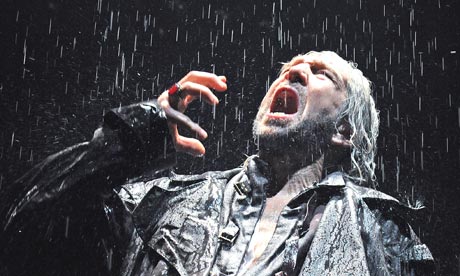 Although this play isn't overtly Christian, the characters do invoke the gods or the stars a lot, mostly to blame them for everything that's happening. This made me think about whether the misfortunes the characters face in Act III and IV, especially King Lear going mad and Gloucester getting his eyes gouged out, can be seen as some kind of divine justice or fate catching up with them for being bad fathers. In Gloucester's case especially, it does seem like fate is really playing with him, since he becomes literally blind after being so figuratively blind about his sons. King Lear going mad also has a feeling of divine justice about it, especially since the storm is what seems to be the last straw for him. He blames his daughters first and foremost for his madness, but his own guilt seems to play a part in it as well, as we see when he meets up with Cordelia again. Overall, the characters in this play face some pretty heavy consequences for their actions, some of them quite immediate, like Cornwall's death. Is this because of divine action or simply natural consequences?
Tuesday, October 6, 2015
Honesty Is the Best Policy

Saturday, October 3, 2015
The Eternal Nature of Art
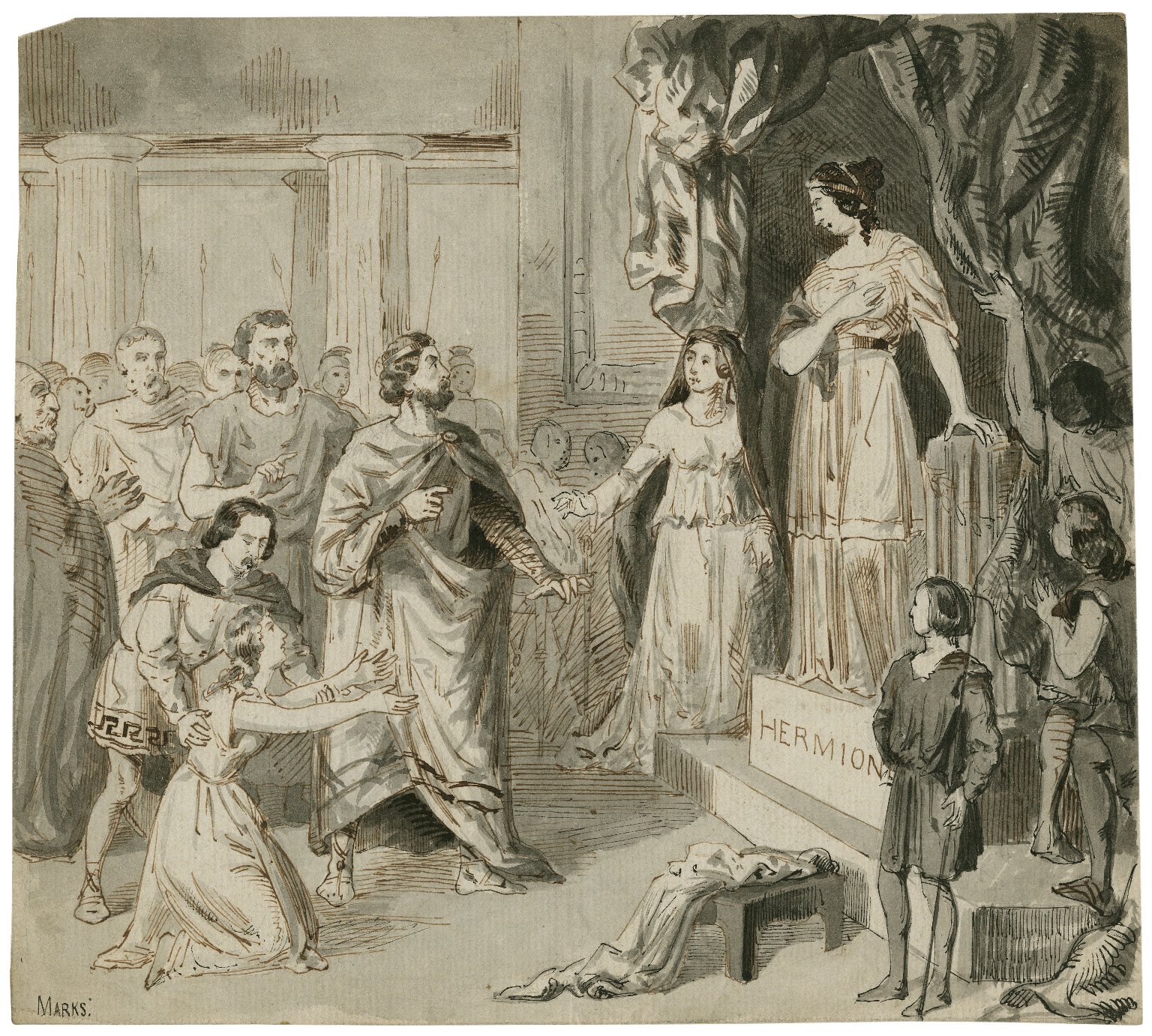 In Act V Scene II, the gentlemen speaking of the sculptor of the statue of Hermione say "had he himself eternity and could put breath into his work, would beguile Nature of her custom, so perfectly he is her ape". This high opinion of an artist, especially in light of Hermione's statue coming alive at the end of the play, reminded me of the ending of Shakespeare's Sonnet 18 when it says: "So long as men can breathe or eyes can see, So long lives this and this gives life to thee." In Hermione's case, this became quite literal since her statue (somehow) allowed her to come back to life. While the quality of the statue was not the only factor in her return to life, the incredible accuracy of the statue appears to allow Leontes to imagine that it really is his wife. This is a very bold statement about the power of art to immortalize its subject.
Tuesday, September 29, 2015
Honor in Royalty

Saturday, September 26, 2015
Two Mites II
For my revision, I changed up a few of the lines that felt awkward. I realized that the word Jerusalem is probably one of those words that just doesn't go in a sonnet, so I took it out completely. I also changed the last two lines to both fix the iambic pentameter and make them more clear. If there's any other problems (especially with the meter) please let me know!
Two Mites
An Imitation of Mark 12:41-44
A widow once in ancient Israel
Went forth with all she had to pay her tithe.
Though she was poor, she pleased the Master well,
Unlike the rich fit for the devil’s scythe,
Whose wealth they gave displayed for all to see.
Not one of these great men who never missed
A single coin of all they gave so free,
Would ever have the faith to be so blessed
As was this humble daughter of the Son
Who gave two coins with love sincere
For God, for Him, her Lord, the Holy One
Whose faultless life would pay our ransom dear.
Today we hold in hand two mites and more
To give us wealth or let our hearts be poor.
Tuesday, September 22, 2015
Two Mites
When reading through the different sonnets, my favorites were the religious ones. A couple of my favorites were "Jonah" and "If Any Lacking Wisdom" because of the way they portrayed familiar scriptures in different ways. I decided to try imitating one of my favorite scripture stories from the New Testament.
Two
Mites
An Imitation of Mark 12:41-44
A
widow once in ancient Israel
Went
forth with all she had to pay her tithe.
Though
poor she was, she pleased the Master well,
Unlike
the rich fit for the devil’s scythe,
Whose
wealth they gave displayed for all to see.
Jerusalem’s
great men who never missed
A
single coin they gave away so free,
Would
never have the faith to be so blessed
As
was this humble daughter of God’s Son
Who
gave two coins with love sincere
For
God, for Him, her Lord, the Holy One
Whose
faultless life would pay our ransom dear.
Today
we hold ourselves two mites and more
To
make us rich in wealth or in heart poor.
As you can probably tell, I really struggled to keep with both the rhyme and the rhythm while still trying to say what I wanted to say.
Saturday, September 19, 2015
Hermia the Fiesty Dwarf

I
watched the live version and then the Rice University production of Act IV
Scene II. I looked specifically at the physical interactions between the
characters in both versions. Some things were quite similar between the two but
there were a few obvious differences. The character that was the most different
was Hermia. In the Rice University production she was much more physically
forceful during this scene than the live version. In the beginning of Scene II
when Hermia accuses Demetrius of murdering Lysander, the Rice University
production had her actually physically threaten him by hitting, punching, and
twisting his ear. The live version had nothing like this. What really caught my
attention was the way both characters acted like this was normal, suggesting
that Hermia had done this to Demetrius before, which is certainly a contrast to
the weak females and strong males that are shown in the other version.
Later
on in the scene, Hermia’s physical reactions were fairly similar in both
versions. She jumped on Lysander, clung to his leg, and tried to attack Helena,
all in very similar ways. In the live version, however, as the scene goes on
Hermia becomes less physical and starts looking less angry and more like she’s
going to cry. In the Rice University version she remains angry and physically
threatening throughout the whole scene.
These
differences created a unique gender dynamic in the Rice University version.
Although Helena never gets very physical (at least in the scene I saw), Hermia’s
physical threats make her seem almost dominant over Lysander and Demetrius
despite her small size. Perhaps they did this to counteract some of the more
anti-feminist elements of the play. If so, they did a good job of at least showing
Hermia as a strong female (though a bit alarmingly abusive) through her physical
interactions with the other characters.
Tuesday, September 15, 2015
The Text is King
This in turn made me wonder why the original Shakespearean text is often viewed as somewhat sacred. In an article that I found via Google on the "dos and don'ts" of Shakespeare adaptations (see here) one of the "don'ts" was to avoid messing with the text. Obviously Shakespeare's use of language was groundbreaking and is still powerful for many modern audiences, but I don't see any harm in changing just a few words here and there to make the text fit a new setting better. It was a bit distracting at times when I was trying to focus on understanding the Shakespearean language, but overall it helped the text work much better in the modern setting.
Sunday, September 13, 2015
The Play Within the Play
 I thought it was very interesting that Shakespeare chose to end the play not with the weddings of the characters, but with a comically awful play within the play. While I was reading I thought that the play would end after Act IV when all the love stories were happily resolved, but instead it kept going into Act V. According to the article on A Midsummer Night's Dream in the Oxford Companion to Shakespeare, the Pyramus and Thisbe story was originally written by Ovid, although this version was significantly changed to more closely resemble Romeo and Juliet. So it appears that Shakespeare was purposefully poking fun at one of his own plays, or perhaps commenting on how plays should and should not be performed. It's also interesting to see the characters who have just had such funny and complicated problems with their own love lives react to a love story played out in front of them. The parallels between Pyramus and Thisbe's ridiculous exclamations of love and Lysander and Demetrius's passionate flattery of Helena makes the latter seem all the more comical and insincere.
Monday, September 7, 2015
A Kingly King

Something that struck me as I was watching the Hollow
Crown version of Richard II was the juxtaposition of Richard and Bolingbroke in
both the casting and in their costumes. The actor for Richard was smaller and
looked fairly young, which combined with his lightly colored and flowy costumes
gave him a somewhat feminine look. In contrast, Bolingbroke was tall, balding,
and always had on darker colored clothing that made him look ready to go into
battle. To me he looked much more like what a king is supposed to look like,
strong and commanding instead of simply ostentatious. The effect of the
juxtaposition for me was to suggest that Bolingbroke really would make a better
king. At the same time, it also made Richard seem more pitiful towards the end,
because he's portrayed as more young and ignorant than evil and powerful.
Subscribe to:
Posts (Atom)