Showing posts with label social proof. Show all posts

Wednesday, November 11, 2015

Socializing Preliminary Literary Research

I'm a big advocate of integrating a social component into the writing and research process -- in the context of literary studies and beyond. To this end, I require my students to do social discovery until they get social proof on their topics and claims. This occurs in the formative stages of their research and writing, allowing them to get useful feedback (and often, specific references and sources) to help them feel more committed to their topics and more prepared to back up their claims.

But my students do need some structure and prodding to make this work. I've posted about this elsewhere in laying out a socially optimized research strategy. This post is a refinement of that process, helping think through whom to contact, why, and when.

So, here is some structure for doing social discovery and obtaining social proof.

Step 1: Make a "Who Might Care?" Graph
  1. Put your semi-specific topic in a circle in the middle of a piece of paper
  2. Divide the paper into four quadrants, labeling each quadrant as follows: HOMIES, PEERS, ENTHUSIASTS, and EXPERTS. For more of an explanation of these types of people, see the top of this post or the image in this post.
  3. Brainstorm who could fit into these quadrants and why they might care


In seeking out peers and friends for feedback, I can obviously include people who will listen to me no matter what (thanks, homies!). But it's a good idea to target individuals among one's friends on the basis of their interests. So, think of the component topics or issues within your working main idea. In this case, I may want to seek out people who are interested in Shakespeare, interested in performance, or interested in virtual worlds, but not necessarily in all of these at once. (See my "homies" section in the image below to see how I've done that).


Skipping ahead to the fourth category of experts, I may also wish to segment various types of people to contact based on aspects of the topic I'm working on. So, I might consult a Shakespeare scholar, or a computer scientist -- even if the former doesn't care about computers and the latter only cares about virtual worlds.

Within the peers and enthusiasts areas, it is often helpful here to think in terms of various media within which these ideas are discussed. These are more likely to be social media than professional or scholarly sources, and the are more likely to be beyond your own personal interests or acquaintances and associated with various organizations, specific social networks, events, publications, and platforms.

For a list of possible points of entry to discover differing types of people by way of different media and categories, see the section on "Where can one do social discovery?" in this post.

Step 2: Make an Annotated Contact List
After doing the brainstorming above, you might want to type this up into an annotated contact list. To see examples of such lists, see the list near the top of this post on "Social Proof Successes by Students." 

Step 3: Make Contact
In general, the less developed one's idea, the more one will consult homies and possibly peers; the more developed one's ideas (and the more specific one's questions), the more one will seek out enthusiasts and experts. For different stages and for different audiences, a different approach is needed. For example, one can do a general query to one's homies as a simple question: "Is having students perform Shakespeare in a virtual world crazy?" To an expert, a more formal and detail approach would be more appropriate. See the examples case studies in contacting experts and of query letters in this post.

Friday, April 5, 2013

Bibliography: Updated and Annotated

OK, PEEPS! THE PROCRASTINATION IS OVER!


If looking at the above picture gives you a worse headache than looking at the rough draft of my paper, then I'm off to a good start. If not, I won't be surprised because it has a long way to go. 

In my attempt to expand my sources, this is what I have found:
 
Social Proof: Finally, Someone to talk to!
 
As some of you may have noticed, I have been having difficulty finding people to talk to about my topic. However, I did follow up on Dr. Burton's hint to post our "tweethis statements" on the internet, and I have been doing so on Facebook, and this caught the attention of my cousin Gloria. One of the small miracles that happened around my grandfather's funeral last weekend was being able to discuss this with her. Gloria's family has never been active in the LDS Church. Gloria attended a ministerial college and has studied religious history, and she told me when she was visiting me that she is currently an all-but-confirmed Anglican. That's what set my radar off, so I asked her a few questions about the Tudors and the start of the Church of England. From what I remember of our conversation off the top of my head, she said that when considering the Tudors it is important to separate the religious from the political. The pope had no reason to not grant Henry VIII a divorce other than the fact that the Holy Roman Emperor was leaning on him to say no, and Henry separating the English Church from Rome was a bluff. Henry needed a male heir more than anything else. If he had to have one legitimate heir, the other child had to become illegitimate. His divorce from Katherine of Aragon estranged him from his daughter Mary and estranged her from Elizabeth. Gloria says it is Mary we need to remember to be sorry for: had the divorce and its aftermath not been so traumatic, she might have been a more competent ruler. Henry made a lot of mistakes, and he realized this in later life, but although his wives Jane Seymour and Katherine Parr attempted reconciliation and Henry made room for Mary and Elizabeth in his will, the damage had already been done. Had he attempted to reconcile himself with his daughters--and reconcile them as well--things would have been better. *wants to cry*

Scholarly Articles: I found these two right when I got back from Arizona and read them during breaks at work (because my coworkers take notoriously long breaks).
    • Neill, Michael. “'In Everything Illegitimate:' Imagining the Bastard in Renaissance Drama.” The Yearbook of English Studies. 23: Early Shakespeare Special Number. 1993: 270-292. Web. 1 April 2013. In case you haven't inferred from the title, this paper is all about THE HORROR OF BASTARDS! ...Specifically in Renaissance Drama. Plenty of discussion about Edmund in King Lear.
     
    • Trace, Jacqueline. “Shakespeare's Bastard Faulconbridge: An Early Tudor Hero.” Shakespeare Studies. 13. 1980: 59-70. Web. 1 April 2013. The author of this article is mainly trying to discuss the possible historical figures relating to the Bastard in King John, but it does discuss the Bastard's motivations and loyalties. 

    Books: 

    • Pierce, Robert. Shakespeare's Histories: The Family and the State. Ohio State University Press, 1971. Print. Pierce talks about the family dynamics of the women in the history plays. A beneficial source on Richard III and King John as well as on ideas about the family in Elizabethan times.
    •  Loades, David. The Tudor Queens of England. London: Continuum, 2009. Print. A biography and analysis of the women who shaped pre-Tudor and Tudor England. This will be my reference for the specific historical discussion of the Tudors. I was going to use The Six Wives of Henry VIII by Alison Weir but it only focuses on the six wives and it is also to detailed. This other book is much more succinct. 

Tuesday, April 2, 2013

Chris Bateman Responded: 2!!

Hey everybody, so we might now be able to count my email to Chris Bateman as an actual conversation. I was intrigued by what he said, and so I responded:

Chris,

Thanks for the generous reply! This is great stuff and really helps me out.

I'm curious, at which end of the spectrum would you put Thatgamecompany's Journey? Does it represent a kind of a middle-market success?

Also, how well do you think Shakespeare's plays themselves might lend to video game adaptations? I'm specifically thinking of The Tempest with its magic and fantasy elements, as well as its treatment of the theme of vision v. reality. Could the medium benefit from adapting Shakespeare?

Thanks again for your time,
Paul Bills

And then he responded (again!):

Paul:

Journey was funded as a loss-leader by Sony in the manner I described for Shadow of the Colossus. Unlike that title, however, Journey made its development costs back.

The Tempest would make an interesting exploration-adventure game, but I think you could also adapt King Lear, Richard III, Much Ado About Nothing, Romeo and Juliet and possibly even Hamlet (although this one is trickier!) into a game-like format. Most of the histories and all the comedies of errors are open to adaptation in my estimation - and many would produce very interesting experiences! Note that I don't think existing game genre formats would work for these game adaptations - you'd need to be creative in designing new approaches.

The medium of videogames could definitely benefit from adapting Shakespeare, or indeed other classic writers - I have always wanted to adapt Jane Austen's Pride and Prejudice into a game, for instance.

All the best,

Chris. 

I know, I know--I have no idea how you would make a game out of Pride and Prejudice either--but hey, the guy is British. I believe it could be done. Any ideas how?

So maybe it helps to be an extrovert

Recent progress in terms of social proof:
I found an article online by BYU professor Bruce Young about teaching the unrealities within The Winter's Tale. I sent him an e-mail with some specific questions about my research paper, and this morning he sent me back a beautifully helpful e-mail. He answered my questions directly, and also kind of just went on a rant about time in The Winter's Tale. I think the rant was just because he felt like it, but almost all of it fit in with other already-written paragraphs within my paper, which is fantastic because now I can go through and add a quote or two from him to beef up my paper. He also sent me some links to resources he thought would be helpful which I'm planning to read through once I finish this post :)

I've been thinking recently about how time can be a liberation to audience members watching The Winter's Tale. The irregular use of time definitely adds an element of mysticism to the play, and I believe that that element of mysticism makes it easier as an audience member to be enveloped by the foreign world on the stage and forget about our individualized everyday realities. I sent an e-mail to my theater history professor asking some questions about theater and escapism and hopefully he'll get back to me soon!

Dan: Oh Dan. He works on the fifth floor in the library, and honestly he's been my sounding board through this entire process and he still is (if you're having issues organizing your thoughts I suggest going to see if you can find a guy wearing a nametag that says "dan" at the help desk on the fifth floor. He's the best). Recently though he's been working on some research papers too so its been fun to be able to return the favor and be a sounding board for him as well. In terms of helping people within class, I've mostly just been trying to read other's posts on the blog, and I have a tendency to stumble upon information pertinent to her when I'm doing my research, so when that happens I try to pass it along to her.

Monday, April 1, 2013

Chris Bateman Responded!

Of the three emails I sent out to scholars in the field of video games, the first to get a response went to Chris Bateman, writer of Beyond Game Design. For posterity's sake, here's his response in full:

Hi Paul,

The email you used is the correct one for 'first contact', but please use this email address for any future correspondence.

My basic point is that we need a "Shakespeare of Games." Shakespeare was himself as much an innovator as a storyteller, mostly taking old stories and adapting them to the new medium of English theater. He took this medium from simple popular entertainment to a true art form. Sometime, I argue, someone could/will do the same for video games and change the world of art and expression all over again.

I agree with this claim, and have made similar suggestions myself. In fact, there is a definite gap in contemporary video games for exploring the concept of adaptation. It's notable in Shakespeare's career that he did not create stories, he only adapted them for the stage - and in the process perfected them for that medium.
 
My question for you, then, is simple: What do you think it would take to create such a "Shakespeare of Games"? Is it possible for just one person, or will it have to be a whole team? Or has it already happened, in your opinion? If so, who?

The problem is not the person, it's the economics. At the moment, videogames have a number of viable commercial niches but none of them lend themselves to a Shakespearean moment. In the upper market, budgets are too high and development too constrained by marketing concerns. Experimentation is essentially impossible in this space.

There are those artistically motivated projects that are funded by a corporation, such as Sony, for brand benefits - Shadow of the Colossus or Heavy Rain for instance - but I don't see this space as likely to give rise to a Shakespearean moment, for slightly different reasons. Innovators in this space are too focused on the form, for a start, and far too likely to want to express their own ideas. This is a possible space it could happen, but not a likely one.

There is currently no middle market for games, which is a problem because this is the space a Shakespeare of games would be most likely to happen. We might get it back, but it's not likely at the moment.

The social games market dominates the lower market with cheap, disposable, addictive games, and other games for smartphones and tablets are largely similar economically. This is not a space likely to give rise to a Shakespeare of games.

Finally, the indie developers are too caught up in their own imaginations - obsessed with fantasy and science fiction, addictive game mechanics etc. - and this space is dominated by the programmers for pragmatic reasons. I doubt any programmer has the mindset to be a Shakespeare of games - although I would love to be proven wrong.

So the economics of game development are currently toxic to the kind of narrative innovation Shakespeare is justifiably famous for developing. The best bet for something like this to happen would be a community-driven development network which pooled resources, providing a wide range of assets that could be shared to create worlds. I tried to set this up myself a while back, but no-one understood why it would be useful and it fell flat. Trying to get game developers to co-operate on anything is a trial; trying to get them to form mutual communities is like pulling teeth, although this is not to say that devs aren't friendly, nor that they don't help each other out.

What would really help this would be an end to the obsession with rising technical specifications and what they can do for games - which is to say, an end to the current economics of home consoles. There is already an instability in this space, so perhaps the situation will improve, but I think not rapidly.
 
Also--do you see games ever being studied as part of the "liberal arts" with a "canon" and "conventional interpretations" and other such academic dressings, or will games remain part of "cultural studies" more for sociologists/psychologists? Or are they something entirely new?

No, I don't believe games are something entirely new - they build upon long traditions in both games (which have at least an 8,000 year history, if you don't count non-human games) and stories (which are even older). These ideas are explored in my book of philosophy "Imaginary Games", which suggests that all art forms are a kind of game, although it is really just a part of that book's topic.

I would say that games are already being studied in the liberal arts - narratologists, for instance, have already written quite a lot about narrative in digital games. There are already conventions and canonical trends within the space, so it is only a matter of time before the humanities side of game studies gets picked up and explored more directly. To get there, however, games have to continue to break with their commercial forms. Artistic developers like Tale of Tales are vital to this process, and I continue to support all artistically-motivated games to the hilt in the hope that we can begin to explore the untapped potential of this medium.

All the best,

Chris.

So, the social scholarship actually works! People really are willing to talk if you engage them in a good conversation. This is awesome!

Saturday, March 30, 2013

Whoops! It's a little late!


Social Proof
Over the last week, I’ve made some headway on my paper, and a significant number of people in the class have commented on the posts and have really helped and encouraged me. I know that this may not necessarily seem like a thorough or more advanced social proof exercise, but it has really helped me as I’ve gone through the process of writing.

Assistance to Others
Hopefully, I’ve been able to help Lizy (at least a little bit). I tried to find a scholarly article that will help her with her paper, and I’ve reviewed portions of her draft that she’s posted to the blog. So far she has been pretty great! She is really working through her draft and is already beyond the expectations of a typical draft. I’m thoroughly impressed. 

Thursday, March 28, 2013

In the vein of...

Kara's post, I just wanted to say thank you to your quick and positive responses on my latest post about the development of my thesis. I sincerely appreciate it and it makes me want to get down to just writing out this paper!

So Happy Together: Social Scholarship

Chris Bateman's Beyond Game Design 

So I have more to report about effort on this subject this week than results, but I still think what I did was important. I emailed three people directly who I think would have great insights on my project: Jane McGonigal, Clint Hocking, and Chris Bateman. McGonigal is a very famous game designer and game activist (she kind of made that a thing all by herself) who believes games can change the world. Hocking is an influential game designer and thinker. Bateman is a philosopher, game designer, and author of Beyond Game Design: Nine Steps Toward Creating Better Video Games. I emailed all three of them slight variations on the following:


My name is Paul Bills and I'm an undergrad English Major at Brigham Young University. I'm currently doing a research project on Shakespeare and video games and I've found your book Beyond Game Design helpful and very insightful.

My basic point is that we need a "Shakespeare of Games." Shakespeare was himself as much an innovator as a storyteller, mostly taking old stories and adapting them to the new medium of English theater. He took this medium from simple popular entertainment to a true art form. Sometime, I argue, someone could/will do the same for video games and change the world of art and expression all over again.

My question for you, then, is simple: What do you think it would take to create such a "Shakespeare of Games"? Is it possible for just one person, or will it have to be a whole team? Or has it already happened, in your opinion? If so, who?

Also--do you see games ever being studied as part of the "liberal arts" with a "canon" and "conventional interpretations" and other such academic dressings, or will games remain part of "cultural studies" more for sociologists/psychologists? Or are they something entirely new?

Any insight you have would be great.

Thanks,
Paul Bills

I chose this messaging because I'm hoping to add any comments I get back from them to the conclusion of my paper--my "so what?" point about calling people to action to take game design to the next level and strive to seek/become the "Shakespeare of games." I haven't received any response yet, but the other reason I chose these three is because they all were very open to being contacted on their websites and all encouraged opening conversations with them. I also was sure to specifically reference the work of theirs that I had read and appreciated to show that I knew what I was talking about (you can see I mentioned Bateman's book in the example above).

Also, Mikaela's post about possible publishing venues got me really excited because the Shakespeare festival is specifically looking for papers on The Tempest this year (already bought my tickets to go see it August 15th!). David has also been a huge help. Dr. Burton, he, and I just sat and talked about my paper for a straight hour on Wednesday. David also offered to have me come over and play some of his favorite games to help me out, an offer I'm pretty sure I'm going to take him up on sometime soon.

As far as helping other people, I think it was last Friday that I talked with Kaylee about her thesis in class and brought up a panel I had attended during the English Symposium that talked about heroes and villains and we talked a lot about the lack of strict heroes or villains in Shakespeare, and whether or not Henry V was an exception. It was a great discussion and Kaylee's since integrated it into her work.

Also, since Britton's topic is so close to mine, talks with him have been very helpful and I feel like I've helped him in return. I brought up the theme of free will v. fate in Julius Caesar and how that would be low-hanging fruit for a game theme because games give players the illusion of free will when really the player is fated to one destiny no matter what they do because the designers (or narrative games, anyway) have to bring the story to a conclusion.

Wednesday, March 27, 2013

I Want to be on the One that Leads to Awesome!

As far as social proofing, I will admit it has fallen off a little because I have started writing my paper and focusing on advancing the ideas I already have developed, but I have talked a little more with my English teacher from senior year and I am always bouncing ideas off my roommates.  My roommate Paige is a psychology major and she has just spent a good portion of one of her classes studying Jung and so she has been a trove of knowledge, secondary sources, and scholarly analysis.  Which has been awesome!


As far as assisting others goes, I was partnered with Steve last week and although I am not sure how much help I was able to offer him, he really helped me ground my argument and get it going.  Steve is working on the nature vs. nurture aspect of pride in Coriolanus and his own investment has helped me as much as it has him.  Sometimes we all need a little motivation right?

So here is a little motivation for you!

Tuesday, March 26, 2013

It actually works!!

bloodbludger4

Oh my gosh! Oh my gosh! Oh my gosh! I am freaking out right now because one of the scholars mentioned in my annotated bibliography commented on my post! Dr. Burton kept talking and talking about how people get really interested in what we are doing, and I just kind of brushed it off like “Yeah, right. People really care what I’m writing about in my Shakespeare class,” but they do! They really do! AND I NEVER thought that I would be this excited about it. I don’t know if I’ll actually end up using the article, but who cares!? I can still get some feedback about how applicable she thinks lying is in terms of literary characters! I am ridiculously excited about this!

Monday, March 25, 2013

I Was Brave Today: Expanding my Social Scholarship

Today's blog post won't be very long. I finally got up the nerve to contact two scholars on disability studies or blindness in literature, and I'm hoping that these efforts work out well. I feel like I was too nervous to do a good job introducing myself and my topic, but here are the two people I emailed. I hope they write back so I can reassure them that I'm not as silly as I may have sounded the first time around.

I wish I had thought ahead and used a fountain pen.
 But I was stuck with email.
Photo credit TMAB2003

Hannah Thompson of Blind Spot

Dr. Thompson studies post-Revolution French literature and has been keeping this blog on cultural manifestations of blindness for about a year. I emailed her this morning specifically about how she, as a legally blind woman, interprets literature that she loves in spite of the way blindness is portrayed in it. I'm really hoping to hear back from her, but I'm nervous.
I found her site through Ice Rocket, which is a way cooler tool than I thought it would be.

Julia Miele Rodas

Dr. Rodas doesn't necessarily specialize in blindness, but she does list disability studies as one of her main research interests. I mostly contacted her because she's teaching a class right now about disability in literature. I asked her if maybe she could put me in touch with some of her students who might be studying blindness, so I'm hoping that works out! It would be fun to talk with people at the same stage of research as me.
Syllabus for her class.

So, sorry this was short, but I spent most of my research this morning just mustering the courage to send those emails.

Wednesday, March 20, 2013

for Mikaela, the Great

Mikaela, thank you so much for the work you did in researching my thesis!  I really appreciate it.  I love that you are using music as part of the nature of time; it's a really cool spin on the idea of time and totally relevant to your thesis.

Random Ideas and Implications of your thesis:

  • In some of Shakespeare's plays, the lower-class speak in prose while the upper-class speak in verse. How could that idea of speaking in verse be constraining or liberating when you think about a famous speech of Hamlet's that is delivered in prose instead of the usual verse?
  • Liz made an awesome comment on one of my blog posts about Hermione's sixteen year disappearance in The Winter's Tale: "One of the things I remember discussing when we read this play in class was that Hermione needed the 16 years to forgive Leontes. . . .[Paulina] also knew that Leontes still loved Hermione, that Hermione still felt the same about him, and she knew they would be much better off if given time to forgive and forget.  I think the real miracle of the story is that they are able to come back together in love, as a family." In this case, time is totally a liberating thing.
Potential Literary Criticism Sources:
There is this book called "Forms of Time and of the Chronotope in the Novel," by Mikhail Bakhtin, which was mentioned in an article on e-book called "Spatial Representations and the Jacobean Stage: From Shakespeare to Webster, by Russell West.  I didn't see much in the e-book on time, but the first book sounds promising.  Unfortunately, it looks like to get it you'll need to request it through interlibrary loan (5-7 business days) but it might be worth it to strengthen the literary criticism research in your essay. 

Thoughts on your thesis:

I like the idea that time can be liberating, as I think time is often portrayed, especially as you mentioned in Shakespeare's sonnets as the enemy, allowing old age and death.  You might have to get a little more specific within your thesis, but I think that'll happen easily as we find more literary criticism for your topic.  

What do you think the "so what?" of your thesis is?  What are the implications that time has this dual nature? I think that will add another important element to your thesis.  


Saturday, March 16, 2013

annography bibliotated. yep.


Working Thesis Statement: How to Teach A Midsummer Night’s Dream to Teenagers

Social Graph
  • My mom: She graduated from BYU in English and she was my homeschool teacher for several years – she is always my first person to bounce ideas off, and she gives great feedback, and she is a good editor.

  • My Aunt Suzanne: She was my high school AP English teacher – also a great resource for teaching methods
  • My Uncle Jack: Was an editor at Deseret Book for like a hundred years. He knows tons about literature and writing.
  • My roommates. J


New Media

Social Networks


Traditional Sources

Hooray for Martin!: The Results of the Tweethis

Martin, who was the person on goodreads I e-mailed about my thesis statement, messaged me back today!  He gave some really great advice and mentioned the connection between Greek myths and The Winter's Tale, which I think would be another interesting element to add to my thesis.  Maybe these myths add to the realism of the play in some way, like the archetypal characters.  

Martin also made a connection to the Bible, which I think is a more approachable and diplomatic way to say supernatural elements, like spiritual things, are true to life.  He directed me to some conversations on goodreads and said he was interested in my topic!  I'm going to write him back to say thank you, but it feels so cool to have someone, possibly in England, who I don't know, but is now sort of invested in my topic and my paper.   

Monday, March 11, 2013

Brave New Worlds: Finding Forums for My Topic

After extensive search on the subject, I found two forums discussing specifically Shakespeare as a video game designer, one on Kotaku, and one on The Escapist.

The funny thing was how opposite the opinions were. Kotaku had some naysayers, but it seemed that several of them thought Shakespeare would actually work out as a game designer. On The Escapist, however, it was almost a unanimous "NO."

The Kotaku forum is now closed, but I linked to my "The Tempest: The Video Game" post on The Escapist and told them a little of what I thought. Hopefully I'll persuade somebody.

Looking forward, I want to find more forums about video games as art, and possibly even the connection of art and theatre, as that seems to be where the most people think the real meat of my topic is.

Sunday, March 10, 2013

"Thy friendship makes [my topic] fresh": Initial Social Successes

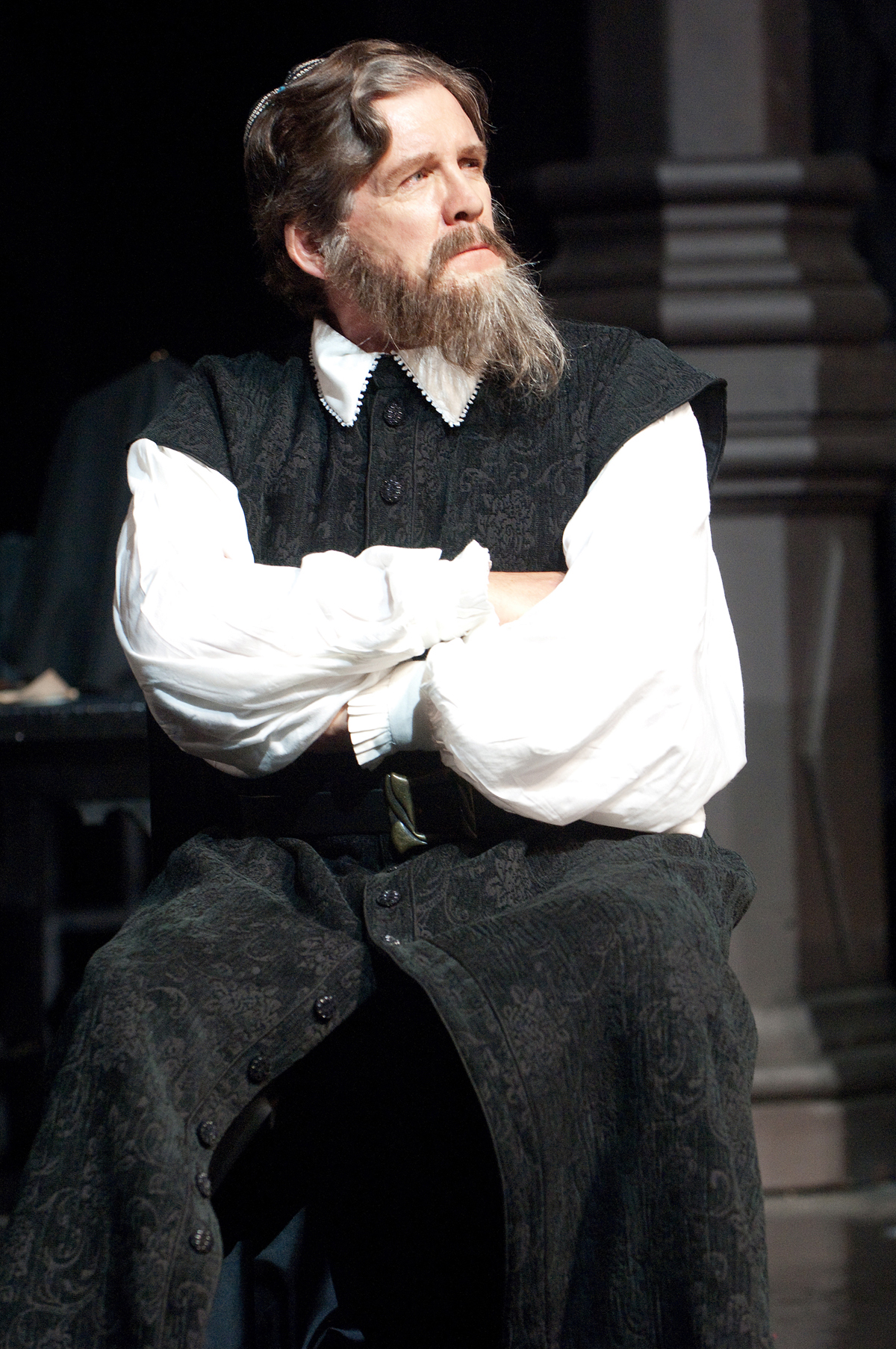
Anthony Heald, himself a Jewish convert,
playing Shylock the Jew.
Posted on Shakespeare Is.
(Title taken from 1 Henry VI, 3.3.87)

"Shylock the Jew (from Shakespeare's 'The Merchant of Venice') is, like Harriet Beecher Stowe's Uncle Tom, often viewed as a two-dimensional racist stereotype. Shylock himself, however, is a much more complex character, allowing for some freedom of interpretation: is he truly a 'dog jew,' or is he 'like [us] in the rest?' (2.8.14, 3.1.67) Understanding how Shylock has been interpreted throughout history and across different cultures gives us a window into ideas about race and racism have changed through the centuries."

I posted the above as my "tweethis" in a couple different places. I, of course, posted this on Facebook, as well as the forums for a club I belong to (expanding my circle of friends). I only posted it a few hours ago, so I haven't gotten a tremendous amount of feedback yet. What I have gotten, though, has been very valuable.

Saturday, March 9, 2013

Help through Facebook

When I first started thinking about King Lear in terms of blind studies, I started out talking with my two best sounding boards: my husband and my mother.

When I talked with my mom about blindness in King Lear and the criticism about it (see my previous post for more details), we talked for a little bit about the modern conveniences that can help the blind. And then my mom mentioned something that I should have remembered anyway.


My mom set me up with her friend in Australia, a rehabilitation therapist, to see if I could talk to people who have lived with blindness and could provide some insight. Soon after, this family friend, Genie, sent me a message:

So, after Genie set me up with her friends who could help me out, I sent a group message to them and, after introducing myself, asked the following two questions:

So, in summary, I have far more social connections than I thought I did that could add relevance to my project! I will post about the kind of answers I get from this Facebook interaction, but this social element has really made me more invested in my project. I've received email encouraging me to pursue this topic, too, so I am motivated to finish this paper. As far as research papers go, that's something new for me.

And, as I'm reaching out through people I know personally, I'm also starting to work on a research wiki. It's certainly in its beginning stages right now, but if you can think of things to add to the FAQ, I would really appreciate it.

My next post will be going back to King Lear and doing my own close reading of the scenes surrounding Gloucester's blindness. Stay tuned for that.

Friday, March 8, 2013

Facebook Freakouts

This might be a little early on to post this, but I already threw up one possible thesis on Facebook to see how people would respond and I was super surprised at the result.

Here's what I posted:


Within 24 hours, the post had generated 26 comments (several by me replying to others) by 6 different people and likes from 5 more people. They ranged from this:


To this:


And this:


And even this:


(Notice this one got 5 likes.)

So, while I'm not quite sure I got much useful feedback to help guide my paper, I did get to articulate my ideas better as I responded to all of these people, and I found out at the very list this topic gets people talking about Shakespeare even if they normally wouldn't bring him into everyday conversation.

If nothing else, it keeps me thinking about my topic. This is fun!

Do You Believe in Magic?

magic from Creative Commons: OUCHcharley
I'm wondering:
  • Do the romantic elements of The Winter's Tale in fact make it more applicable to life than a tragedy?
  • How does the supernatural element of a romance make it more true-to-life?  
  • What role does fate play in a romance?

Wow, let me tell you, Wow.

oh dang I typed this up and thought I'd posted it hours ago. Lame. Sorry!

Reading through Dr. Burton's posts and articles about social proof are helping me come to terms with the validity of social networking for professional and academic purposes. I think my "social graph" would consist of Google Plus and Facebook, plus my roommate circle and family members who are, fortunately, mostly English majors (sweet!). They give me good feedback and I am becoming more and more dependent on them.

I proposed these three paper topic ideas on Facebook and Google+ and talked to my roommate about them, and thanks to comments from my family, old high school teachers, friends and an almost ex boyfriend, I've been able to narrow down my ideas. Before I tell you the direction in which I am narrowing, though, what do YOU think?


Ideas for my Shakespeare paper: 
Most effective ways to teach A Midsummer Night's Dream to a high school class. 
OR Why A Midsummer Night's Dream is a better choice for a high school class than Romeo and Juliet. 
OR Why teach Shakespeare to teenagers: Five life lessons to be learned through A Midsummer Night's Dream.