Showing posts with label facebook. Show all posts

Friday, March 8, 2013

Wow, let me tell you, Wow.

oh dang I typed this up and thought I'd posted it hours ago. Lame. Sorry!

Reading through Dr. Burton's posts and articles about social proof are helping me come to terms with the validity of social networking for professional and academic purposes. I think my "social graph" would consist of Google Plus and Facebook, plus my roommate circle and family members who are, fortunately, mostly English majors (sweet!). They give me good feedback and I am becoming more and more dependent on them.

I proposed these three paper topic ideas on Facebook and Google+ and talked to my roommate about them, and thanks to comments from my family, old high school teachers, friends and an almost ex boyfriend, I've been able to narrow down my ideas. Before I tell you the direction in which I am narrowing, though, what do YOU think?


Ideas for my Shakespeare paper: 
Most effective ways to teach A Midsummer Night's Dream to a high school class. 
OR Why A Midsummer Night's Dream is a better choice for a high school class than Romeo and Juliet. 
OR Why teach Shakespeare to teenagers: Five life lessons to be learned through A Midsummer Night's Dream.

Sunday, March 3, 2013

Oh, is that why they invented Facebook?

While browsing the various "process" articles, I found one post that was particularly encouraging.

An earlier post I'd read filled my initial idea full of holes, revealing that tons of stuff had been said about my particular topic already. With that kind of background  I didn't think that there was much I could say to contribute to the discussion.

But then I found this post. In it, Janelle talks about how she was able to use social media as a way to refine her ideas, and how she was able to turn her somewhat nebulous idea into a firm thesis, largely on account of Facebook. To me, this was very encouraging; now I think that I might be able to talk about a few directions I want to go in, then see what people think would be compelling.


Tuesday, November 6, 2012

Social Proof

I was very surprised at the amount of feedback I received when I posted my ideas. My Facebook post about my thesis received a like and three comments, which was fun. I was also pleased to see that the people who responded to my post were engaging with each other. My cousin and my friend were validating each others' ideas through likes and comments, which was fun to see. Also, thanks to Jessica from our class. :)


What I was really excited about though, was the response I received from my old English teacher from high school. I was a little worried that I wasn't going to get a response, but I have been able to share ideas with her. One thing she said changed my research question a bit. She was writing to me about how Shakespeare is one the best psychologists. When she said that I thought that psychology was interesting and so I changed my research topic to focus a little more on how Shakespeare's works can apply to adolescent psychology. This is an angle that I was not planning on taking, and it is moving into a realm that I am unfamiliar with, but I'm excited. Any tips would be appreciated!

I messaged my teacher back to see if I could post our conversation on the blog, I will keep you all updated. Meanwhile though, I have enclosed a funny conversation I stumbled upon that illustrates the importance of teaching Shakespeare. We need to have a basic knowledge of Shakespeare if only so we can understand pop culture. My favorite though, is the comment that talks about the importance of "Shakespear." Oh no...


Shakespearian Marriage Politics

Well, I didn't get as many responses to my Facebook or blog/forum posts as I had hoped, but I did get some helpful ideas from my former-English-professor grandfather in response to my Facebook message that helped me better hone my search. Imagine that! I didn't expect him to be one who communicates through Facebook, so that was fun.

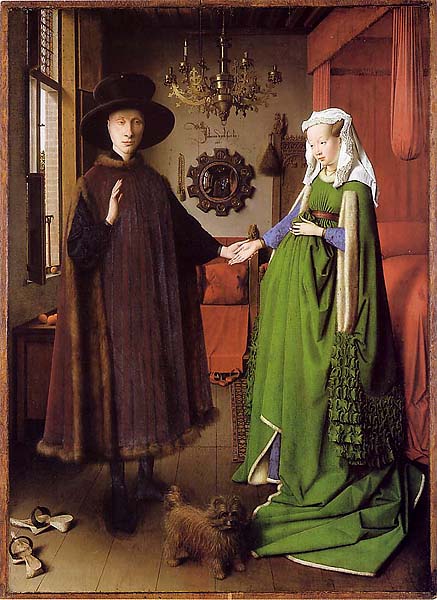
In the course of my research, I found an article which references a painting by Jon van Eyck which reflects the tradition of "common consent" marriage practices I'm discussing in my analysis. Although I'm not currently planning on using the picture in my paper, I thought it would be interesting to include it here for reference. And maybe it will even be useful for one of you...?

(Interesting note: although only the couple is present, the mirror reflects four people, perhaps representing God and the painter--or observer of the painting--as witnesses of their marital vows.)

Now, normally I wouldn't be any more willing to let people read my draft at this point than I would be to let them rifle through my sock-and-underwear drawer, but... here are the first few pages of my draft in all its odious roughness:

Monday, November 5, 2012

Making Shakespeare Appealing

This is the working draft of my paper. As I continue to work, I am hoping to bring in more textual analysis and also some psychological studies about the research that is being done on the psychological and social needs of adolescents. I know it isn't perfect, but it provides a decent framework of where I want to go as I continue to research and write.

---


Mallory Brugger
Dr. Burton
English 382
5 November 2012
Making Shakespeare Applicable
            Shakespeare’s Othello contains many lessons that are applicable and important for secondary students to understand. Lessons like trust, honesty, and communication are important at every stage of life, and especially important during the formative years of middle and high school. As well as being valuable and instructional to students, educators would do well in becoming comfortable with these themes and the emotional needs that their students have.
            Teaching Shakespeare in schools is important for many reasons. One reason is because Shakespeare is so prevalent in pop culture. I was on Facebook the other day and witnessed the following conversation: “Dad: ‘To be or not to be; that is the question.’ Zach (little brother): ‘Wasn’t that Yoda who said that?’” This conversation alerted me to a disconnect that exists between these “mysterious words” and their source. At least the younger brother was aware that there was some significance to the words. That’s a start. And if the disconnect wasn’t bad enough, the first comment is, “oh sad day… need to set that kid down with some Shakespear!” “Shakespear” without an “e.” It seems like the woman who commented also could have used some Shakespeare knowledge under her belt.