(With many prayers and creative attempts, I finally figured out how to upload a video onto YouTube!)
Showing posts with label posted by Brinn. Show all posts
Showing posts with label posted by Brinn. Show all posts
Monday, December 17, 2012
Brinn's video preview of Measure for Measure
Here's a brief video introducing the focus of my research analysis for Measure for Measure:
(With many prayers and creative attempts, I finally figured out how to upload a video onto YouTube!)
(With many prayers and creative attempts, I finally figured out how to upload a video onto YouTube!)

Friday, December 14, 2012
The Story of My Research Paper: Brinn
Well, when I first read Measure for Measure, I was a little confused by some of the rationalizations/conflicts between justice and mercy, and how quick some of the most pious characters were to excuse sexual liberality in others. Even Isabella, a main character who wants to become a nun, is seduced by a man to free her brother and decides to another woman (this man's former fiancee) out for herself in the nighttime rendezvous. This "bed trick" is suggested to her by a man who is supposedly a friar, and both of them seem to think it's perfectly morally fine. I was so confused by this that I decided I didn't like the play at all and wished I had chosen a different one. But as I began my research online and in the reference section of the library (great resource!), I discovered a couple of articles that explained some of the different Medieval and Renaissance marriage practices and perceptions that were very different from modern views on what constitutes a 'valid' legal marriage. I posted a couple of my ideas/questions for my "tweethis" on Facebook, and joined Goodreads so that I could post there too. I initially posted my tweethis on Goodreads, but didn't get much response, so later I went back and posted again, this time with a more general question about information on Measure for Measure and Elizabethan marriage customs. In response to this post, a man from the UK suggested a history book that luckily happened to be available in the BYU library, so I was able to turn there as a research guidepost as well. Also, my grandfather replied to my Facebook message with some helpful suggestions about historical movements to research, which led me to learn more about the influence of the Puritans in government during the Elizabethan era and really helped me make sense of the play and direct my paper. The feedback from classmates on the blog and in class during the writing process was very helpful as well.
In choosing an audience, I think I was most interested in communicating my research to anyone (probably mostly other students like me) who reads Measure for Measure and would like some contextual information to better understand and appreciate the play. Without understanding the context, Measure for Measure is easy to misinterpret from a modern perspective, so my goal with the paper was to provide clear information that would help guide another student through the process of contextualizing the play. I know that once the context became clear for me, I really began to enjoy the play!
Thursday, December 13, 2012
Learning Outcomes--Brinn
Gain Shakespeare Literacy
I really enjoyed the range of sonnets and plays we read, discussed, and watched this semester. I feel more confident with my understanding of Shakespearian texts and contexts through the research I did on my own, as well as what I learned by reading about others' discoveries on the blog/Digital Dialogue. I feel I can discuss texts such as Hamlet, Henry V, King Lear, Much Ado About Nothing, Measure for Measure, and others with both people who are already familiar with these works as well as those who are not. I had a great time at the Grassroots performance of Comedy of Errors, and it made me want to attend more of their performances and invite others who may be skeptical about Shakespeare, since this is guaranteed to be a fun, positive experience. I'm glad we were encouraged to do self-directed learning as we studied the plays, as I was more proactive in studying the historical context of Henry V and possible sources of King Lear, and it really prepared me to delve into my research for Measure for Measure, both online and in the library reference section.
I really enjoyed the range of sonnets and plays we read, discussed, and watched this semester. I feel more confident with my understanding of Shakespearian texts and contexts through the research I did on my own, as well as what I learned by reading about others' discoveries on the blog/Digital Dialogue. I feel I can discuss texts such as Hamlet, Henry V, King Lear, Much Ado About Nothing, Measure for Measure, and others with both people who are already familiar with these works as well as those who are not. I had a great time at the Grassroots performance of Comedy of Errors, and it made me want to attend more of their performances and invite others who may be skeptical about Shakespeare, since this is guaranteed to be a fun, positive experience. I'm glad we were encouraged to do self-directed learning as we studied the plays, as I was more proactive in studying the historical context of Henry V and possible sources of King Lear, and it really prepared me to delve into my research for Measure for Measure, both online and in the library reference section.
Tuesday, December 4, 2012
Laurence Olivier's "As You Like It"
Olivier's production of As You Like It was well done and fun to watch, although the film quality is grainy, since the film was released in 1936. This play deals with elements of cross-dressing, gender roles, and romantic trickery, and was interesting to see how these themes were portrayed in the 1930's in comparison to what would be acceptable today. For example, the scenes where Rosalind is pretending to be a boy named "Ganymede" (who is Zeus' gay cup-bearer in Greek mythology, although that's not explained in the play) and convinces Orlando to "practice" wooing her (him?) in Rosalind's name (since Orlando doesn't know she's really Rosalind herself, not Ganymede) are shown as being relatively innocent, although highly flirtatious to the point that a modern audience would wonder why Orlando doesn't seem to react much to Ganymede's intense "practices". I think the actors would have to perform this scene with more political sensitivity, as well as humor, today in order for it to be successful. I saw a Grassroots Theater production of this play, and they definitely played up the modern humor that these scenes invite. They also portrayed women with a much more modern angle, rather than the soft, helpless, "angelic" women of the 1930's version.
Wednesday, November 21, 2012
Marriage Politics in Measure for Measure--Final Paper
I think my top publication option would be through BYU's Criterion, but another viable option would be the University of Washington's undergraduate journal Intersections.
Tuesday, November 13, 2012
Elizabethan Marriage Politics
Well, my renewed efforts to get some feedback from the Shakespeare forum on Goodreads were successful! I re-phrased my question to get more general help on the topic of marriage during the Renaissance, particularly in reference to Measure for Measure, and a wonderful gentleman in the UK recommended a chapter of a book on British history that I was able to find in the BYU library. Pretty cool.
My Grandfather's online feedback on what kinds of things to look for when exploring/developing my topic helped direct my general search for specific contextual information regarding marriage customs/conflicts during Shakespeare's time.
I've also been talking with roommates about the topic, and trying to explain my paper, just like with the video exercise, has helped me clarify my argument and my understanding of how I want to develop it.
I found the majority of my most helpful sources on JSTOR and in the Shakespeare reference section of the HBLL (5th floor), as well as Tudor history books in the reference section on the 1st floor.
My Grandfather's online feedback on what kinds of things to look for when exploring/developing my topic helped direct my general search for specific contextual information regarding marriage customs/conflicts during Shakespeare's time.
I've also been talking with roommates about the topic, and trying to explain my paper, just like with the video exercise, has helped me clarify my argument and my understanding of how I want to develop it.
I found the majority of my most helpful sources on JSTOR and in the Shakespeare reference section of the HBLL (5th floor), as well as Tudor history books in the reference section on the 1st floor.
Thursday, November 8, 2012
Video, Process, and Bibliography
Here's my video preview:
(I spent over two frustrating hours trying to get this to work, so I hope it came through okay this time... if not, I'm sorry.)
Social Networks/New Media:
(I spent over two frustrating hours trying to get this to work, so I hope it came through okay this time... if not, I'm sorry.)
Social Networks/New Media:
Thanks to the comments on my 1st draft, I was tipped off to find a link to some scholarly essays about "Measure for Measure," which is great, since I've struggled to find sites related to this specific play. This site has other plays as well, and gives access to digital versions of first folios, prompt books, illustrations, etc., so it could be useful for others, too: http://college.holycross.edu/projects/isp/measure/mainmenu.html
Tuesday, November 6, 2012
Shakespearian Marriage Politics
Well, I didn't get as many responses to my Facebook or blog/forum posts as I had hoped, but I did get some helpful ideas from my former-English-professor grandfather in response to my Facebook message that helped me better hone my search. Imagine that! I didn't expect him to be one who communicates through Facebook, so that was fun.
In the course of my research, I found an article which references a painting by Jon van Eyck which reflects the tradition of "common consent" marriage practices I'm discussing in my analysis. Although I'm not currently planning on using the picture in my paper, I thought it would be interesting to include it here for reference. And maybe it will even be useful for one of you...?

(Interesting note: although only the couple is present, the mirror reflects four people, perhaps representing God and the painter--or observer of the painting--as witnesses of their marital vows.)
Now, normally I wouldn't be any more willing to let people read my draft at this point than I would be to let them rifle through my sock-and-underwear drawer, but... here are the first few pages of my draft in all its odious roughness:
In the course of my research, I found an article which references a painting by Jon van Eyck which reflects the tradition of "common consent" marriage practices I'm discussing in my analysis. Although I'm not currently planning on using the picture in my paper, I thought it would be interesting to include it here for reference. And maybe it will even be useful for one of you...?
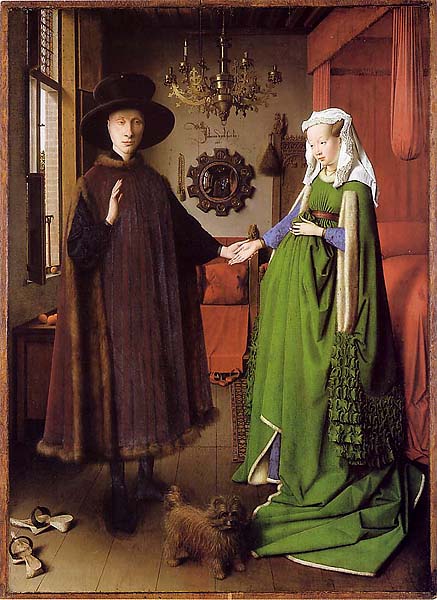
(Interesting note: although only the couple is present, the mirror reflects four people, perhaps representing God and the painter--or observer of the painting--as witnesses of their marital vows.)
Now, normally I wouldn't be any more willing to let people read my draft at this point than I would be to let them rifle through my sock-and-underwear drawer, but... here are the first few pages of my draft in all its odious roughness:
Thursday, November 1, 2012
Marriage Politics in Measure for Measure
Updated
thesis:
In
his play, Measure for Measure,
Shakespeare draws on teachings from the King James Bible to challenge the moral
superiority of the Puritan Manifesto and new Puritan leadership, especially in
regards to conflicts between traditionally accepted marriage practices and the
stricter Puritan marriage regulations.
Although this is much more condensed than the thesis presented in my last post, I'm still working on researching and refining it, so any feedback would be appreciated.
Monday, October 29, 2012
Measuring Up
I'm studying Measure for Measure, and have been fascinated by the deep biblical undercurrents which contribute to the tension and dilemmas that drive the plot of this play. I'm interested in the sociopolitical context of the play, since the strict Puritan Manifesto had been recently instated, calling for a "letter of the law" Mosaic observance of biblical teachings and moral codes, in conflict with traditional marriage customs such as the "common law" marriage practiced by many, including possibly Shakespeare himself. The biblical references, and even the plot itself, draw attention to the challenge of balancing justice and mercy, but strongly emphasize the merciful Savior of the New Testament (the higher law) versus the "harsh" God of the Old Testament (the Mosaic law).
I think this video clip from the play does a fabulous job of illustrating this biblical tension:
Measure for Measure: Act II, Scene II
I think this video clip from the play does a fabulous job of illustrating this biblical tension:
Measure for Measure: Act II, Scene II
Subscribe to:
Posts (Atom)