
Showing posts with label As You Like It. Show all posts
Showing posts with label As You Like It. Show all posts
Tuesday, October 27, 2015
As You Like It
When it comes to my paper topic As You Like It is one of the best examples of Shakespeare not supporting the idealistic love that everyone thinks he does. Many times during the play cliches like dying do to a broken heart are explicitly argued against. "and in all this time/ there was not any man died in his own person,/ videlicit, in a love-cause." Those who are in love are over the top when it comes to expressing their feelings and even do crazy things like giving or receiving lesson about love and how to woo someone. Everything pertaining to love is exaggerated in the most hilarious ways. There are other times where a kiss is compared to an orator spitting when he has nothing else to say. This play is a great play. It is a satire on the cliches of love and truly an entertaining play. I highly recommend giving this one a chance.

As You Like It
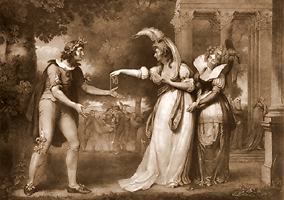
I have thoroughly enjoyed reading this play. There are so many clever moments in the dialogue, and it's just nice to read a comedy after reading King Lear. (I love King Lear, I promise). In terms of my paper, I think that if I focus on the settings theme I've got a great source on my hands. The court is a deadly and dangerous place to be while the pastoral scenes are lively and fun. This is similar to King Lear, with the forest/storm scene and the ensuing chaos, The Winter's Tale, with the literal passing of time and location change that made for a polarized play, and Midsummer Night's Dream with the fairies and their dark side in the woods. I especially think that one is perfect because the further away from the court you go the more juxtaposed it is. This actually makes me think of my reading for my American Literary History class. We read a piece by Crevecouer, who talks about the three different places in the burgeoning American landscape. The city folk, the more working class, and the backwoodsmen. It fits into this mindset very well. Perfect for my assertions. If I go with language however, I think I would be better-suited to looking into the more oft-read plays, because those are the ones that younger readers are more exposed to. I have a feeling I'll go with setting just because we've gone over it so much already.
Anybody looking for anything in regards to gender roles might like this play. Rosalind has quite a bit of power, yet she is also dressed as a man while she gains that power. So is this female power, or male power? And her power is specifically over a man, so that is even more interesting.
Back to my topic, after my experiences working on A Midsummer Night's Dream, I find that these setting changes have a great effect on the audience. In particular, the younger set. They most definitely notice the difference.
I looked up information on the settings in Shakespeare, and in the blogisphere I didn't dig deep enough to find anything about rural settings, but I did find something interesting about the settings in general. The author delved quite deeply into the fact that Shakespeare lived in England but often set his plays elsewhere. This makes me wonder if perhaps he was using the rural/city contrast to amp up his knowledge of other places, because that's an aspect of culture that can be seen everywhere.
http://calshakes.org/blog/2014/06/shakespeares-settings/
Monday, October 26, 2015
Players and Lovers

I want to address two different quotes from my play. One is wholly more self-aware, and one is just an entertaining and clever ploy that I can't help but draw attention to. The first is the classic, "All the World's a Stage" poem in Act II Scene VII, from Jacques.
  All the world’s a stage,
And all the men and women merely players;
They have their exits and their entrances,
And one man in his time plays many parts,
His acts being seven ages. At first, the infant,
Mewling and puking in the nurse’s arms.
Then the whining schoolboy, with his satchel
And shining morning face, creeping like snail
Unwillingly to school. And then the lover,
Sighing like furnace, with a woeful ballad
Made to his mistress’ eyebrow. Then a soldier,
Full of strange oaths and bearded like the pard,
Jealous in honor, sudden and quick in quarrel,
Seeking the bubble reputation
Even in the cannon’s mouth. And then the justice,
In fair round belly with good capon lined,
With eyes severe and beard of formal cut,
Full of wise saws and modern instances;
And so he plays his part. The sixth age shifts
Into the lean and slippered pantaloon,
With spectacles on nose and pouch on side;
His youthful hose, well saved, a world too wide
For his shrunk shank, and his big manly voice,
Turning again toward childish treble, pipes
And whistles in his sound. Last scene of all,
That ends this strange eventful history,
Is second childishness and mere oblivion,
Sans teeth, sans eyes, sans taste, sans everything.
It's long, I know. But there are just so many different angles to look at this from! First, there's the context in the play, which is that we play roles--that of the baby, the teenager, the adult, the old man, etc. This is important in and of itself because we already know Shakespeare addresses issues of old age and senility. Is this perhaps another jab at the old age that admittedly plagues every person, but is still reprehensible to the youthful characters of the plays? Another angle is that of the performance aspect. Jacques speaks truth when he says that we are all players, on a stage. But this goes deeper than simply our position in life--these are literal roles and we are performing for the world as we go through the necessary roles in life.
The other quote is from Rosalind in disguise to Orlando, when she tells him he cannot possibly be in love.
Act III Scene II
A lean cheek, which you have not, a blue eye and
sunken, which you have not, an unquestionable
spirit, which you have not, a beard neglected,
which you have not; but I pardon you for that, for
simply your having in beard is a younger brother's
revenue: then your hose should be ungartered, your
bonnet unbanded, your sleeve unbuttoned, your shoe
untied and every thing about you demonstrating a
careless desolation; but you are no such man; you
are rather point-device in your accoutrements as
loving yourself than seeming the lover of any other.
So in this scene Orlando asks Rosalind in disguise why she doesn't believe he can be in love with Rosalind, and despite knowing full well his complete devotion, she still goes into this lengthy description with him. I find this rather characteristic of this play in general, and of this character. It's cunning and witty, and she manipulates him in the kindest way to get what she wants.
Sunday, October 25, 2015
A Motley Fool
I remember that in class we had talked about the role of fools in Shakespeare's plays. We had said that they are usually the characters that say what needs to be said but can get away with it because they are the fools and are not taken seriously. In As You Like It, the fool, Touchstone, is the "wise fool" that we had talked about. In Act 1, scene 2, he is talking to Celia and Rosalind, telling them about a knight who swore on his honor. When Touchstone makes the comment that the story is related to Celia's father, Duke Frederick, Celia becomes angry and tells to stop or he will be punished. Touchstone's response is an amazing one. "The more pity, that fools may not speak wisely what wise men do foolishly." This line is the ultimate statement of what we had talked about in class. What makes this even more interesting is that Celia agrees with him when she says "By my troth, thou sayest true."
The next quote is from Act 2, scene 7. Jaques, who earlier was brooding, comes back to Duke Senior at camp much more happy than before. When asked why, Jaques gives his monologue about meeting a fool (Touchstone) and reiterates what the fool said. Part of what he said was, "Tis but an hour ago since it was nine,/ and after one hour more 'twill be eleven;/ and so, from hour to hour, we ripe and ripe/ and then, from hour to hour, we rot and rot;/ and thereby hangs a tale." Jaques sings the fool's praises, even going as far as wanting to be a fool. Little did he know that Touchstone was really mocking/ commentating on Jaques brooding.
The next quote is from Act 2, scene 7. Jaques, who earlier was brooding, comes back to Duke Senior at camp much more happy than before. When asked why, Jaques gives his monologue about meeting a fool (Touchstone) and reiterates what the fool said. Part of what he said was, "Tis but an hour ago since it was nine,/ and after one hour more 'twill be eleven;/ and so, from hour to hour, we ripe and ripe/ and then, from hour to hour, we rot and rot;/ and thereby hangs a tale." Jaques sings the fool's praises, even going as far as wanting to be a fool. Little did he know that Touchstone was really mocking/ commentating on Jaques brooding.
Tuesday, December 4, 2012
As You Like It (It does live up to it's name!)
I also watched As You Like It: Live from Shakespeare's Globe.
Having been to the Globe this summer, it was very enjoyable for me to watch another production from a different angle this time. This previous experience with the venue helped me understand what it would have been like to watch this production in particular.
Although the overall tone of the play was quite comedic and light, there were quite a few parts of the play that seemed to come across as somewhat somber and heartfelt. For example, the "Seven ages of man" speech that Jacques gives was delivered with a sincerity that seemed almost uncharacteristic of his usually comic character. These sections, rather than seeming disconnected with the play, made it seem more genuine and interesting than an all-out comedic play would have.
Like both Jessica and Katherine, I enjoyed seeing the interaction the actors had with the audience. Having been a groundling myself, I know that when the actors interact with you, you get all the more excited about being there and you feel like you are a part of Shakespeare. For example, it was entertaining to see Orlando throwing out the poems to the crowd and Jacques pointing to the young boys as he was giving his "Seven ages of man" speech. Those connections with the audience aren't something that can be as readily felt in a filmed version of the play, but the general playful nature of the production still comes across as you see this interaction.
I admired the ability of the actors to transition between a variety of settings with almost no props. The props were unnecessary because the actors were entertainment enough. I think this production by the Globe was close to the way in which Shakespeare would want it to be performed--unassuming, funny, and full of witty entertainment.
Having been to the Globe this summer, it was very enjoyable for me to watch another production from a different angle this time. This previous experience with the venue helped me understand what it would have been like to watch this production in particular.
Although the overall tone of the play was quite comedic and light, there were quite a few parts of the play that seemed to come across as somewhat somber and heartfelt. For example, the "Seven ages of man" speech that Jacques gives was delivered with a sincerity that seemed almost uncharacteristic of his usually comic character. These sections, rather than seeming disconnected with the play, made it seem more genuine and interesting than an all-out comedic play would have.
Like both Jessica and Katherine, I enjoyed seeing the interaction the actors had with the audience. Having been a groundling myself, I know that when the actors interact with you, you get all the more excited about being there and you feel like you are a part of Shakespeare. For example, it was entertaining to see Orlando throwing out the poems to the crowd and Jacques pointing to the young boys as he was giving his "Seven ages of man" speech. Those connections with the audience aren't something that can be as readily felt in a filmed version of the play, but the general playful nature of the production still comes across as you see this interaction.
I admired the ability of the actors to transition between a variety of settings with almost no props. The props were unnecessary because the actors were entertainment enough. I think this production by the Globe was close to the way in which Shakespeare would want it to be performed--unassuming, funny, and full of witty entertainment.
Laurence Olivier's "As You Like It"
Olivier's production of As You Like It was well done and fun to watch, although the film quality is grainy, since the film was released in 1936. This play deals with elements of cross-dressing, gender roles, and romantic trickery, and was interesting to see how these themes were portrayed in the 1930's in comparison to what would be acceptable today. For example, the scenes where Rosalind is pretending to be a boy named "Ganymede" (who is Zeus' gay cup-bearer in Greek mythology, although that's not explained in the play) and convinces Orlando to "practice" wooing her (him?) in Rosalind's name (since Orlando doesn't know she's really Rosalind herself, not Ganymede) are shown as being relatively innocent, although highly flirtatious to the point that a modern audience would wonder why Orlando doesn't seem to react much to Ganymede's intense "practices". I think the actors would have to perform this scene with more political sensitivity, as well as humor, today in order for it to be successful. I saw a Grassroots Theater production of this play, and they definitely played up the modern humor that these scenes invite. They also portrayed women with a much more modern angle, rather than the soft, helpless, "angelic" women of the 1930's version.
Monday, December 3, 2012
A little more on The Globe's 'As You Like It'
Oh hey, it looks like a lot of people decided to watch As You Like It performed at The Globe, including myself. :) The Films on Demand site is currently giving me some grief, so I've only watched about half of the play so far... and I may be a little bitter about it, because I LOVE this production. Sometimes I say, with good intentions, that I'll go back and finish something--this is actually something that I absolutely will go back and finish. I'm really excited to finish watching this play.
I liked what Catherine had to say about this performance being a hybrid of movie and theater. Obviously, we aren't there in the audience deciding what we want to look at. The camera makes the decision for us, but that was part of the production that I really enjoyed. I thought the camera had such great comedic timing... it really emphasized the right things at the right time.
I liked what Catherine had to say about this performance being a hybrid of movie and theater. Obviously, we aren't there in the audience deciding what we want to look at. The camera makes the decision for us, but that was part of the production that I really enjoyed. I thought the camera had such great comedic timing... it really emphasized the right things at the right time.
Friday, November 30, 2012
As You Like It: Live from the Globe
I choose As You Like It because it was one that I wasn't familiar with. Watching the recording from the Globe was AMAZING!!! It would be awesome to visit someday but this was a really good substitute for my college budget. (You really can't beat free!) I loved this performance because the players were interacting with the audience: fighting down by the groundlings, running away from each other INTO THE AUDIENCE, heckling the other players from the back, etc etc. The songs also brought an interesting twist because I wasn't quite used to those melodies or harmonies that were sung, and so it brought a more authentic feel to the performance.
However, it was interesting that it wasn't until Rosalind was picking up poetry from the forest that I realized I actually had seen this play before. It was produced at my middle school and obviously was shortened and condensed to appropriate for younger audiences which is why I didn't quite recognize it at first. Although both performances were enjoyable and I was laughing out loud, the Globe version is superior because when they started dancing at the end they incorporated both Shakespearean and modern dancing. The audience recognized popular moves and clapped and cheered along with the actors. I felt that it made the experience more realistic because that's exactly what Shakespeare would have done when his plays were originally performed. It was perfect!
However, it was interesting that it wasn't until Rosalind was picking up poetry from the forest that I realized I actually had seen this play before. It was produced at my middle school and obviously was shortened and condensed to appropriate for younger audiences which is why I didn't quite recognize it at first. Although both performances were enjoyable and I was laughing out loud, the Globe version is superior because when they started dancing at the end they incorporated both Shakespearean and modern dancing. The audience recognized popular moves and clapped and cheered along with the actors. I felt that it made the experience more realistic because that's exactly what Shakespeare would have done when his plays were originally performed. It was perfect!
Subscribe to:
Posts (Atom)