Tuesday, October 6, 2015

Virtue or Vice?

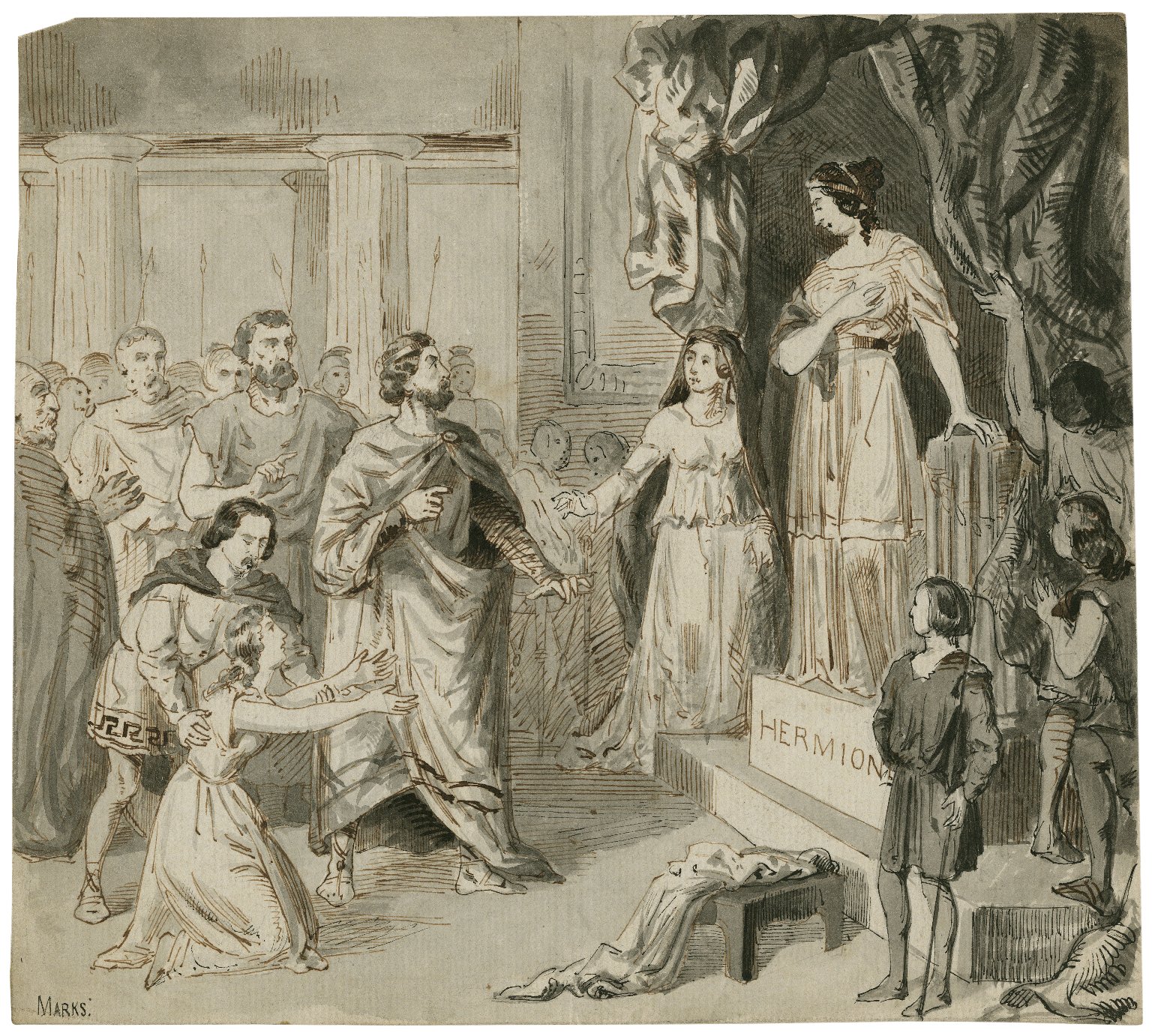
Paulina in “The Winter’s Tale” and Edmund in “King Lear” have very similar characteristics.  They both have a way of planting ideas into others’ heads and yet acting as if they are not doing that.  It was so interesting to have just discussed this in class and then to see Edmund doing the exact same thing in Act 1 Scene 2.  In Edmund’s conversation with his father in relation to the letter that he wrote to frame his brother Edgar, Edmund takes the role of standing up for his brother when he is in fact setting his brother up.  Then we see a little later that Edmund is praised for having been the means of revealing his brother’s treachery.  This is just like Paulina when she shows the statue of Hermoine.  Her words sound like she is convincing the king it is just a statue but also suggesting to him that it could really be Hermoine.  So when Hermoine does come to life, it seems like it is all thanks to Paulina for making that happen.  We know that Edmund is a bad guy, yet we see Paulina as a good person, somewhat suggesting that being a smooth talker can both be a virtue and a vice.  

We also see this with Cordelia’s lack of voicing her love extravagantly for her father.  When she does so, she feels as if that is a virtue whereas her father feels it is a vice.  I think this is one thing that Shakespeare does successfully, which is demonstrating the duality of virtues and vices, making us ask what makes someone actually good and actually bad?

Is he good?  Or bad?

Old King Lear

Acting
I watched a production of King Lear in high school, done by a high school, and I honestly assumed that once I actually started reading it I would suddenly have all of these "aha!" moments where I realized that the play I saw wasn't that great of a telling. Surprisingly, that has not been the case thus far. My initial thoughts about King Lear match perfectly with my thoughts of him as I read this play.

Anyway. One of the most interesting aspects of this play so far is the power struggle that runs through each storyline. Even down to the servants-Kent is trying to do right by his king, and instead gets treated like a cheap villain. That type of thing. Edmund wants the glory and power that his brother has, and Goneril and Regan want the power that their aging father is clinging to. The power that they seek overrules the familial connections that should be of the utmost importance. I was particularly intrigued by the treatment of Lear by Goneril and Regan during Act II, when they keep denying him access to their homes, and by attempting to reduce his number of servants, they essentially undermine his power and authority. As they take away the number of people who are literally there to serve and obey him, they are increasingly reducing his symbolic power over both them and the world. The fewer people at his command, the less powerful he is. I find it a great use of a tangible, quantifiable tactic that knocks him down a rung, more than once. And if you think about it, power is the ultimate undoing in the beginning as well. Lear isn't really that concerned with "love", in the traditional sense in Act I. He isn't asking them if they love him. He's a powerful king who wants to be sure that he adored, and that his love can be rewarded with monetary gain. Interesting commentary on power..

Sunday, October 4, 2015

Generally confused about this play...

Okay, the heading for this post is probably a bit of a misnomer. I am not confused about the plot of this play, the characters, or about what it is talking about. I feel like A Winter's Tale defies categorization... at least in the way that it seemed easy to characterize the other plays we've studied in the past. Richard II was obviously a history play, A Midsummer Night's Dream was very obviously a comedy, but A Winter's Tale is not quite so clear to me. I've never seen this play or read it before, and so Hermione coming back to life was a bit of a shock for me. Honestly it was really just funny! There are so many of these elements that seemed out of place to me. Some elements seem fairly typical like the themes of royalty, love, and jealousy. However, I was not expecting clowns, bears eating humans, or magic bringing a statue to life.
The ending is also a mixed bag of feelings. Everything seems happy because the princess is alive and well, Hermione is back to life, the king realizes his faults, and it almost seems like Shakespeare could have added a couplet at the end that included something about happier ever after. Despite these elements that feel like they amount to a happy ending, there are still some elements that remain unaccounted for. Whatever happened to the man eaten by a bear? What about Mamillius? It would be nice to understand more about the power or trickery that brought Hermione back to life.
Of all the plays we've read, I feel like this one was the most complex. There are fewer answers to the "why" questions that I'm used to asking as I read. I wonder why Shakespeare chose to make this play slightly more nuanced, or if he just got lazy and did not feel like tying up loose ends. I would appreciate hearing your opinions as to why there are many different inexplicable parts of this play, and why you think they're there.

P.S. While I was doing a little bit of research, I found this article about Hermione vs. Hermione Granger. It only talks about A Winter's Tale for a small part of the article, but worth the read for Harry Potter fans :)


Hermione the Muggle (Or maybe not?)


I've seen The Winter's Tale performed before, so the ending did not shock me the second time around. I was pretty surprised during the production to see that happen, though to be honest once they began speaking of a statue I began to suspect. It just seemed a little too perfect to have an artist suddenly finish this statue of the dead queen right when everything becomes restored and everybody is found, etc. Especially since Paulina begins to go on and on about the king only marrying again once he finds a woman like Hermione. Initially I did believe that Paulina had faked Hermione's death, and her actions seemed consistent with this. John's post, however, mentioned that there is proof that Hermione had to have been dead the entire time, else certain parts of the play didn't pan out. When I did see the play though it seemed obvious and purposeful that Paulina had been the mastermind behind the plot to teach Leontes a lesson. They played it with this intention, leading me to believe that there was no magic whatsoever, but really only a carefully crafted long con. After reading the play and the blog posts, and understanding the romantic genre better, I can see how this magical aspect fits.

It seems that there is a general consensus about Shakespeare's romances, that they are the most mature of all his writing. I may not have understood that before, and in regards to magical aspects I might have some arguments. But in the general sense of character and plot development, I think that I agree. Hermione and Leontes have a deeper, richer, more complicated love story than do many other couples in Shakespeare's works. When we read Midsummer we identified the fact that those characters are more like tropes, or stereotypes, due to the comedic genre. And even in the tragedies, there is only so much character development.

Saturday, October 3, 2015

The Eternal Nature of Art

In Act V Scene II, the gentlemen speaking of the sculptor of the statue of Hermione say "had he himself eternity and could put breath into his work, would beguile Nature of her custom, so perfectly he is her ape". This high opinion of an artist, especially in light of Hermione's statue coming alive at the end of the play, reminded me of the ending of Shakespeare's Sonnet 18 when it says: "So long as men can breathe or eyes can see, So long lives this and this gives life to thee." In Hermione's case, this became quite literal since her statue (somehow) allowed her to come back to life. While the quality of the statue was not the only factor in her return to life, the incredible accuracy of the statue appears to allow Leontes to imagine that it really is his wife. This is a very bold statement about the power of art to immortalize its subject.

Acting on Faith

In the final scene we see that Hermione comes back to life from a statue form.  And in the end, King Leontes accepts that it is really her, accepting her back as his beloved wife.  This is a great contrast to the very first act, where Leontes chooses not to accept Hermione and her truth as it truly is.  Thus he rejects her and so happens the whole mess.  The importance of this contrast gives to us some deeper meaning s that make Leontes' actions more understandable and also his redemption a greater deal.  In each of these moments, Leontes is faced with a choice.  He can choose to act on faith, believing that Hermione really is telling the truth, she is faithful, and in the end that she is truly herself after transforming from the statue.  In the beginning, he doesn't act on this leap of faith, thus turning into what we see as an awful tyrant.  On the other hand, he makes the opposite choice, choosing to act on faith which leads him and his family to be presumably happy.

I think this is where we can find that this story applies to everyone.  When we act on faith, we are happy and those around us are positively affected by our happiness.  When we choose not to act on faith, we are miserable and we cause those around us to be miserable as well.  So really, to me, it isn't so much the question of whether Hermione coming back to life was a stretch of imagination or a secretive doing by Paulina, but it is supposed to portray a core truth about faith and acting on faith.

The idea of comparing the two scenes, Act 1 and Act 5, and many of the ideas I voice here root from an article I found called, "Visual and Ethical Truth in 'The Winter's Tale'" by James Knapp.  It can be found at the following link:  http://search.proquest.com.erl.lib.byu.edu/iipa/docview/1808599/A4DC894B6C3F4593PQ/7?accountid=4488


Friday, October 2, 2015

Paulina Rocks!

In these first four acts of the play, I think that my favorite character has been Paulina. I know we talked about it a lot in class, but even before that I just loved how she stood up to the king and how she just says her mind! She refutes any argument of Shakespeare not having strong female characters. Though it was potentially lethal to critique the king, she does it anyway. She is the queen's most loyal defender. And in the rest of the play, she has such in an important role, too! One article I found said this of her: "Paulina is Hermione’s friend and the wife of Antigonus. She is intelligent, spirited, and a loyal friend. She defies the rules of Sicilian society by appearing in court and bringing Leontes his newborn daughter, risking harsh punishment to defend what she believes is right. She is a noblewoman, elegant, and strongly commands a room of men. Her silhouette is more subdued than Hermione’s, with her long, lean silhouette and high collar elongating her body allowing her to look feminine, yet powerful...Her gown is tastefully yet sparsely decorated; her elegance comes from her posture and the strength with which she carries herself." Written for a play, as directions for casting, I thought that the way they planned to portray her fit with my own opinions of her and her bearing and appearance. I am excited to try watch a performance of this and to see how she is portrayed on stage. She really is one of the best characters in the play.
     One devil’s advocate type question, though: How do you think the play might have turned out if Paulina hadn’t faked Hermione’s death…? (I just assumed that’s what happened…. Anything else would just… blow my mind. So yeah. I'm just gonna stick with that as what happened for the sake of this blog.) I feel like this is the one thing she does that I am not quite in agreement with... I know that the shock of Hermione's 'death' is what kind of helps Leontes turn things around, but hadn't Mamillius's already started him down that path...? If so, Hermione and Leontes could have had those 16 years together... Which makes me wonder if Paulina's plan was all that great after all.


http://scholarworks.umass.edu/cgi/viewcontent.cgi?article=1968&context=theses