Showing posts with label twelfth night. Show all posts

Thursday, November 5, 2015

Annotated Bibliography

1. William Rose, Benet. "William Shakespeare." Benét's Reader's Encyclopedia. 3rd ed. New York: Harper & Row, 1987. Print.
library
The entry on Shakespeare explained that many of Shakespeare's plays and poems have been heavily inspired by classical works like Ovid and Seneca. Even though he's viewed as the peak of creativity and hailed as the best English writer, Shakespeare was doing to old works what millennial are doing to his works today-- remixing them, modernizing them.

2. "Twelfth Night." Shakespearean Criticism. Ed. Michelle Lee. 3rd ed. Vol. 34. Farmington Hills: Cengage Gale, 2001. Print.
library
In the introduction of the Twelfth Night volume, Shakespeare's influence by classical works is further established. He's always touted as a man of original content, but draws so much inspiration and plot points from others' works! I also learned that Twelfth Night is a good play to look at if I'm studying millennial application of gender issues in Shakespeare.

3. Bowers, Fresno. "William Shakespeare." Dictionary of Literary Biography: Elizabethan Dramatists. Vol. 62. Detroit: Gale Research, 1987. Print.
library
The Shakespeare entry helped me situate where Twelfth Night (and several other works) fall in the timeline of Shakespeare's career. It also has provided a bit of context for the creation of each play, especially listing the source material from which Shakespeare drew. This will be helpful as I frame my paper with the idea that Shakespeare himself approves of adapting to fit one's era.

4. Shakespeare-online.com, especially Mabillard, Amanda. Why Study ShakespeareShakespeare Online. 20 Aug. 2000.
website
The section "Why Study Shakespeare?" in particular helped me pinpoint what exactly about Shakespeare's works have universal appeal enough for them to remain relevant in our modern day. (It also listed some excellent modern adaptations of his works to look into.)

5. "A-Z Guide to Shakespeare: Twelfth Night." Oxford Reference. Web. 3 Nov. 2015.
website
After reading sources that explained that a lot of Shakespeare's works were inspired or loosely based off other works and legends, I was excited to find out what he used for inspiration when working with Twelfth Night. This entry provided background material specifically about this play such as performance notes and timelines-- very useful information!

Tuesday, October 27, 2015

Viola's the Man

My paper is still going to focus on the millennial generation's influence on Shakespeare. The reason I chose to read Twelfth Night was so that I could better understand one of pop culture's finest Shakespearean twists-- She's The Man. Now that I understand the work that inspired the movie, I plan on rewatching it in order to pick out specifics of how modernity remixed Shakespeare into something even just as culturally relevant, albeit for a younger audience, as the original. (I may read Taming of the Shrew if I have time, too, so that I can also include 10 Things I Hate About You.

One concept that Twelfth Night plays with is gender. Much of the humor comes from characters mixing up their genders or overstepping the boundaries of their sex. However, gender roles are not just laughed at, but legitimately blurred. (Think Orsino liking Viola's Cesario disguise even once he finds out she's a woman.) I'd like to look up recent papers discussing gender conflicts in Twelfth Night and see if any commentary has been made that connects the gender issues of Shakespeare's Illyria with current LGBTQA gender and sexuality issues.

The idea that clothes determine who you are (Viola dressed as a man making her a man, etc.) is something that holds weight in the millennial generation today. I'd also like to see if that's a theme that carries weight in modern twists on Shakespeare. It's definitely relevant today.

Sunday, October 25, 2015

To quote or not to quote, that is the question (not Hamlet, but it fits)

Here are a few quotes that stood out to me as I read Acts II and III of Twelfth Night:


  1. In Act II, Viola exclaims, "O time! thou must untangle this, not I; It is too hard a knot for me to untie!" This idea of time clearing up all confusions or injustices shows up again and again in Shakespeare's works. Ultimately, some characters just decide to go with the flow and let fate figure everything out because Fate was considered to dictate how events played out. (This attitude definitely shows up in Winter's Tale and Midsummer Night's Dream!)
  2. Sir Toby greets Feste who comes in to perform by saying, "Welcome, ass." Such a succinct way to showcase Toby's incompetence-- by calling a person such a name, Sir Toby only makes himself sound like one. His nobility is the only reason no one's calling it out, though! Anyway, that's the one sentence that gives the rest of you an understanding of his character without reading the play.
  3. Viola makes an excellent analysis of Feste in particular, but of the fool trope that shows up in many of Shakespeare's plays (Rosemary, you may want to look at this quote for your research!): "This fellow is wise enough to play the fool,And to do that well craves a kind of wit. He must observe their mood on whom he jests, The quality of persons, and the time, And, like the haggard, check at every feather That comes before his eye. This is a practise As full of labor as a wise man’s art, For folly that he wisely shows is fit. But wise men, folly-fall'n, quite taint their wit."

Saturday, October 24, 2015

Envoys and Permissions in Twelfth Night

I am struggling to express this articulately, so please challenge me as needed for any clarification.
There are three or four characters that spend the play alternating between speaking on behalf of themselves and speaking on behalf of a patron. What's interesting to track, however, is who does it with permission (such as Feste and Viola) and who does it without permission (lookin' at you, Malvolio). Speaking on behalf of a powerful social figure such as Orsino or Olivia kind of gives these envoys exception to the social order, and the complicated messes that ensue are direct responses to this disruption of power.

For example, Malvolio crosses a line (in the minds of Sir Toby Belch, Maria, Feste, and Sir Andrew Augersomething) in act 2 scene 3 when he interrupts their merrymaking by claiming Olivia's authority.

Malvolio: My masters, are you mad? or what are you? Have ye no wit, manners, nor honesty, but to gabble like tinkers at this time of night? Do ye make an alehouse of my lady's house, that ye squeak out your coziers' catches without any mitigation or remorse of voice? Is there no respect of place, persons, not time in you?

Malvolio: Sir Toby, I must be round with you. May lady bade me tell you, that though she harbours you as her kinsman, she's nothing allied in your disorders. If you can separate yourself and your misdemeanors, you are welcome to the house; if not an it would please you to take leave of her, she is very willing to bid you farewell.
Act 2 scene 3
In return, Sir Toby Belch and company claim Olivia's voice  in order to teach Malvolio a lesson by writing letters in her voice to lead Malvolio into a net made by his own ambition and social offenses.

Viola, acting even more completely as proxy for Orsino, gets herself into trouble as Olivia uses her imagination to create a Cesario that rivals Orsino's vision of Olivia.

Olivia    Here, wear this jewel for me, 'tis my picture;
              Refuse it not; it hath no tongue to vex you;
              And I beseech you come again to-morrow.
              What shall you ask of me that I'll deny,
              That honour saved may upon asking give?
Viola     Nothing but this; your true love for my master.
Act 3 scene 4

Viola     The honourable lady of the house, which is she?
Olivia    Speak to me; I shall answer for her.
              Your will?
Act 1 scene 5
Eventually characters speak on behalf of each other without even realizing it, i.e. Sebastian for Cesario/Viola, Cesario/Viola for Sebastian. Additionally, Sir Toby fabricates on behalf of Olivia, Feste on a priest, etc.

Monday, March 11, 2013

After the Final Rose (My happily ever after?)

I did it. I found my connection, my Shakespeare research paper soul mate, and we're in love. Hopefully this love lasts longer than any Bachelor contestant's love, because I'm not here to play games. I'm here to find my thesis.

Ok, enough with the lame Bachelor jokes (they relate, I promise). This past week or so I've been struggling to find a topic for my paper that really resonated within me. My play I chose to read was Twelfth Night, and while I absolutely loved the play, I felt as though it didn't give me something to latch on to. It did, however, give me a dive board from which I feel into the genre of researching love and romance. I took to Facebook immediately, figuring the masses would definitely have something to say on the subject. That was my first mistake. I received no response. I figured it was because I either

a. was too general in my questions, or
b. asked way too many in one status update
(probably both)

So I switched tactics. After reading Amelia's comment here, I had an idea: 

I can't believe I'm admitting this, but I love the Bachelor/ette reality TV show. I'm addicted to it, like millions of other men and women (8.6 million, to be exact), so why not explore it's connection to Shakespeare? I thought I'd see what Facebook had to say about this. 

Somebody actually posted this in response to my questions.
The initial response wasn't great. I got a pretty strong negative reaction at first, but it's always darkest before the dawn. I finally got a positive response from (gasp) another English major! We began discussing the similarities between reality TV today and Shakespeare in the past. We came down to this basic idea:

People throughout the ages seem to have this obsession with unrequited love, finding love, crazy passionate love, puppy love, mismatched love... the list really goes on. From the mismatched love of Midsummer Night's Dream, to the gender confused triangle in Twelfth Night, people love love, and that love has carried over into the modern world (Don't believe me, check it out here. People have DEFINITELY taken from Shakespeare's love plots to create the reality TV we watch today). But, it's not just love that we love, it's love that's seemingly out of our control, love manipulated by someone with greater power than those experiencing the infatuation. And we don't just like it when love is manipulated be someone, but when everything is out of the hands of the hero/ine. Take The Tempest, where really everything lies in the hands of Prospero, or The Bachelor/ette, where everything lies in the hands of the producers (let's be real here, people. we all know this is true). 

So this is where I'm a little stuck. Maybe this whole connection to Shakespeare seems contrived to you, but I really do think there's something there. I mean I just see a lot of connections between reality TV today and the way Shakespeare's characters manipulate and handle love in the plays. What do you think? Hopefully you're in agreement, because I really really don't want to find another topic.  

Sunday, March 10, 2013

Help = Appreciated.

Thanks so much for the comments on my last post. I really appreciate the input. The comparison to Dwight Schrute, while fun, may not merit a 12 page paper. Though I was excited about it, I appreciate the "come back to Earth, pal" comments.


Monday, March 4, 2013

"Gamble everything for love" -Rumi

Talk to me about love. Specifically, define love for me. 

  1. If love is unreturned, does that justify spiteful actions of revenge towards the unfeeling? 
  2. Can unrequited love change the definition of love? 
  3. How can love be a major driving factor in decision making and character building? 
  4. Does the way a person love define who they are? 
  5. If two people are suffering from unrequited love, yet they handle the situation in different ways (say threatening to kill/ volunteering to die), does that mean they both are really in love, or does one (or both) just think they're in love?
These are some questions I've been mulling over in my head in regards to the play Twelfth Night. My attention was draw to this idea of unrequited love during this little exchange between Viola and Orsinio in Act V:


ORSINIO: Come, boy, with me.
My thoughts are ripe in mischief:
I’ll sacrifice the lamb that I do love
To spite a raven’s heart within a dove.

VIOLA: And I, most jocund, apt, and willingly,
To do you rest, a thousand deaths would die.

Wait, what? Orsinio is willing to 'sacrifice'* his servant Cesario (that's Viola's disguise), and Viola is willing to let him? 

In the play, both of these characters suffer from unrequited love. Orsinio is in love with Olivia, and can't seem to take a hint, and Viola is dressed as a man, so of course Orsinio doesn't love her back. But that's not what's interesting. 

Both are dealing with watching their love love another, yet they handle it in starkly different ways:
  • Orsinio takes the vengeful "I'll teach you" path, deciding to 'sacrifice' his most trusted and faithful servent Cesario (spoiler, it's Viola!) because he knows Olivia loves Cesario (awk). 
  • Viola (as Cesario) takes the "anything for you my love" path, and agrees to be sacrificed!
*It's never directly stated what Orsinio means when he says he's going to sacrifice Cesario (banish him, fire him, imprison him), so I've taken my creative license to interpret it as he will be killing Cesario. 

This raised the questions you read above. Why do they take such vastly different cathartic measures in dealing with their problems? What does this reveal about the characters, and in turn, they play? How does it change our idea of love in the modern world?

Your thoughts, my homies? 


doo doo doo, do do do do do, do do do do do, do do do do do do do do do.

Could you form the tune out of that title
That's right, friends: The Office.

This I think will actually be an interesting topic. Today in class, we briefly touched on how a previous paper compared the joker and Iago and how they functioned in their societies-- personifying modern day fears.

I think it may be interesting to do the same thing with another set of characters and values. I brought up how someone mentioned to me at work how a lot of extreme personalities in Shakespeare's plays could be seen in the television show, The Office.  

Particularly, one Dwight K. Schrute: beet farmer, bear enthusiast, battle star Galactica fan. After reading the play for my 291 class last week, I realized that this man just may be Malvolio of Twelfth Night personified.

Like Malvolio, Dwight inserts himself authoritatively where one should not-- always seeking power. (ex: Assist Regional Manager vs. Assistant TO the regional manager). Likewise, Malvolio breaks up the ale and cake scene in the play, managing where it really is Olivia's place to do so.

Malvolio functions a man representing the under dog class of the time: I believe it was the puritans. Dwight similarly represents a socially awkward under dog with alternative interests.

Another quality of overlap for the two is that everyone picks on these characters and no one seems to like them. One in particular picks on both. Jim Halpert for Dwight... and Sir Toby for Malvolio. Both have a female companion: Pam for Jim and Maria for Sir Toby.

Is this worth pursuing???

Should I analyze the relationship between Jim/Dwight vs. Sir Toby/Malvolio?? Or see how Dwight/Malvolio functions in creating social/class breakthrough and struggle? This could be really fun if I can pull it off.


TTFN,

Kara V. 

Saturday, December 15, 2012

Twelfth Night Clip

Once again, I'm sorry about the watermark. Hopefully it's not too distracting...

Thursday, December 6, 2012

Branagh Twelfth Night

I also watched Kenneth Branagh's Twelfth Night. It was fun to watch but it wasn't at all my favorite version of this play. I typically enjoy the plot of Twelfth Night simply because of all of the ridiculous gender confused people running around everywhere. This play also has a dark side too it, though. The pranks that are played are really quite torturous and when one thinks about it, very disturbing as well. I guess we don't often think about the result of a prank on someone else, and if we do realize how hurtful it can be, it is all the worse when we go through with it. I think in that regard, Twelfth Night is very applicable to younger school goers who must deal with the dilemma of being bullied, or being the bully. I enjoyed this production. It felt very much like a play, but I have come to expect a little more cinematography from Branagh, so this was a bit of a let down, even if it was more authentic. Either way, it was still funny.

Tuesday, December 4, 2012

Twelfth Night (Branagh)

I see someone else has already posted on this movie, but I haven't read it yet, so hopefully I won't repeat everything that has already been said.
I was a little frustrated with this production. Shakespeare is difficult because in order to preserve the language, one has to preserve the historical setting, or else it is inconsistent. Some of the costuming in this production was inaccurate historically, and it made the language seem a little out of place.
What I did really like was that this entire production takes place out-of-doors, and all in essentially the same place. That holds true very well to the play-like qualities I often think of with Shakespeare productions.
I had never actually read or seen any kind of production of this play before. I had seen She's the Man so I had a very vague idea of the story, but other than that, I went into this pretty blind. And you know, this is possibly my least favorite of all Shakespeare I've ever seen/read. It was very pointless. So much of the plot is based on pranks and motives that seemed rather weak or under-explained that I definitely was not kept involved. As a production, however, it was fantastic. The acting was very good. The actor for Viola/Cesario was very expressive and convincing.

Monday, December 3, 2012

Kenneth Branagh's Twelfth Night


I watched Twelfth Night, directed by Branagh.  Viola is played by Frances Barber, who plays Goneril in the Ian McKellen version of King Lear.  The movie is reminiscent of that version of King Lear in that it sits somewhere between a play and a movie. For all but two brief scenes (Viola and Sebastian after their shipwreck), the action happens in two sets, which are Olivia’s yard and Duke Orsino’s yard. The entire film takes place outside.  The scene in which Malvolio is picked on happens in Olivia’s yard where he is imprisoned in a sort of cellar. The colors are very subdued. Malvolio, played by Leonato from Branagh’s Much Ado About Nothing, is quite old.  This makes his desire to win Olivia over seem even more presumptuous, but does not take away from his pitiable state at the end of the play which incites a lot of sympathy.

The overall mood of the movie is not very comedic.  It keeps all of Shakespeare’s language, but puts emphasis on the melancholy aspects of the play.  The subdued colors add to this, as does the portrayal of the fool.  He seems to have strong and obviously unrequited feelings for Olivia.  The only really funny character to me in the film is Sir Andrew Aguecheek, whose lack of wit is very entertaining.  This was surprising to me because he only annoyed me while I read the play. His part turns melancholic, too, however.  It was very interesting to see this interpretation of Twelfth Night and it enhanced my understanding of the play.  

Monday, November 19, 2012

Twelfth Night: Final Paper

Here is the link to my paper:

https://docs.google.com/open?id=0B6ftQZFayfGPZnVFaEpQUVNlSmc

As far as publishing this paper goes, I could publish in Intersections, an online quarterly journal from the University of Washington.  This journal accepts papers any time without prompt via email. I would need to include a cover page, an abstract, and a bio.


Also, the English Journal would be incredible to be published in, although the odds of getting published would increase after I'm a teacher, or with the help of someone already teaching.  To meet the requirements for this journal I would need to lengthen my paper by two to six pages and not submit it anywhere else.

Monday, November 12, 2012

Publishing and Researching


Publishing:
I found a really cool webpage with lists of journals for undergraduates to contribute to in art and literature. It's found at: http://unl.libguides.com/content.php?pid=207791&sid=1732413

A couple promising journals are:

Young Scholars in Writing: Undergraduate Research
A refereed journal dedicated to publishing research articles written by undergraduates in a wide variety of disciplines associated with rhetoric and writing. The Journal seeks theory-driven and/or research-based submissions from undergraduates on the following topics: writing, rhetoric, composition, professional writing, technical writing, business writing, discourse analysis, writing technologies, peer tutoring in writing, writing process, writing in the disciplines, and related topics. Submission deadline June 30.
(With its emphasis on rhetoric this one might be good for Kasey)

and...

Intersections
Intersections is a peer-reviewed quarterly online journal that features student essays and theses from a wide range of disciplinary locations within the Arts, Humanities and Social Sciences. They welcome submissions from students outside the University of Washington community.

Wednesday, November 7, 2012

Twelfth Night Video Preview

So, I had some technical difficulties with this movie...and it has a watermark across it. Sorry about that...


Monday, November 5, 2012

Twelfth Night Draft and Tweethis Comments

For my paper I asked people on my Facebook account if they read Twelfth Night in junior high, and if not what plays they read.  I found out that, at least amongst my acquaintances, it is not commonly taught.  I have one acquaintance, though, who knew of a school where the 8th graders are studying it. He directed Twelfth Night last year and he's played Malvolio. I've asked him more about that and I'm awaiting his response.

Here's my 4 page draft!  It's very rough. I have a lot more research to do. Any thoughts would be appreciated, though.

Wednesday, October 31, 2012

Twelfth Night Tweethis and Bibliography

My updated Thesis is:

Twelfth Night is a valuable play to be studied by junior high students as an introduction to Shakespeare because of its insights into human nature and cultural changes, interesting historical context, and entertaining qualities.

Do you think this is specific or arguable enough?

Annotated Bibliography:

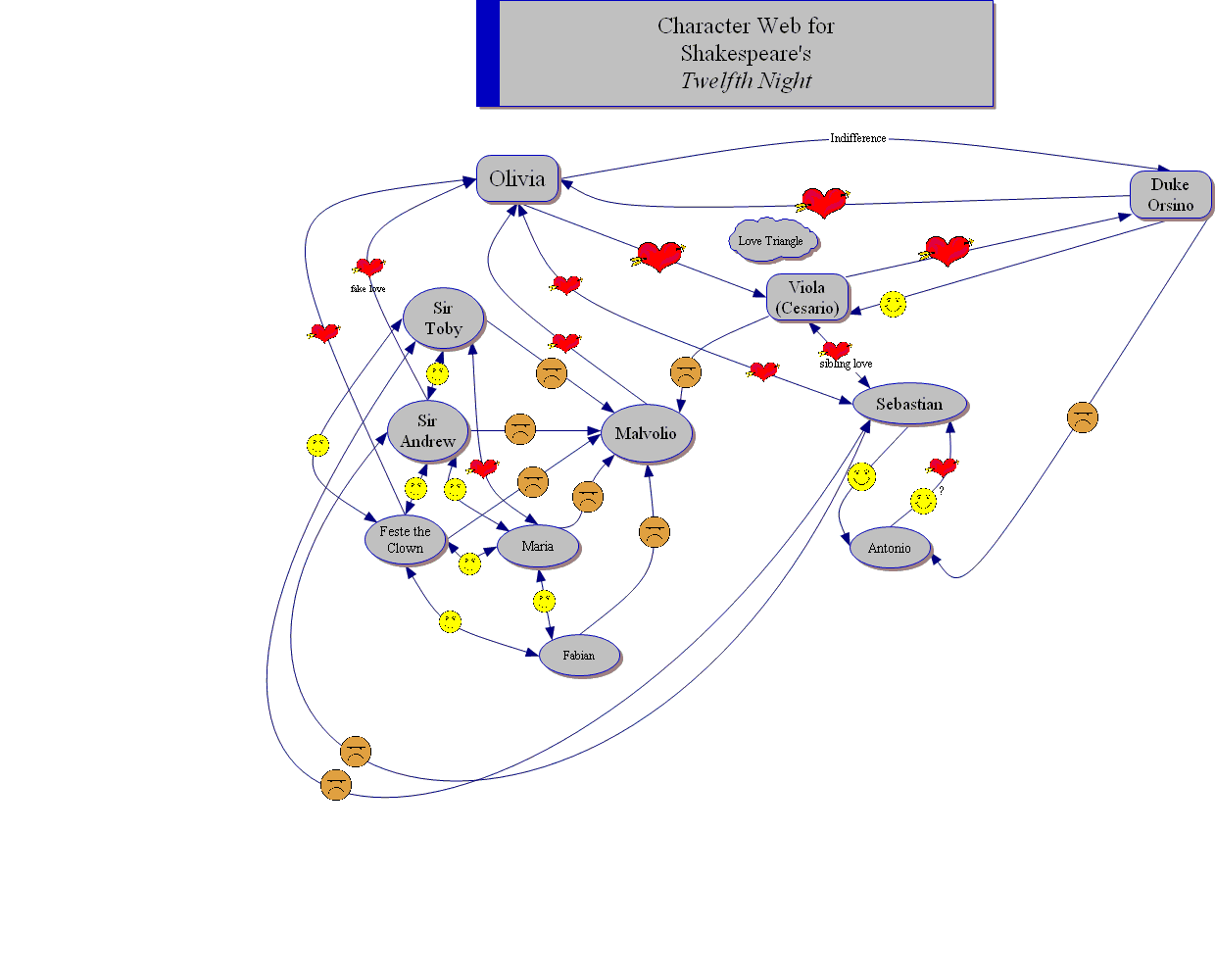
Social Graph:
As far as a social graph I've got my cousin, Grayson. He's an actor and he's probably very familiar with Shakespeare. My old roommate Kirsten got a degree in English Teaching and would have helpful insights.  My mom will she listen to whatever I say and provide me with intelligent responses. My roommate Jocelyn Gray, like my mom, will listen to whatever I say, and she comes from a different perspective.